Thursday, February 6, 2020


The Crimes of Mena:
GRAY MONEY

by the Staff of the OZARK GAZETTE

GRAY MONEY

Activists seeking documentation that would support claims that the state of Arkansas was involved with money laundering on a massive scale may have found the missing link in their three year search. 

Documents obtained by the Arkansas Committee show that the Arkansas Development and Finance Authority, a Bill Clinton signature project, was involved in a highly questionable, and possibly illegal, sixty-million dollar deal in which ADFA borrowed 5 million dollars from a Japanese bank in order to buy stock in a Barbados insurance company.  The stock was not registered with the Securities and Exchange Commission.

The state of Arkansas was the lead investor in a deal which poured sixty million dollars through a Barbados company, Coral Reinsurance, which is currently under investigation by insurance regulators in New York, Pennsylvania, and Delaware as well as by Manhattan District Attorney Robert Morgenthau, lead prosecutor in the BCCI scandal. 

Additionally,the Ozark Gazette has recently been told that as a result of the release of the Coral documents the independent counsel, Kenneth Starr, is also investigating the deal.

Persons involved in the deal, which began in 1987 and ended in 1991, include Bob Nash, then president of ADFA and now Personnel Director of the White House, Robert Rubin, then president of Goldman Sach's
investment bank and now Secretary of the Treasury, and Maurice Greenburg, president of American International Group, and a candidate in 1995 to be Director of Central Intelligence.

The American International Group is a 100-billion dollar, multi-national insurance company which founded Coral Reinsurance Company in 1987.  The fact that AIG founded Coral was hidden from
insurance regulators for at least 3 years and was only recently proven by the reluctant release by ADFA of the original stock placement memorandum.  Maurice Greenburg as president of AIG is a very well
connected businessman and a player in international politics.  He serves as the chairman of the US-China Business Council and lobbied hard (and successfully) for the Clinton administration to sever the
link between China's human rights record and renewal of China's most-favored-nation trade status. Members of the board of directors of AIG include Martin Feldstein, Harvard University economics professor and former chairman of the President's Council of Economic Advisors and Carla Hills, former U.S. trade representative.  AIG's  international advisory board is headed by Henry A. Kissinger.

The original deal was pitched to ADFA by Goldman-Sachs, a New York based securities firm which played an important role in the transaction.  Goldman-Sachs had pledged to sell the stock for Coral and in addition pledged to buy the stock if for any reason the other investors could not hold it and were forced to sell.  Goldman's president at the time was  Robert Rubin, later appointed by the Clinton administration to succeed Lloyd Bentsen as the Secretary of the Treasury.

THE SEARCH BEGINS

Founded in 1990 as a student organization at the University of Arkansas, the Arkansas Committee's major focus was on Arkansas' involvement with the mysterious activities at the Mena airport during the 1980's.  The Committee spent two years unsuccessfully trying to convince the state government to
investigate links between major drug smuggler Barry Seal (also a government informant), who worked out of the Mena, Arkansas airport, and the U. S. Intelligence community.

Recently, two very respected investigative journalists, Roger Morris and Sally Denton, have published the most authoritative and highly documented account to date of events at the Mena airport between 1982 and 1986. 

Based on over 2,000 documents including the previously unpublished personal papers of Barry Seal, their article "The Crimes of Mena" in the July issue of Penthouse Magazine reveals the government's protection, and cover upof drug smuggling, gun running and money laundering.

Realizing that personal accounts were not sufficient to convince skeptics, in the summer of 1992 the Committee began what would become its most difficult journey - finding enough hard evidence to convince the media (the court of last resort, the government having rebuffed two years of pleas to do the job itself) to investigate and write about Mena.  And so they began trying to locate the long buried paper trail, armed onlywith the Freedom of Information Act and determination.

But what sort of hard documentation could they reasonably hope to find?  The Committee's sources had on more than one occasion indicated that up to ten million dollars a week in illegal cash was going through Arkansas at the height of the Mena operation. Therefore the most logical course seemed to be to the hoary old cliche,  follow the money.

For two important reasons, the Committee decided to look into the ArkansasDevelopment Finance Authority (ADFA).  First, some admittedly circumstantial evidence linked ADFA to the Mena operations.  Secondly, as a state agency, ADFA was subject to Arkansas's Freedom of Information Act, and so documents could be extracted from what was hoped would be an important source of information.  Throughout 1992, the Arkansas Committee contacted numerous sources in their search for evidence that ADFA may havebeen involved in money laundering operations. Several people assured them that ADFA was indeed involved, knowingly or otherwise, with laundering many millions of dollars.

ADFA sells bonds as a state bonding agency, and it was alleged that many of the bonds were bought with drug money.   But this meant that even if the bonds were purchased with black money, ADFA would still be in the clear, since ADFA could claim that they had no knowledge of the sources of the money used to purchase their bonds.  Additionally, ADFA does not sell it's own bonds directly to the public, but instead uses a middleman - a bond underwriter - the perfect deniable link.  Committee member Mark Swaney suspected that it was possible that ADFA had become involved in money laundering directly, so he began searching for other ways in which black money may have been moved with ADFA's involvement. 

In August of 1992, Swaney received what he felt was his first real break, when a source told him to look for ADFA's involvement with an insurance company.

COMMITTEE HITS PAY DIRT

Life not being like the movies, it took two years before the Committee was able to find any such link.  In 1994, Swaney and the Arkansas Committee (in thus far their last official act as a group) sued ADFA for
their auditor's working papers, after the documents were not forthcoming.  The lack of interest on the part of the main stream press had not changed and the only attendees at the press conference announcing the suit were one reporter, and a camera crew from a public access television station. 

In a recent Arkansas Supreme Court ruling that has extended the power of the state's freedom of information act, Swaney and the Arkansas Committee were handed a unanimous victory when the court overturned the original decision by Judge Kim Smith.  The new ruling places the burden of obtaining public documents held by private companies on the relevant state agency. The decision means that state agencies cannot circumvent the freedom of information act by insuring that they are not in possession
of sensitive documents.  (Oh, we don't have "physical possession" of that document - because we gave it to our lawyer to keep...)

The Committee reasoned that the public audits of ADFA were unlikely to provide any useful information, however the working papers of the auditors should yield a much more complete and detailed picture of ADFA's dealings. 
Because the Committee members were not financial experts they decided to locate someone well versed in accounting and/or auditing to review the papers when and if they could obtain them.  To this end, Swaney teamed up with well-known independent financial analyst and ADFA critic, Roy Drew.  

In a conversation about their collaboration, Drew told Swaney that he had found evidence of ADFA's involvement in a very strange deal with a certain Coral Reinsurance Company.  Roy Drew had been reading the minutes of ADFA's board of directors meetings and found one paragraph (in thousands of pages) describing a deal where ADFA would borrow 5 million dollars from the Sanwa bank's Chicago branch to buy stock in Coral Reinsurance.  Additionally, the minutes revealed that according to the terms of the loan ADFA did not have to repay the loan if it did not make as much money in dividends on the
stock as it owed in interest on the loan.  To the Committee, this seemed to be the long sought after link between ADFA and an insurance company, especially since there was no known connection to any other insurance business.

After finally obtaining an opportunity to examine the ADFA auditor's working papers, the Committee asked ADFA for copies of all documents relating to the Coral insurance deal. Derek Rose, PR man for ADFA, readily agreed to make the Coral documents available. On December 2, 1994 ADFA's auditors (Deloitte & Touche) allowed Swaney and Drew limited access to the working papers.  On the same day Swaney visited ADFA and copied the entire Coral file that Rose had retrieved for him.  While Swaney was copying the documents, Rose was apparently seeing the material for the first time. It quickly become obvious to Swaney that several documents contained in the file where very sensitive  inter-office ADFA
memos.  One of the memos, apparently written in a panic by Bob Nash, indicated that he had been questioned about the Coral deal in 1992, and had been shaken by it.  In addition, a letter written to ADFA by the Delaware Department of Insurance requested information concerning ADFA's involvement with Coral Reinsurance, and strongly suggested that they were investigating Coral Reinsurance.

CURIOUSER AND CURIOUSER

After returning to Fayetteville, Swaney and the Committee began to study the documents in detail.  Several facts were especially interesting given the background of the search.  First, Coral Reinsurance was incorporated in the tiny Caribbean island of Barbados - a notorious haven for money launderers due to it's very lax banking regulations, and tight corporate secrecy laws.  If someone wanted to launder cash, this was a good place to do it.  Second, the deal was structured in such a way as to prevent the reporting of the ownership of the stock to the IRS.  Third, the stock certificate plainly stated that "these securities have not been registered under the securities and exchange commission act of 1933".  The deal had all the earmarks of a clandestine arrangement designed to conceal the true ownership of Coral Reinsurance.

Further information gleaned from the documents showed that ADFA's role in the deal was unique.  There were several other investors, none of whom had any visible government connection.  Also, ADFA's share of the stock was larger than any other investor, and ADFA had signed a "put agreement" with Goldman Sach's in which they obligated themselves to buy the stock of any other investor in the case that the investor found that they could no longer hold the stock, and Goldman could find no other qualified investor.

Finally, in case ADFA couldn't hold the stock, Goldman Sach's would buy it.  In no case was the Sanwa Bank ever to own the stock.

The total amount of stock in the deal was 1,000 shares at $60,000 per share for a total of 60 million dollars.  ADFA's portion was 84 shares for a total of $5.04 million.  Another very interesting fact was that the money apparently never left the Sanwa Bank.  The whole transaction was conducted on paper.  Sanwa loaned the $60 million to the investors, who used it to buy the stock in Coral, which then redeposited the money back in the Sanwa bank in the form of a certificate of deposit.   Also mentioned in the documents was the American International Group, a huge insurance company with international business and political connections.  The documents indicated that Coral was going to re-insure AIG as part of its business.

Taken together, these facts indicated that this deal was indeed very  strange.  ADFA took no risk, since the loan with Sanwa guaranteed it a profit, and was secured solely by the stock.

ADFA did nothing more than sign papers, in exchange for a profit of $58,000.  At first glance, any intelligent person would question a deal that promised something for nothing (indeed, it was later revealed that one of ADFA's legal advisors - John Selig of the Mitchell firm - did ask the crucial questions, "what's in it for AIG? why pay us for nothing?"). 

Swaney and Drew could not help wondering whether or not ADFA's role wasto provide the appearance of legitimacy and liquidity so that the other investors would not be fearful of getting involved.

Roy Drew and Mark Swaney wanted to learn all that they could about the Coral deal before releasing the documents to the media, so that further information could be obtained before media involvement stirred up the situation.  Roy Drew contacted the Delaware Department of Insurance to find out what their original interest in Coral had been and to see if they were still interested in obtaining the ADFA documents.

The Delaware Department of Insurance was in fact very interested in the documents and a series of strange phone conversations took place between Drew and his contact at the DDI. 

Drew was told that ADFA had never responded to the DDI's request for information, so that they had no documentation on the Coral-ADFA deal. 

Initially the DDI was very suspicious of Roy Drew, not being sure with whom they were dealing.  They  requested assurance from him that he was not a member of any official US government agency and that he was not working for ADFA or Coral.  

Shortly after these initial exchanges Drew's original contact at the DDI was taken off the case and his superiors informed Drew that his contact had been instructed not to say anything more to anyone about
case.  Seeing no point in trying to get further information from Delaware about the case, Swaney and Drew decided to release the story to the media. A reporter for the business section of the New York Post,
John Crudele, had been following the progress of the Committee's efforts and in early January, 1995, Swaney mailed him the Coral documents.

FURTHER REVELATIONS

Things began to get even stranger on January 6, 1995.  That day John Crudele of the New York Post published a column which called attention to whole deal involving Coral, ADFA and AIG.  The story was only on streets in New York for a few hours when Swaney received a call from a man who told Swaney he had been conducting his own investigation of Coral Insurance and AIG but had not realized until then that the connections led to people now in the White House.  When Swaney asked him to identify himself, he declined to do so, for fear of retaliation.

We will call him Mr. Anonymous.  It seems that Mr. Anonymous is an insurance man in New York City - a competitor of AIG - and at sometime in the last two years he became very suspicious of AIG because its
affiliates were offering insurance at premiums way below market rates. 

Mr. Anonymous told Swaney that he could not believe that a legitimateinsurance company could stay in business offering such low rates.  Mr. Anonymous suspected that he was in competition with an illegal
enterprise, and began poking around in the affairs of AIG.  At some point after that, Mr. Anonymous became frightened, and dropped his investigation, because he believed that the repercussions were damaging his own business.  Mr. Anonymous also told Swaney (and John Crudele of the New York Post) that AIG and it's relationship with Coral Reinsurance was under investigation by the insurance regulators of Pennsylvania and New York.

Mr.  Anonymous had discovered that AIG was doing a lot of business through the island nation Bermuda.  He then flew to Bermuda to examine the records of AIG's business dealings.  In conversation with Swaney, Mr. Anonymous said that one of the companies that he believed to be underwriting policies issued by AIG had given a Fort Smith, Arkansas address.  When Swaney asked for the name of the company, Mr. Anonymous told him it was Beverly Indemnity.

Intrigued by the new connections to Arkansas, Swaney requested, and received, copies of the documents that Mr. Anonymous had obtained in Bermuda.  The documents for Beverly Indemnity of Bermuda contained the names of two of its officers, Robert Pommerville, and Ronald C. Kayne. 

Swaney suspected that Beverly Indemnity was controlled by the well-known Beverly Enterprises of Fort Smith, AR - a call to Beverly Enterprises revealed that Pommerville did indeed work for Beverly Enterprises. 

Pommerville was later identified as the General Counsel for Beverly Enterprises.  At the time of the Coral Insurance deal, Beverly Enterprises was owned and controlled by Stephens, Inc.

In a telephone interview Mr. Pommerville stated that Beverly Enterprises has an ongoing relationship with one of AIG's affiliates.  The National Union Fire and Home Insurance company of Pittsburgh,
Pennsylvania insures the Beverly Enterprises nursing homes.  In turn, Beverly Indemnity, Inc. reinsures National Union.  Mr. Pommerville stated that the arrangement was a step toward Beverly Enterprises
becoming self-insured. Beverly Enterprises has a current connection with ADFA though Bobby Stephens (no relation to Stephens Inc.) who is a member of the board of directors of both ADFA and Beverly Enterprises.  The minutes of the board of directors meeting at which the board members
voted to buy the Coral Reinsurance stock show that Bobby Stephens was absent. 

Beverly Enterprises has an intriguing past association with ADFA.  Those with long memories will recall that in the year after the Coral deal, a controversy erupted involving Beverly Enterprises, ADFA and
former Arkansas Attorney General Steve Clark.  At that time ADFA was considering a deal involving a bond issue which would have benefited Beverly Enterprises.  Clark interrupted the public ADFA meeting
involving the issuance of the bonds and claimed that the Stephens family, then the principal owners of Beverly Enterprises, had offered him a $100,000 campaign contribution (translated- bribe) if he would
remain neutral on the deal involving ADFA and Beverly Enterprises. 

Other observers of state politics have claimed that Clark's later problems originated with his grandstand announcement "in front of God and everybody" at the ADFA meeting.

Soon after the columns by John Crudele appeared in the New York Post, other media began to be interested in the Coral Reinsurance deal. Business Insurance magazine reported on the Coral deal.  An AIG spokesperson denied that AIG had organized Coral Reinsurance. Other industry sources told John
Crudele that $450 million dollars had suddenly appeared in Coral's account in just the last two weeks of 1987.  Investigators have been unable toidentify the source of the cash infusion.

Further columns on the story by John Crudele indicated that AIG was attempting to distance itself from Coral and would only say that Coral wrote reinsurance policies for AIG - investigators for insurance regulators wanted to know if AIG actually in fact owned Coral.  This is the reason that the Delaware Department of Insurance originally contacted ADFA in 1992.  The DDI wanted to see the stock placement memoranda because such memoranda usually include information on who is starting the company,
what the nature of the business is, and with whom it intends to do business.

In mid December Swaney had written another FOIA request to ADFA, asking for copies of documents relating to the Coral deal which were not in the original file obtained on the second of December.  Two of documents requested were:

1) the confidential stock placement memoranda.
2) the written legal opinion promised by ADFA to Coral which was supposed  to state that ADFA had legal authority to buy the stock in first place. 

ADFA responded to the FOIA by stating that all of the Coral documents in ADFA's possession had already been copied by Swaney.

By the middle of February 1995 it was determined that ADFA's response, while technically true, was simply a dodge since the requested documents were in fact in the possession of one of ADFA's attorneys, Ann Ritchie-Parker of the Mitchell Firm, a prestigious Little Rock law firm.

When the long sought after memorandum was finally obtained' it revealed that indeed, AIG had founded Coral Reinsurance.

While all of these facts were in themselves very interesting, an event in the latter part of February, 1995 added yet another twist to this bizarre story.  In an article in February 20 issue US News & World
Report it was revealed that Maurice Greenburg was being promoted by Senator Arlen Specter as the successor to Woolsey as Director of Central Intelligence.  Jack Wheeler, writing in the February 22 issue of Strategic Investment Newsletter, stated that the Clinton administration had sent up a "trial balloon" in January on the possibility of nominating Greenburg as the new Director of Central Intelligence.  There was very little support for a Greenburg nomination.  Did the newly published details of the Coral-ADFA deal deflate the balloon?

At about the same time Bob Nash, author of the "panic" memo, and former President of ADFA was made the director of White House personnel by Clinton. 

On February the fifth, Lloyd Bentsten, former Secretary of the Treasury was appointed to the board of directors of AIG.

Bentsten's successor at the treasury was Robert Rubin, the President of Goldman Sachs at the time of the Coral/ADFA deal.

By the middle of February the stories written by Crudele were attracting attention in the Arkansas press.  Andrea Harter of the Democrat Gazette began a month long investigation into the Coral deal.  The story appeared March 5, 1995 and revealed even more extensive connections between AIG/ADFA. 

In the year preceding the purchase of Coral stock by ADFA, an AIG affiliate had managed over one billion dollars worth of ADFA's bonds. Having been founded in 1985 and starting business in 1986, by early 1987 ADFA had only been in business a little over a year.  AIG's involvement with that much of their bonds so early in ADFA's history indicates a very strong relationship. 

Once again, considering that the Arkansas Committee had been told that US Intelligence had indeed laundered money through ADFA, and that the sale of ADFA's bonds was one such vehicle for doing so, Maurice Greenburg's connections to international politics and intelligence was very interesting.

As a result of Andrea Harter's investigation it was determined that the written legal opinion referred to in the Coral/ADFA documents did not exist.  Ms. Ann Parker-Ritchie claimed that "everyone agreed at the time that it was legal for ADFA to purchase the stock" so the opinion was never written down.   Although this point was not challenged by Harter in the Democrat Gazette article, John Haman noted in the following weeks edition of the Arkansas Times that Article 12, Section 7 of the Arkansas State Constitution flatly prohibits the state of Arkansas from owning any stock.  Thus it would appear that ADFA's purchase of the Coral stock was illegal.  Mark Swaney comments "no wonder they didn't write the opinion down on paper!"

Aside from the cloak-and-dagger aspects of the Coral Reinsurance deal, the Arkansas Committee's investigation of ADFA reveals some interesting points concerning this center of financial power in Arkansas.  First is the fact that ADFA's dealings do not have to have anything to do with helping the
economy of Arkansas directly.  Aside from a small profit of $58,000 on a 5 million dollar loan, who in Arkansas benefited from the Coral deal? Who in Arkansas benefits from the billions of dollars in bonds which ADFA sells? 

Certainly the bond daddies of Stephens and other underwriters.  Roy Drew has studied the dealings of ADFA and calls the agency "an unregulated savings and loan".  ADFA has claimed that they have oversight in the form of independent auditors.  In fact, the legislation that created ADFA in 1985
specifically prohibited ADFA from using the Joint Legislative Auditing Agency - the state's public auditors.  Was this an attempt to circumvent the Freedom of Information Act?   Documents obtained by the Arkansas Committee from Deloitte & Touche (ADFA's auditors) show at least one example of the auditors covering up for ADFA and was reported in the February 17, 1995 issue of the Arkansas Times.

Auditing firms are noted for being more than willing to please their customers, as in the infamous Silverado Savings and Loan case. 

The auditor's papers also showed that the board of directors of ADFA on four occasions approved loans in spite of their own staff's recommendations that the companies not receive the loans.  Two of the loans have since defaulted. In three of the four cases, the companies were owned by people who were friends of the members of the board of directors.  In one of the four cases, $400,000 was loaned to the husband of a long time ADFA employee, and former secretary to Bob Nash.

Considering that the board is entirely appointed by the governor, the possibilities for political corruption are obvious.  Consider that the flow of billions of dollars is controlled essentially by one man.  Consider
the unaccountable power which flows to the person who can decide which underwriters get to slop at the trough.

Regardless of the outcome of the five separate investigations into AIG-Coral and ADFA, the results of the investigations of the Arkansas Committee have revealed a source of unaccountable power which is
inconsistent with a democratic government.

For Committee members (such as Mark Swaney, Charlie Reed, Carol Conger, and John Benedict) it means that they may at last receive attention for what they have been trying to point out, and not how it might affect anyone's political fortunes. 

For those who may only get their information from daily newspapers, here is a brief background of what became known as the Mena Connection.  In 1982, the near legendary drug smuggler, turned DEA informant, Barry Seal relocated his operations from Louisiana to the small town of Mena, Arkansas.
Shortly thereafter, locals began to notice strange occurrences at the airport.

Over the next two years, local law enforcement officials heard stories of drug smuggling, gun running, illegal aircraft modifications, money laundering, and paramilitary training in the surrounding hills. Police began an investigation, only to have it taken over by the federal government.  After two more years, through 1986, local and federal investigators had what they believed to be solid evidence of these crimes, only to see the United States Attorney refuse to present their evidence to the eventual grand jury.

Later, these investigators, and members of the grand jury themselves, complained loudly to the press that the case had been mishandled.  When in October of 1986, Barry Seal's airplane was shot down over Nicaragua (the opening chapter of the infamous Iran/Contra affair) it became obvious to some observers that there had in fact been a cover-up of the alleged activities at the Mena airport.

Reasoning that even if the federal government had covered up what had occurred at Mena, it was still possible for the state government to investigate the situation, the Arkansas Committee's early strategy was to press for state investigation of Mena.  From 1990 through early 1992, the Committee wrote letters, organized demonstrations, visited the offices of state officials, collected evidence and held press conferences, all in an attempt to pressure officials into reopening the case at the state level.

Failing to persuade officials to act, the Committee could not help but wonder why.  Soon, they were faced with a previously unthinkable conclusion - it was as much an inside job as anything else.

Suspecting that Governor Bill Clinton had reason to hide such state involvement, the Committee decided to go public. Up to this point the Committee had been treated fairly and on occasion, even praised by the
local media.  However, now that the Committee was pointing an accusing finger at the local hero, the media began to turn against the people who were asking for simple justice. 

At every step of the way, it has been an uphill battle. They have been accused of being dupes of the Republicans, of being cat's-paws of dark political forces.  Mark Swaney, the leader of the group, has vivid memories of being angrily accosted by the editor of a liberal newspaper, zealously defending Bill Clinton against these infidels. The veracity of the accusations, that Clinton may have had knowledge of CIA involvement with Mena was not the point, the editor insisted. If we don t have Clinton, who do we have?

They found themselves in the uncomfortable position of being praised by right-wingers, who had their own agendas, and vilified by liberals, who feared that any serious criticism of the shining hope of the Democratic party might mean four more years of George Bush. In few instances was the truth ever the issue, but merely how the facts might affect the political fortunes of Arkansas' favorite son. 

Information the group supplied became the basis for articles in The Nation, The Washington Times and Village Voice, as well as providing groundwork for exposes on television programs such as "A Current Affair," and  'Now It Can Be Told."   

However, in May 1992, the efforts to tell the truth about Mena slid off-track when Time magazine, attempting discredit the allegations, printed a major story purporting to tell the truth  about the events in Arkansas, especially regarding connections to Bill Clinton, who was beginning his rapid ascent to the White House. The direction of the story was that it was much ado about nothing.

Wednesday, February 5, 2020

Selecting an Ally from Oil Rich Countries

Breaking Up With the Shah

Middle school friends?
History tells us that America's choice of the most strategic ally in the oil-rich middle east in the twentieth century is not far different from choosing a best friend in middle school. All involved are uncomfortable and confused, and often erupt in jealousy and threats when they lose favor.

In August 2018 I published here a long-researched piece called "Within the Netherworld of International Currency Exchange Rates," which helps us understand the financial crisis that haunted Nixon on a daily basis during his time in office, as threats were hurled at him from trade partners and military allies alike. Another piece, "Saudi Arabia: the Nixon Years," gives a broader overview from an historical perspective.

During Nixon's first term, Secretary of State William P. Rogers had negotiated, and "international oil companies" had agreed with six of the ten OPEC countries in Tehran on February 14, 1971, to a five-year oil tax and price agreement. Those six countries of the Persian Gulf did not include Libya, Algeria, Indonesia or Venezuela. The terms gave the six countries (Abu Dhabi, Iran, Iraq, Kuwait, Saudi Arabia, and Qatar) a 30% increase on their price for oil with other increases through 1975. Just prior to that point in time, Nixon and his cabinet officials tried to maintain a balancing act between Iran and Iraq, but the balance began to tilt to Iran after the agreement was signed.

According to Foreign Relations, 1969–1972, Volume E–4, Iran and Iraq, in the Office of Historian Summary:
The Nixon administration’s tilt toward Tehran led to significant shifts in its policy toward Iran and Iraq in 1972. First, the United States abandoned its sporadic efforts to rein in the Shah’s extravagant military spending. During his May 1972 visit to Tehran, Nixon promised to sell the Shah any American arms (short of atomic weapons) that he desired. Second, at the same meeting, the President conceded the Shah’s point that Iraq, now a close Soviet ally, was a security danger to the Gulf region.

To help keep the Ba’athist regime [Iraq] off-balance, the U.S. Government began to support the Iraqi Kurdish rebellion under Mullah Mustafa Barzani in July 1972. Although the Shah had funded Barzani for years, Washington had resisted Kurdish appeals for aid on the principle of non-interference in the internal affairs of other countries. After the Iraqis signed a treaty with the Soviets in April 1972, however, U.S. officials “particularly in the Central Intelligence Agency (CIA)” agreed that the threat from Baghdad warranted U.S. attention.
Rogers resigned as Secretary of State as of September 3, 1973, about ten months after Nixon fired Richard Helms as Director of the CIA. Henry Kissinger replaced Rogers and, only a week after Rogers' departure, King Faisal of Saudi Arabia issued a dire warning to the Nixon administration:
"America's complete support of Zionism against the Arabs makes it extremely difficult for us to continue to supply U.S. petroleum needs and even to maintain friendly relations with America."
In simplest terms, the oil shortage enforced on Americans was caused by the U.S. trying to pick two "best" friends.

It was apparent that King Faisal was speaking not only for Saudi Arabia, but purportedly for all the OPEC countries (Abu Dhabi, Algeria, Indonesia, Iran, Iraq, Kuwait, Libya, Qatar, Saudi Arabia, Venezuela), which were bound by the terms of the 1971 Persian Gulf Agreement. At the same time, however, a counter-threat came from Israel to boycott U.S. oil companies should the U.S. government demand that Israel return Arab land occupied since 1967. Nixon decided to ignore the warning by Faisal, thus appearing to tilt in favor of Israel and to allow the Shah of Iran to control the balancing scale of Muslims and Christians in the Arab world. Roham Alvandi wrote in 2012 that Mohammad Reza Pahlavi (the Shah of Iran):
had normalized Iran’s relations with the Soviet Union and now sought Iranian primacy in the Persian Gulf in the wake of Britain’s withdrawal from the region in 1971. Mohammad Reza Shah had seen five American presidents  pass  through  the  White  House;  each  in  turn  had  frustrated  and disappointed him in his ambition to make Iran the region’s leading power. But now, under the Nixon Doctrine, the United States would rely on the shah to maintain stability in the Persian Gulf.
Kissinger and Nixon therefore ignored Faisal's warning, possibly believing the Saudis could be kept in line by the Shah of Iran, while they put more value on America's relationship with Israel. That decision, which would prove to be a mistake, was taken during the course of Nixon's desperate determination to be reelected in 1972--leading to the Watergate tragedy.

Richard Helms, Director of the CIA, was also caught up in Watergate by refusing to tell the FBI not to investigate Nixon's imbroglio at Watergate for national security reasons. He was fired shortly after the election, in the second week of November 1972. But because he did not tattle about it, he was allowed to become the next Ambassador to Iran. Thomas Powers would later write in Rolling Stone:
Because the CIA put the shah in power, Iran is an important bulwark in the defense of the Persian Gulf oil states, the U.S. embassy in Tehran is huge, demanding the talents of an administrator, and the CIA runs a number of major programs in Iran such as electronic listening posts and the like. It was a congenial job of importance, in other words, and Helms may also have concluded it would not be a bad idea to get out of Washington.

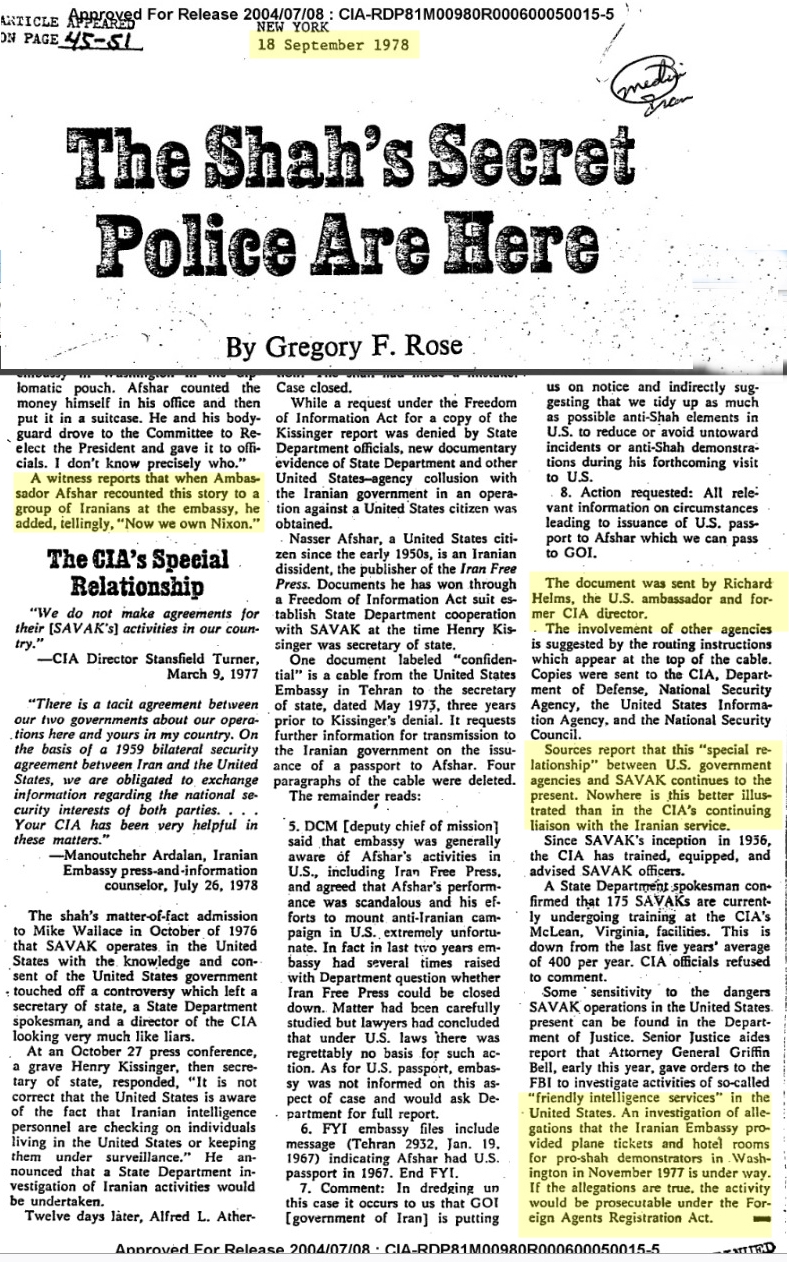
When Powers published his article and book about Helms in 1976, nobody seemed to know that the Iranians, who had always been so important to British oil interests, were even then in the process of being replaced by the Saudis, with whom the Americans were becoming more and more dependent for oil. Helms probably knew that, when he asked to be posted to Iran where as Ambassador he not only continued to work with the Shah's secret police force, SAVAK, but he secretly monitored and mentored his replacements from his post in Iran.

George Bush, too, must have known. He did not directly succeed Helms as CIA Director, but he was not far behind, appointed by Gerald Ford to replace William Colby, who had just revealed  to Democrat Frank Church's Senate Committee a multitude of evils committed by the intelligence agency.

Between the time Bush, as head of the Republican National Committee, had advised Nixon to resign in August 1974, and Colby's resignation from the CIA, Bush had been very busy recruiting young Saudis to set up CIA-sponsored businesses in the United States, to ensure their oil wealth would be invested here rather than abroad.

Training Saudis to Develop Their Oil


 Ever since 1938, when oil was discovered in Saudi Arabia, American men have recognized a need to control the family who owned the wealth that flowed from that oil. Americans were not the first however. The British had discovered oil in Persia (now Iran) in 1908.

The first American-educated Saudis were scholarship students sent by Saudi Aramco shortly after WWII to study petroleum engineering. They often chose Princeton (near the former headquarters of Standard Oil of New Jersey) or the University of Texas. None of the big universities shunned them, however. California, whose big oil companies owned shares in Aramco, also courted princes such as Ali Abdallah Alireza, who attended UC Berkeley in 1945 and completed a master's degree in geology by 1947. President Gerald Ford would welcome Alireza to U.S. as Saudi Ambassador in 1975.


Another Saudi scholar, Ghaith Pharaon, whose father was an important adviser to King Faisal, had received an MBA from Harvard, as well as having studied at Colorado School of Mines (1958-61) and Stanford (1961-63).

Occidental board chairman Armand Hammer, fighting a corporate takeover by Standard Oil of Indiana,  had at first mentioned unnamed Arab interests as having purchased a million shares of Occidental Petroleum, identifying the individual investors by name in late December that year, the first time Pharaon's name saw print, only a few months after President Nixon's resignation.

In 1975 Pharaon achieved even more recognition when he acquired shares in Detroit's Bank of the Commonwealth -- 80% of the Barnes family's controlling stock in that bank, which resulted in his owning 42.4% of the preferred shares and 31.2% of the common, according to AP reporting.

On May 7, 1975 President Ford signed E.O. 11858 entitled "Foreign investment in the United States," which created the Committee on Foreign Investment in the United States (CFIUS). Only then did  George H. W. Bush officially relinquish his position as head of the Republican National Committee, moving into his office at the Central Intelligence Agency.

Deep Politics and John Connally


The most intriguing reporting about the new Arab wealth appeared in Texas Monthly magazine (April 1975), where an unidentified author indicated that Pharaon, as a foreign national who was forbidden to take a seat on the board of directors of the Detroit Bank of the Commonwealth, would be represented on that board by Frank Van Court, an attorney associated with the Houston law firm of Vinson, Elkins, Searls, Connally & Smith--of which John Connally was senior partner.

Cashing in on Saudis' oil weath
Harold Melvin Hyman, in his book, Craftsmanship and Character: A History of the Vinson & Elkins Law Firm, identified Van Court as one of Connally's close associates (pp.357, 378).

Frank Van Court had been born in San Angelo, Texas, but grew up on a ranch just outside of Crane, Texas. He earned a  place at Rice University, studying economics, before obtaining his law degree at the University of Texas in 1968. Within less than ten years, he left former Governor John Connally's Houston law firm to work for only one client--Saudi Arabia's wealthiest businessman in the United States, Ghaith Pharaon. In 1978 Van Court represented Pharaon in his investment in Dallas' Plaza of the Americas.

Khalid bin Mahfouz
Texas Monthly writer Robert Barnstone reported two and a half years later, in November 1977, that John Connally, former Secretary of Treasury for Nixon (Feb. 1971-June 1972) was entering into a partnership with Saudi businessmen Ghaith Pharaon and Khalid bin Mahfouz, to buy a Houston bank--Main Bank of Houston--along with Frederick Erck of Alice, Texas. Since 1973 Erck had also been Connally's partner in the First City National Bank of Floresville. Main Bank would be mentioned again in 1991when evidence surfaced linking that bank to the Bank for Credit and Commerce International (BCCI) scandal.

Fred Erck was married to Ann McGill Erck and managed his wife's ownership of a one-third interest in La Paloma Ranch, —22,000 acres of land in Kenedy and Kleberg counties (King Ranch country), together with  a 1/3rd of 1/8th non-participating royalty interest in the cotenants' share. Bankruptcy by the McGills in 1990 put the property into the hands of Lee M. Bass, one of the notorious heirs of the Sid Richardson fortune.

The Ercks--in Texas' heyday of oil production--saw more oil and gas income than they knew what to do with, but by 1973 Texas crude production had been supplanted by Saudi Arabia. In September 1973 Fred Erck, then a 33-year-old rancher, expanded his banking portfolio by buying control of the First City National Bank of Floresville with former Texas governor, John B. Connally. A life-long Democrat, Connally had first been appointed Secretary of the Navy and later picked to head the Treasury Department during Nixon's first term, following in the footsteps of his mentor, Robert Bernerd Anderson.

Connally had launched Democrats for Nixon in August 1972, just weeks after burglars were busted in the Watergate offices of the Democratic National Committee. Fortunately for Connally, the burglary, though detected, did not prevent Nixon's re-election. The Texas Democrat, as Secretary of the Treasury, became the man who implemented Nixon's decision to end the Bretton Woods Agreement, originally negotiated by FDR's administration in 1944:
Nixon directed the suspension of the dollar’s convertibility into gold. He also ordered that an extra 10 percent tariff be levied on all dutiable imports; like the suspension of the dollar’s gold convertibility, this measure was intended to induce the United States’ major trading partners to adjust the value of their currencies upward and the level of their trade barriers downward so as to allow for more imports from the United States....
Group of Ten (G–10) industrialized democracies agreed to a new set of fixed exchange rates centered on a devalued dollar in the December 1971 Smithsonian Agreement. Although characterized by Nixon as “the most significant monetary agreement in the history of the world,” the exchange rates established in the Smithsonian Agreement did not last long. Fifteen months later, in February 1973, speculative market pressure led to a further devaluation of the dollar and another set of exchange parities. Several weeks later, the dollar was yet again subjected to heavy pressure in financial markets; however, this time there would be no attempt to shore up Bretton Woods. In March 1973, the G–10 approved an arrangement wherein six members of the European Community tied their currencies together and jointly floated against the U.S. dollar, a decision that effectively signaled the abandonment of the Bretton Woods fixed exchange rate system in favor of the current system of floating exchange rates.
Actually, only the U.S. Dollar would "float," while the other currencies would be pegged to it under an agreed ratio. The U.S. was given the power to set the price of crude oil in dollars, a power that, according to James Norman, the U.S. would exercise in following years as an economic weapon against "enemy" nations, notably China and the U.S.S.R.

John Connally would be forced out of office by the "milk scandal" and tried in Washington, D. C. in April 1975. His indictment, announced in late July 1974 made headlines only two weeks before Nixon's resignation. Texas Monthly also ran an intriguing piece about Connally's trial for accepting two bribes of $5,000 each to influence an increase in milk price supports from an American association of dairy farmers. Those were the days before anyone dreamed foreign money could corrupt our politics.

The link between these seemingly disparate events is another Texan -- President Eisenhower's favorite--Secretary of Treasury Robert Bernard Anderson--who had long been John Connally's business and financial mentor. Anderson taught Connally that oil and money, unlike oil and water, do in fact mix quite well.


Wednesday, October 23, 2019

Saudi Arabia: the Nixon Years


"Politics, as we all know, is a game played by the powerful on a field of irony. 
And irony, just like politics, makes for curious bedmates…" Al Reinert
"Bob and George Go to Washington," Texas Monthly (April 1974).


Long Live the Saudi King 

Abdulaziz ibn Saud (full name Abdulaziz bin Abdul Rahman, or just Ibn Saud for short) had founded the House of Saud in 1932--deposing his half-brother, Muhammad Ibn Talal, the previous king. Once Ibn Saud deposed Ibn Talal, he arranged a marriage between one of his own son's and a daughter of the deposed King. This daughter, Watfa, married Musaed (Musa'id), a son of Ibn Saud, born in 1923 to wife, Jawhara of the Al Sudairi family. Jawhara's sister Haya was another wife of Ibn Saud and the mother of three of his approximately 40 sons by assorted wives. Ten of those sons rose to hold the title of Crown Prince and are pictured below.

Crown Princes of Saudi Arabia (click to enlarge)
Rashidi family, published 1997

Musaed and Watfa had a son, Faisal bin Musaed, born in 1944 before they divorced. Faisal was then sent to live with his mother's family, the Rashidis, of which Muhammad Ibn Talal, who died in exile in 1952, was a member. Meanwhile Faisal's father, Prince Musa'id, remarried, had other children, and did not hold any significant administrative positions--never viewed as a possible successor.

King Faisal bin Abdulariz was shot and killed in March 1975 by an estranged nephew, Prince Faisal bin Musaed bin Abdulaziz. By June 18 the nephew had been convicted and beheaded by Saudi leaders, who were quick to label him "deranged."

The 27-year-old assassin had lived in the United States from 1966 until 1973 while studying political science and obtaining a degree from the University of Colorado at Boulder in 1971. He then moved to UC Berkeley for graduate studies. Called a "radical" by his Saudi countrymen, he had attempted unsuccessfully to convince Saudi Arabia to put an end to Islamic rule.


Nixon's Balancing Act in the Middle East

In August 2018 I published a long-researched piece about the history between the United States and Saudi Arabia called "Within the Netherworld of International Currency Exchange Rates." That research helps to understand the financial crisis that haunted Nixon on a daily basis at the end of his first term and into his re-election.

During Nixon's first term, Secretary of State William P. Rogers had negotiated, and "international oil companies" had signed on, with six of the ten OPEC countries in Tehran on February 14, 1971, to a five-year oil tax and price agreement. The six countries of the Persian Gulf did not include Libya, Algeria, Indonesia or Venezuela. The terms of the agreement gave the six countries (Abu Dhabi, Iran, Iraq, Kuwait, Saudi Arabia, and Qatar) a 30% increase on their price for oil with further increases through 1975.

Just prior to that point in time, Nixon and his cabinet officials were attempting to maintain a balancing act between Iran and Iraq, achieved somewhat with help from the Kurds' resistance in Iraq. According to Foreign Relations, 1969–1972, Volume E–4, Iran and Iraq, in the Office of Historian Summary:
The Nixon administration’s tilt toward Tehran [Iran] led to significant shifts in its policy toward Iran and Iraq in 1972. First, the United States abandoned its sporadic efforts to rein in the Shah’s extravagant military spending. During his May 1972 visit to Tehran, Nixon promised to sell the Shah any American arms (short of atomic weapons) that he desired. Second, at the same meeting, the President conceded the Shah’s point that Iraq, now a close Soviet ally, was a security danger to the Gulf region. To help keep the Ba’athist regime [Iraq] off-balance, the U.S. Government began to support the Iraqi Kurdish rebellion under Mullah Mustafa Barzani in July 1972. Although the Shah had funded Barzani for years, Washington had resisted Kurdish appeals for aid on the principle of non-interference in the internal affairs of other countries. After the Iraqis signed a treaty with the Soviets in April 1972, however, U.S. officials “particularly in the Central Intelligence Agency (CIA)” agreed that the threat from Baghdad warranted U.S. attention.

King Faisal Issues a Threat

Rogers resigned as Secretary of State as of September 3, 1973, and Henry Kissinger replaced him. Only a week after Rogers' departure, King Faisal of Saudi Arabia issued a dire warning to the Nixon administration:
"America's complete support of Zionism against the Arabs makes it extremely difficult for us to continue to supply U.S. petroleum needs and even to maintain friendly relations with America."
Balance in the Middle East could no longer be achieved on a binary scale. With King Faisal, purportedly speaking not only for Saudi Arabia, but for all six OPEC countries bound by the terms of the 1971 Persian Gulf Agreement, the scale was almost impossible to manipulate, especially with Israel re-entering the fray--threatening to boycott U.S. oil companies if the U.S. government conceded to Faisal's additional demand that Israel "return Arab land it had been occupying since 1967."

Nixon had to choose between the demands of two strong allies--Israel or Saudi Arabia--while also keeping the Shah of Iran as a friend. All that had to be done for the Shah was to open the door for him to buy all the weaponry he could wish for.

Roham Alvandi wrote in 2012 that Mohammad Reza Pahlavi (the Shah of Iran):
had normalized Iran’s relations with the Soviet Union and now sought Iranian primacy in the Persian Gulf in the wake of Britain’s withdrawal from the region in 1971. Mohammad Reza Shah had seen five American presidents  pass  through  the  White  House;  each  in  turn  had  frustrated  and disappointed him in his ambition to make Iran the region’s leading power. But now, under the Nixon Doctrine, the United States would rely on the shah to maintain stability in the Persian Gulf.

Two Crown Princes Passed Over

Faisal had been the third King of the Saudis following the death of Ibn Saud. After Faisal was assassinated in 1975, as shown in the chart above, the succession followed in an orderly process until Salman became the new King of Saudi Arabia on January 23, 2015 following the death of his half-brother. Note that two crown princes were ahead of him to be king, one of whom was already deceased:
  • Talal bin Abdulaziz (died December 2018) and 
  • Nayef bin Abdulazriz (died June 2012).
Why were Talal bin Abdulaziz (whose son was the well-known and wealthy pro-American  Alwaleed bin Talal) and the sons of Nayef (notably Mohammad bin Nayef) skipped from the line of succession?

Reports leaked out in 2017 (shortly after President Donald Trump's inauguration) that Nayef was removed as a result of a plot organized by the man commonly known today as MbS, Mohammed bin Salman about whom it was said at the time:
The decision to oust Mohammed bin Nayef and some of his closest colleagues has spread concern among counterterrorism officials in the United States who saw their most trusted Saudi contacts disappear and have struggled to build new relationships.
And the collection of so much power by one young royal, Prince Mohammad bin Salman, has unsettled a royal family long guided by consensus and deference to elders.
Jamal Khashoggi
As early as 1989 while "Saudi intelligence ... was coordinating aid to the fighters as part of its cooperation with the CIA against the Soviet Union in Afghanistan," Jamal Khashoggi, who had traveled with the Arab mujahideen in Afghanistan, "criticized Prince Salman, then governor of Riyadh and head of the Saudi committee for support to the Afghan mujahideen, for unwisely funding Salafist extremist groups that were undermining the war." Jamal's rise "was linked with the Faisal clan — Turki and his brother Saud al-Faisal, the longtime Saudi foreign minister. Educated at Georgetown and Princeton, respectively, the Faisal brothers represented the thoughtful, moderate face of the royal family."

As for the Talal branch, James Wynbrandt wrote in 2010:
The attack [on September 11, 2001]  brought long-festering antagonisms between the two nations to the fore. The Saudis were blamed for exporting an intolerant brand of Islam and donating large sums to groups that supported terrorism. The United States was blamed for its unbending support for Israel, which was seen as the root cause of the attacks. Prince Alwaleed bin Talal, son of the founder of the Free Princes movement [formed in 1962 and ended in 1964], came to New York to express his sympathy and offered a $10 million donation for the victims, along with advice for the United States to rethink its Middle East policy. New York mayor Rudolph Giuliani rejected the advice and the $10 million donation, and the episode came to represent the vast gulf that had suddenly opened between the two longtime allies.
Prince Alwaleed bin Talal
Prince Talal and his son, in short, were, according to David Ottaway, "liberals" compared with their countrymen--a term traditionally used to mean those advocating more democratic reforms and limiting autocratic power of leaders. The father had been forced out the cabinet for his suggested reforms in 1961, but in 2007 he was again a member of the Allegiance Council, which was supposed to be consulted when one of the members of the ruling family died before another was admitted in his place. When Prince Nayef ascended as Crown Prince in November 2011 without consulting anyone, Talal resigned from the Council, watching his country became ever more undemocratic until Talal's death two months after Jamal Khashoggi's murder.

In 2015 Jamal had convinced the son of Crown Prince Talal bin Abdulaziz, Prince Alwaleed bin Talal, whom the Washington Post referred to as "a reform-minded Saudi billionaire," to finance a news channel in Bahrain. It was unfortunately removed from the airwaves by Bahrain after only 24 hours for featuring an "interview with a prominent Bahraini Shiite politician who had criticized the regime."

Jamal Khashoggi at Alwaleed's news channel

Two years after Jamal's plan to liberalize the media failed, Prince Alwaleed was arrested "plus at least 10 other princes, four ministers and tens of former ministers," as part of Crown Prince Mohammed bin Salman's plan to consolidate power, and Jamal fled the country.

Greg Olear wrote in Medium, after reports of Jamal's murder began to surface, that "Trump and Kushner both have skin in the game." He continued:
Saudi Arabia was the first state visit Trump made as president, a trip organized and pushed for by Kushner, who is chummy with MbS and has acted as the de facto ambassador to Saudi Arabia. Khashoggi was not banned from Saudi media for his criticisms of MbS, but rather for his criticisms of Donald Trump. More importantly, U.S. intelligence knew of a plan to lure Khashoggi back to arrest him, so the president and the de facto ambassador to Saudi Arabia must have also known. If they knew and did not share the information with Khashoggi, they are liable.
Alwaleed was released in January 2018, ten months before Jamal Khashoggi's murder. When he spoke in an interview with Fox News the following December, he sounded like a defeated man, one who had made a deal with his captors, whom he now insisted were honorable. It was a secret deal, so we may never know the truth.


~~~~~~~~~~~~~~

"Saudi Arabia: Creation of the Petrodollar" has been in draft form for several years, being added to and edited as time permitted. Because of the length and complexity, I have decided to divide it into several parts. The next segment will follow soon.


Monday, April 29, 2019

D. Harold Byrd

Researched and written
by Linda Minor

D. Harold Byrd's Convergence with Mac Wallace?

As promised in Part II of "Tale about a Tail," this post will give you more information than you ever wanted to know about the background of D. Harold Byrd. We may return to tracing Tail #N-17888 in a later post. What initially piqued an interest that motivated me to research D. Harold Byrd in greater depth were two facts I discovered about Byrd while researching the history of TUSCO:
  1. Byrd was born in a tiny town called Detroit in Red River County, Texas in 1900, and he graduated from the University of Texas in Austin in 1921, yet the college-degreed geologist had been made to look like a rube with the nickname "Dry Hole."
  2. His first big oil discovery in the Talco Field of northeast Texas led to partnership in a refinery in Mt. Pleasant, Titus County, Texas in 1937 with three other independent oilmen--Captain J.F. Lucey, Ralph Emerson Fair (who bought 5,000 acres near Camp Bullis at Boerne, Texas--developed by his heirs into Fair Oaks Ranch), and Jack Frost.
Towns in northeast Texas where Byrd, Wallace, Rainey and Witt families lived and worked
In addition to being the site for the Talco Refinery, Mt. Pleasant, for those who aren't up on Texas trivia, was once the hometown of LBJ's favorite assassin, Mac Wallace. Just north of Mt. Pleasant is Red River County, where a significant number of lives in Mac's history converged. His father Alvin Wallace had been born in Mt. Pleasant and began his career as a concrete contractor there. He built roads and bridges in partnership with Mac's uncle, Leonard Roy Bowden, a brother of Alvin's sister Nellie.

Nellie Arlene Wallace had married in 1914, and both her husband and brother were farmers in Titus County, before they left for WWI. Upon their return, they formed a road-paving company called Wallace & Bowden to bid on government road and bridge contracts. The asphalt produced by the Talco Refinery would have been a cheap source of road material for their business, although they also were concrete contractors.

In order to expand their business, Wallace and Bowden moved to the city, to an office address at East Grand Avenue near the Mt. Auburn Elementary School. Both the Wallace and Bowden families lived nearby. Mac Wallace was a 1938 graduate of Woodrow Wilson High School in the Mt. Auburn area of Dallas.

He joined the Marine Corps after graduation and on November 3, 1939 was aboard the U.S.S. Holland, a submarine based in San Diego. From there it appears he was shipped to Hawaii. According to Joan Mellen, in 1938 Mac had injured his lumbar spine playing quarterback for Woodrow Wilson High School and required spinal surgery. After joining the Marines, he reinjured his back in a fall on the USS Lexington on June 27, 1940 and was discharged two months later.

He enrolled in the spring semester of 1941 at the University of Texas, where in 1943 he was shown as a member of the student assembly and was elected president of the Students Association in 1944. He was also one of eight men selected to the UT secret society known as the Friars Society, as well as a member of the elite Tejas Club. The Friars had been created in 1911, and until 1949 they never selected more than  four new members per semester. Notables in the Friars, according to their website, included
  • Arno Nowotny, fall 1925
  • Cecil Bernard Smith, spring 1927
  • Allan Shivers, spring 1931*
  • Joe R. Greenhill, spring 1936
  • Jake Pickle, spring 1937
  • John B. Connally, spring 1938 *
  • Dolph Briscoe, Jr., spring 1942*
  • Jack B. Brooks, spring 1943
  • Malcolm (Mac) Wallace, spring 1944
  • Horace Busby, spring 1945 
  • Theodore Strauss, spring 1945
  • Ronnie Dugger, fall 1950
  • Lloyd Hand, spring 1951
  • Barr McClellan, fall 1960
  • Fred Hofheinz, spring 1960
The three men marked with asterisks * would become Texas governors. Greenhill would serve many years on the Texas Supreme Court, while Jake Pickle and Jack B. Brook would serve for many years in the U.S. Congress and be closely associated with LBJ. Notowtny and Smith will be discussed in a later post for their role in organizing the UT Cowboys.
Walt Brown referred to Notwotny in 1998 as "future Dean of Men at the University of Texas and alleged CIA recruiter at UofT."

Ronnie Dugger was in his day a well-known "liberal" journalist who also authored a biography of Johnson. Strauss, brother of Robert S. Strauss, would become a wealthy businessman in Dallas. The name of Horace Busby also appeared in the list. Busby was hired to work for Lyndon Johnson in Washington, D. C.

Joan Mellen writes of Busby's knowledge about Mac Wallace. Holland McCombs, researching LBJ for LIFE magazine, interviewed Wallace and concluded, according to Mellen:
Wallace was assigned to strong-arm businessmen into rewarding Johnson for the small business loans that Johnson had bestowed upon them. Mac Wallace’s role was to facilitate the Faustian bargains low-level Texas contractors and businessmen had made with Lyndon Johnson, to collect payment. For these forays to Texas, Mac Wallace later earned the melodramatic sobriquet of Johnson’s “hatchet man.” The term was first attached to Wallace at the time he was an employee at the Department of Agriculture and seems not to have involved violence. Johnson sent Mac Wallace back to Texas to “arrange to buy or get a piece of” the businesses of those to whom Johnson had awarded the favor of those loans.  [Mellen, Joan. Faustian Bargains: Lyndon Johnson and Mac Wallace in the Robber Baron Culture of Texas (p. 80). Bloomsbury Publishing. Kindle Edition.]
Mac Wallace stands out because of his 1952 conviction for murder with malice. The jury, however, sentenced him to only five years in prison, but suspended that sentence, so that he never served a single day inside. The only defense presented by his attorneys (Polk Shelton and John Cofer, long-time associates of Lyndon Johnson) was in the argument that the prosecution found no motive for the cold-blooded killing. Nevertheless, the lack of any apparent motive could not overcome the fact that a witness had identified Wallace and written down the license plat number of his car, in which a blood-stained shirt was found two hours after the shooting.

Mac Wallace named to Friars June 1944, Daily Texan, UT newspaper
Mac Wallace had led a student protest in 1944 against the dismissal of Dr. Homer P. Rainey, the well-educated Clarksville-born (see map above right) man who had served as the head of FDR's American Youth Commission (1935-39), immediately prior to being selected as president of the University of Texas.  Whether or not Rainey had met Lyndon B. Johnson, when the latter headed the Texas branch of the National Youth Administration, the focus of which was finding jobs for young people, is unknown. The NYA, though not affiliated with Rainey's American Youth Commission within the Education Department, both groups did focus on finding jobs for young people during the post-depression years. Only a few months after the student protests Wallace was chosen as a member of the Friar Society.

Mac Wallace at the University of Texas in 1944
Courtesy of Life
Life magazine captured a memorable photograph of D. Harold Byrd, well-known as a band booster, in 1941 at a University of Texas Longhorn game. Seated directly behind him at the game was the daughter of President Homer Price Rainey (born in Clarksville,TX in 1896), the man against whose firing by the Board of Regents in 1944 because he supported economic professors who "espoused New Deal views." The regents themselves had fired such professors in 1942, and Rainey's protest of the firing resulted in his being dismissed by the Regents in 1944.

By 1944 Mac Wallace's father was a road and bridge builder in a company with his brother-in-law (Wallace & Bowden), bidding on jobs as far away as Johnson City, often in conjunction with Maurice Edward Ruby, a contractor who helped Mac's father pay the bond to get Mac released from jail during his murder trial. Another contractor from the same small town in Hays County who helped pay the bond was John E. Greenhaw, who died in January 1965 of cirrhosis of the liver.


Dr. Homer P. Rainey, 1939
 Rainey's biggest booster on the U.T. Board of Regents was J. R. Parten, a progressive Democrat, who was also very close to Congressman Sam Rayburn. Both men favored the hiring of  Berkeley physicist Dr. E. O. Lawrence as a professor at UT. The loggerhead between Rainey and the Regents began late in 1939 when Houston attorney James A. Elkins warned the Regents that the Legislature would "kick the Regents across the state line if they [University of Texas] dared to squander tax dollars" to build a nuclear cyclotron, an "atom-smashing machine." [quoted by Susan R. Richardson, in "Reds, Race, and Research: Homer P. Rainey and the Grand Texas Tradition of Political Interference, 1939-1944," an essay which appears in a book edited by Roger L. Geiger, Perspectives on the History of Higher Education: 2005 (History of Higher Education Annual) (2005), page 141.]


The Rainey Controversy

From Susan R. Richardson, "Reds, Race and Research," page 144.
What brought on Rainey's downfall as president of the University of Texas was that when W. Lee O'Daniel was re-elected governor, he believed he had been given authority to appoint new regents who opposed the University president. Then, once O'Daniel left the state office to fill a U.S. Senate seat, his lieutenant governor, Coke Stevenson, became governor and continued the process of packing the Board with anti-Rainey men.

New regents voted in a bloc with Lutcher Stark, lumberman from Orange, Texas, to fire pro-New Deal economics professors, as well as to cut the salary of J. Frank Dobie, a Texas history folklore writer with only an M.A. from Columbia University in New York. A "liberal" oilman, Parten opposed these efforts and began spreading rumors about their intent of "fomenting a coup." [See inset, left, from pages 144-5.]

It was the ex-Marine and elected student body president, Mac Wallace, who led the protest against Rainey's firing, which occurred during the fall of 1944, a few months before his selection to the Friar Society.

Joan Mellen wrote of Mac Wallace's activities during the summer of 1945 in New York City, poised to continue his education, but not quite sure what path he would take:
On June 11, 1945, Mac Wallace enrolled at the School of Law at Columbia. Two weeks later, he dropped out “for reasons of ill health.” He had contracted a nasty skin infection that required expensive injections that he could not afford. He never went back. Instead, he registered for the fall semester beginning in September 1945 at the New School for Social Research as a candidate for a master’s degree in economics. He took courses in “money and credit (essentially Keynesian)” and “trade policies and tariff construction.” ... Wallace dropped out of the New School without receiving a degree. At the turn of the new year 1946, he quit his job at the National City Bank to “work on a campaign” and returned to Texas. Homer Rainey was seeking the Democratic Party nomination to be governor of Texas and Wallace would be his Dallas city campaign manager. He would also be the state director of College Students for Rainey. To complete his undergraduate degree, he enrolled in classes at the University of Texas and commuted between Dallas and Austin. [Mellen, Joan. Faustian Bargains: Lyndon Johnson and Mac Wallace in the Robber Baron Culture of Texas (pp. 70-71). Bloomsbury Publishing. Kindle Edition. ]
Information available on the Friars website considerably differs from what Mellen writes in her book, which states:
As a senior, Wallace was now eligible to be elected to the Friar’s Society. The 1946– 47 Friar’s group of eight included not only Wallace, but Horace Busby; Dolph Briscoe Jr., a future governor of Texas; and future congressman Jack B. Brooks. [Mellen, Lyndon Johnson and Mac Wallace... (p. 73).]
If the website is to be believed, Mac was already a Friars member before he went to New York in the summer of 1945, not yet having completed his degree. Not long after returning to Austin, he married:
That summer of 1947 Mac took up with a pretty, sexually adventurous young woman named Mary Andre Dubose Barton. “Andre,” as she preferred to be known, and her sister Ruth had been adopted by Kostromey [sic] Palestrina Barton, a Methodist minister known as “KP,” who taught at the University of Texas, and his wife, Roberta, a former English instructor at UT.


In 1922 R.J. (Ruddell Jones Byrd, sometimes called Leo by his family) and his wife Ada lived at 822 N. Lancaster in Dallas, but before long they had moved farther west to the unincorporated area between Grand Prairie and Irving onto Lone Star Road. His younger brother had been born in Detroit, Texas in


By 1953, D.H. had taken over the company his brother, R.J. had started after apparently selling his interest in Byrd-Frost to his former partner.

Did his growing up in this area have even greater significance, when considering the fact that, after his murder conviction which resulted in a suspended sentence and immediate release, Malcolm Everett (Mac) Wallace was given a security clearance to work for Ling-Temco-Vought's facility in California?

Is it simply a remarkable coincidence that the name of Mac Wallace's younger brother was Harold David Wallace?

Mac's father, Alvin James Wallace, had been born (1896) and reared in Mt. Pleasant, but by 1920 he was married and living in Red River County at Johntown.


By 1944 Texas businessmen, although most were still Democrats since Reconstruction days, were fed up with FDR's New Deal "liberalism." When Rainey ran for governor of Texas in 1946, he was defeated by Beauford Jester and his running mate Allan Shivers. As Richard Bartholomew informed us in his monograph, "Colonel Burris' wife, Barbara J. Burris, is the daughter of Governor Jester." QJ has mentioned the Burris family often and even contains a detailed genealogical study of the family; Burris was also mentioned in my edited remarks from 2014 JFK Assassination Conference. Understanding how he fit into the network of men behind LBJ has never been completely understood. It may be the key to the real perpetrators.


Who Else was Born in Detroit, Texas?

David Harold (D.H.) Byrd's father Edward transplanted his roots to Texas, after growing up in Cape Girardeau, Missouri, following his marriage in 1879 in the tiny town of Blossom Prairie, Texas, the hometown of his chosen bride, Mollie Easley. For those interested in what I call "Byrd's Back Back Story," I will post the research into the family simultaneously with this segment. Otherwise, it becomes much more bulky and confusing than it already is.

Politics is about power. When Edward Byrd married Mollie Easley in 1879, he was initiated into a circle of power that would descend to his youngest son, D. Harold, for, as it happens, Mollie and her younger brother Edwin grew up in eastern Lamar County near John Nance Garner, who, the Texas State Historical Association tell us "was born on November 22, 1868, in a log cabin near Detroit, Texas. He went to school at Bogata and Blossom Prairie. At eighteen he went to Vanderbilt University in Nashville, Tennessee, where he stayed only one semester, possibly because of ill health. He returned to Clarksville, Texas, read law, and was admitted to the bar in 1890. After an unsuccessful run for the office of city attorney he moved to Uvalde, where he began law practice." He also ran for county judge and in 1895 married Mariette "Ettie" Rheiner, daughter of a Swiss immigrant who had settled in Texas in 1860.
D.H. Byrd's grandfather was R. J. Easley, Garner's "lifetime friend." Photos from FDRlibrary website.
We first begin seeing the name John Nance Garner in newspapers in 1904, a couple of years after his first election to the U.S. Congress. There he garnered favor from the boss of the region, James Babbage Wells, Jr., better known simply as Jim Wells, whose south Texas political machine shepherded Garner's election to Congress. Possibly because of Wells' protection, Garner's district was one of the safest, enabling him to attain the coveted role of Speaker of the House of Representatives.

John Nance Garner (fourth in a series of men with the same name) was born in 1868 in the same town where D. Harold Byrd would be born in 1900. Garner's father (age 17) was listed near Clarksville in Red River County's 1860 census, and his mother, Sallie Guest, was born in Blossom Prairie in 1851. Six of Garner's seven siblings still lived in either Red River or Lamar County when he was, elected Vice President in 1932.

Within six years the pride Garner felt about being on the ticket with Franklin Roosevelt had turned to disgust, and his siblings and friends joined with others who turned against the President and began campaigning to nominate Cactus Jack Garner as the Democrats' standard bearer. They were angry for FDR's selection of Henry A. Wallace as Garner's replacement.

We jump now to what John Nance Garner did during his retirement after 1940.