Showing posts with label dallas police. Show all posts

Friday, January 16, 2026

Sexual Blackmail in U.S. Oil Policy

I published the article below at this blog on March 30, 2011 before I had ever heard the name Jeffrey Epstein. While reviewing the blog to correct dead links and otherwise clean up the posts, I realized once again how events from the past tend to repeat themselves in the present day. Unfortunately, the past events which were hinted at in the excerpts quoted below as "Deep Politics in Dallas," were never fully grasped by historians or the general public. The men in Texas and Missouri involved in the honey traps described below, for the most part, got away scot-free with their escapades. Their true motives were never revealed during their own lifetimes.

Only as we look back, knowing what we know now, can we begin to see the pattern that emerges. The Texas men owned vast oil resources, not just in Texas, but worldwide. Although they claimed to be "independent" oilmen, they had strong ties to "big oil," as well through relationships with other families in Texas connected to the old Standard Oil banking and securities industries. They also had deeply embedded connections to organized criminal enterprises throughout the country. This is only one part of how those combined resources helped them set up a system of sexual blackmail used to control votes in the Senate and later in the Richard Nixon White House.

Linda Minor, January 16, 2026 

 DEEP POLITICS IN DALLAS

An excerpt from Peter Dale Scott, Deep Politics and the Death of JFK:                                                                                

No one has yet documented the rumors one hears in Dallas that Ruby's relationship to the wealthy oilmen and "high rollers" of the Del Charro derived from his practice of supplying girls for them, their parties, and their private clubs.
What remains unexplained is the story of Ruby's relationship in 1963 to Candy Barr, a nationally known stripper and protegee of Mickey Cohen in Los Angeles. In 1957, Barr had been arrested and convicted on trumped-up marijuana charges, by the same players (prosecutor Bill Alexander and Judge Joe B. Brown) who in 1964 would convict Ruby on evidence that led to a reversal; Barr's defense attorneys, Joe Tonahill and Mel Belli, also represented Ruby. 27
In 1963 Ruby was regularly in telephone contact with Candy Barr, who was then out on parole but not permitted to visit Dallas. The rumor persists that the phone calls related to the stripper's attempt to blackmail someone of prominence. The rumor is reinforced by the knowledge that sexual blackmail was a practice for which Mickey Cohen was famous. 28
For some reason the Barr case also drew the attention of Gordon McLendon, who was one of those who told me in 1977 that she [Barr] had been framed on the marijuana charge (by members of the Dallas Police Narcotics Squad). McLendon's brother-in-law Lester May became her first attorney. McLendon told me this when I asked him for information about his friend Bedford Wynne.

While not giving me the answers I was hoping for, he volunteered the detail, which seemed trivial at the time, that Wynne's intimate friend George Owen, later the first [sic] husband of Maureen Dean, had been the man present at Candy Barr's arrest who may have helped set it up. 29

 Maureen "Mo" Biner Dean
He also volunteered to me the detail, which at the time seemed unrelated, that when Bobby Baker emerged in 1972 from his time in prison for tax evasion and fraud, he went to stay with McLendon at his Cielo Ranch north of Dallas. I thought later that McLendon here was possibly standing in for Bedford Wynne and Clint Murchison, Jr., two of McLendon's friends who had been mentioned in the Bobby Baker hearings and were now unwilling to be publicly associated with Baker.


Since recent revelations about Watergate, I now wonder if the real link was not George Owen. Owen was extremely close to Bedford Wynne, and would party with him in Mexico, or even in his law office, where William McKenzie (of whom more in Chapter 18) was a partner.

George Owen also introduced to Bedford Wynne (the friend of Bobby Baker and member of his Quorum Club) to the woman Owen would later marry: Maureen Biner, who played a much-underestimated role in Watergate as the girlfriend, and then the wife, of John Dean.

27. Gary Mills and Ovid Demaris, Jack Ruby (New American Library, 1968), 64-68.

28. Davis, Mafia Kingfish, 262, where it is asserted that Marilyn Monroe knew both Mickey Cohen and John Roselli.

29. Mills and Demaris, Jack Ruby, 66.
~~~~~~~~~~~~~

A second excerpt from Peter Dale Scott, Deep Politics and the Death of JFK (1993), p. 236:

The most important of these [scandals in Washington involving politicians, call girls, and assignations recorded by intelligence experts for intelligence purposes] is Heidi Rikan's call-girl operation, a few doors from the Democratic National Committee headquarters in Watergate, which two separate and well-researched books have now seen as the key to the 1972 Watergate break-in and scandal.
According to both books, the phone line inside the DNC which was supposed to be tapped by Howard Hunt's Watergate burglar (including Frank Sturgis) was a special line (not going through the central switchboard), which DNC staffers and friends used to phone the Heidi Rikan call-girl operation. 37 Jim Hougan adds that the phone line was already being tapped by a stringer for Jack Anderson, Lou Russell. 38

Lou Russell was a former FBI agent who had helped Nixon with the Hiss case when he was both HUAC's committee counsel and also Hoover's informant on the Committee. 39 An employee in 1963 of Watergate burglar James McCord, Russell was close to Heidi Rikan's call girls whose line was the target of the Watergate burglars. Russell also had an unexplained financial relationship to McCord's attorney, Bernard Fensterwald (a longtime backer of the Garrison and other investigations of the John F. Kennedy assassination) and may have been working for Fensterwald as well.

The book, White House Call Girl, pictured above, was written as "fully sourced political non-fiction" by Phil Stanford and first published as an e-book in 2013. 

Bernard Fensterwald

Fensterwald
At this point it should be pointed out that James McCord's attorney, Bernard Fensterwald, as early as 1957 was employed as an aide to Democratic Senator Thomas Hennings of Missouri, who became John Dean's father-in-law in February 1962 when Dean was first married to Karla Hennings. An attorney from Nashville, Tennessee, where his father was manager of a clothing store, Fensterwald became an administrative assistant to the Senate subcommittee on Constitutional Rights chaired by Senator Hennings. Fensterwald resigned from that position with the subcommitte in January 1959 to become the top aide of Senator Estes Kefauver of Tennessee.

Sen. Kefauver's subcommittee had conducted an investigation into the professional sport of boxing and proposed legislation creating a national boxing commissioner with "power to clean  up the fight game by withholding licenses from boxers, managers and promoters in interstate bouts," a bill not supported by Attorney General Robert Kennedy. Soon after that Fensterwald was fired by Kefauver, and soon found a job working for Democratic Senator from Missouri--Senator Edward V. Long, a defender of Jimmy Hoffa.

Fensterwald showed considerable animosity against RFK in March 1965 over the Jimmy Hoffa case:

MARCH 3, 1965
By JACK C. VANDENBERG
WASHINGTON (UPI) — Sen. Robert F. Kennedy, D - N.Y , clashed with a Senate subcommittee today over its airing of charges that he mishandled an investigation of Teamster boss James R. Hoffa while he was attorney general. Kennedy appeared before the judiciary subcommittee to protest what he called the "implication that I handled myself in some shocking manner while I was attorney general." The former cabinet member made no attempt to hide his irritation over the way the sub-committee handled the charge leveled against him by New York attorney Thomas A. Bolan, a witness at Tuesday's hearing.
Bolan said Kennedy had tried to influence public opinion against Hoffa by instigating unfavorable publicity while the Teamster boss was under indictment. 
Makes Special Appearance
Kennedy, who denied the charge Tuesday, made a special appearance before the subcommittee today to repeat his denial and object to this handling of the matter.
He told the subcommittee he believed it was improper for Chairman Edward V. Long, D-Mo., to make statements about the matter "after hearing only one side of the story. After hearing Bolan's charge Tuesday, Long said he considered it a "shocking matter." The chairman said he would refer the testimony to the Senate Judiciary Committee for whatever action that group might want to take. Kennedy, a former chief counsel for a Senate investigation subcommittee, said he believed it was standard practice —when it was known a matter was coming up — to try to present both sides of a story.
Bolan had said that Kennedy arranged in March, 1961, to have Life magazine publish a story based on an interview with Sam Baron, a disgruntled Teamster Union official, at a time when Hoffa was under indictment.
Definition Of 'Fink'
In an exchange today with subcommittee counsel Bernard Fensterwald Jr., Kennedy said he saw nothing wrong with his actions as attorney general. Fensterwald asked Kennedy if he believed it was proper for a government official to "act as an intermediary between the press and a fink."
"What's your definition of a fink?" Kennedy demanded. "A person who is a stool pigeon," Fensterwald  retorted. "That's your definition," Kennedy snapped. "I consider Mr. Baron as a public spirited person who was doing his duty."
Fensterwald asked if Kennedy thought it was proper for a public official to arrange for publicity unfavorable to a person under indictment. "I never did anything like that and that is the implication of the testimony and remarks made by the subcommittee yesterday," Kennedy said heatedly.
At Tuesday's hearing, Kennedy's methods in prosecuting New York attorney Roy M. Cohn also were questioned. Bolan represented Cohn in New York last year when the former McCarthy committee counsel was tried and acquitted of charges of attempting to bribe a U.S. attorney. Cohn, who also testified Tuesday, made only indirect references to Kennedy. But Bolan told the subcommittee that Kennedy planted an article about a dissatisfied Teamster official in Life magazine. 
Denies Charge
Kennedy denied the charge, the New York Democrat said the Teamster official—Sam Baron—came to him "in fear of his life." According to Kennedy, Baron said he wanted to get in touch with some non-governmental official to tell his story. Kennedy said he set up a meeting with Life magazine with the understanding that nothing would be published until something happened to Baron. At the same time, Hoffa was under indictment, and Baron was "cooperating with the FBI," Kennedy said. Bolan was testifying before the subcommittee about a mail over placed on him. Bolan said he came across the information about Kennedy's involvement in the Life story while investigating the circumstances surrounding a similar story on Cohn.
Senator Ed Long, for whom Fensterwald worked for several years as counsel for his committees and subcommittees, would later be accused of business relationships with Hoffa's attorney, Morris Shenker of St. Louis. Shenker's 1989 obituary stated:
Shenker
Shenker, a Russian immigrant who grew up in north St. Louis, first made a name for himself as a young lawyer by doing free legal work for the poor and getting involved in Democratic politics.
He had been recurrently in the national spotlight since representing gambling figures before the Estes Kefauver hearings on organized crime in the early 1950s.
Hoffa, his most famous client, had links to organized crime and disappeared in 1975. He is presumed dead.
Because of his Teamsters connection, Shenker, who operated the Dunes Hotel and Casino in the 1970s, ran afoul of the Nevada Gaming Commission. (Shenker's name had also surfaced often in connection with loans from the Teamsters Pension Fund.)
Despite state and federal investigations, however, Shenker escaped indictment until this year. In February, a federal grand jury accused him of conspiring to conceal hundreds of thousands of dollars from the Internal Revenue Service and bankruptcy creditors. The money supposedly was diverted from a California partnership owned by his children to individuals in Canada and then back to Shenker's secretary in Las Vegas in an elaborate scheme to avoid creditors. Shenker denied any wrongdoing.
Shenker had filed for bankruptcy in 1984 after a $34-million court verdict against him for money he borrowed from the Culinary Workers Pension Fund for resorts in Southern California and other projects. He had been involved in court battles over his finances ever since.

Tuesday, April 30, 2013

Who Was Jay Harrison?

The article below appeared on JFKCountercoup2, a blog written by Bill Kelly, JFK assassination researcher. It is not clear from the posting where or when the article appeared. What it fails to mention is who provided the information for the obituary, or even who wrote it for the newspaper. Very likely it was furnished by Walt Brown, the history teacher and COPA member trusted by Harrison at the time of his death to receive his files and papers

Jay's father's parents were John Calvery/Calverley Harrison (born in Lancashire, England, in 1868, died in Leominster, MA in 1921) and Eva Maude Proctor (1876 – 1950). Jay's mother was born in California to John Archibald Fraser, Jr. and Charlotte Theresa Mcclintock.

Obituary: HARRISON, JOHN FRASER [J and Jay]

Jay was born in Portland Maine on 8 Nov 1933. He was the only child of John Alexander and Leonore Mary (Fraser) Harrison. His father was then the Portland Branch Manager for the Burroughs Adding Machine Company.

His paternal ancestry went back to 5 pilgrim passengers onboard the Mayflower that landed in Plymouth, MA on 16 December 1620. His maternal ancestry went back to the Fraser Clan in Kintail Parish of Ross and Cromarty County Scotland thence to Brockville Ontario, Canada, along with a direct linkage to Simon Fraser (his Great-Grand Uncle) of Canadian historical fame.

Jay used to joke that one day, when he was about 13 and living on the family farm back in Ogunquit Maine, he looked into a mirror and said "Where in the world did he come from?" and he searched for the answer to that question for the rest of his life. He was an active genealogist from that day forward.

Jay graduated from Montgomery Blair High School in Silver Spring MD and went on to the Industrial Engineering School at The University of Maryland. His college education was interrupted by the Korean Police Action in early 1953.

Jay was drafted into the US Army and was trained in communications and intelligence and among other assignments was assigned to the Joint Chiefs of Staff Communication Center in The Pentagon. Following his "active" service he was assigned to a Reserve SIRA Team (Strategic Intelligence Research and Analysis) for 6 more years.

Jay held, during his military service, every Security Clearance ever issued and was sworn to secrecy on many subjects for the rest of his life. He abided by that commitment and refrained from addressing subjects that are today common topics on the internet.

Jay also attended George Washington University and the University of Maryland while he was stationed in Washington, DC, and then in later years Graduate School at the University of Texas in Austin.

As a veteran, and while attending UofM, Jay worked evenings repairing Multilith printing presses in Government agencies for Addressograph-Multigraph in Washington, DC. Jay then joined the sales component of A-M and became a Junior Salesman in Rochester, NY servicing Eastman Kodak Co. It was in Rochester that he met and married Marian Ernest, another A-M employee. Upon promotion to Senior Salesman Jay was transferred to the newly created branch office in Montgomery, Ala. Jay and Marian arrived in Montgomery in the first week of December in 1955 and that was the same week that Rosa Parks refused to relinquish her seat to a white person on the bus and the famous "bus boycott"  began.

Over the next few years Jay was promoted and reassigned by AM to Cleveland, OH, Erie, PA and eventually Dallas, TX in late 1959.

On 13 Jun 1961 he became a Reserve Officer on the Dallas Police Department. His military background and genealogical research experience was used by the DPD's Criminal Intelligence Section.

At the time of the Kennedy Assassination at 12:30PM on 22 Nov 1963 he was on assignment observing the Black Muslim Church, as intelligence information was that members of that church would be creating a scene somewhere along the motorcade route. When the shooting event happened, he went to the School Book Depository Building and arrived there 4 minutes following the shooting. Later that day he was on the guard team for Governor Connally at the ICU in Parkland Hospital.

He was the first Reserve Officer of the DPD to be awarded the The Meritorious Conduct Award, the highest award to an officer of the DPD. This award was made on May 14, 1965 for his research efforts  into the Kennedy Assassination and associated events before, during and after the action.

In 1964 he left A-M Corp and joined one of his clients (Texas Instruments) as its Corporate Printing Coordinator.

In July 1966 he was was hired by Frank McBee, the VP of a small but rapidly growing, electronics firm in Austin to be their Publications Manager. That company's name was TRACOR. Jay's first day there was  Monday, 1 Aug 1966, and he and a personnel officer ate an early lunch at the Night Hawk Restaurant at 19th and Guadalupe. They came outside about 12:05 and at that time Charles Whitman was shooting from the Tower.

In 1968 Jay became VP of Market Development of Norman Harwell & Associates (NHA, Inc) the 2nd largest technical publication firm in the world. In 1971, after the elimination of MIL-Spec requirements of the federal government, NHA went from over 1700 employees to less than 100. Unfortunately Jay was one of the ones that was looking for a new job.

In 1974 he returned to Austin and went to work for Nash Phillips-Copus Co (NP-C) as a salesman in their Multi-family Division. He was NP-C's Salesman of the Year in 1975 and 1976. He was awarded the Outstanding Salesman of the year award by the Austin Association of Sales Executives;  He was one of the top 10 Salesman in the nation in the years 1976, 77 and 78 by the National Association of Homebuilders. Jay was promoted to Sales Manager of NP-C in 1977. NP-C was the 2nd largest builder in Texas and 7th largest builder in the nation. CenTex Construction (a Clint Murchison, Sr Company) was the largest builder in both TX and the nation.

In 1979 Jay founded Texas Real Estate Marketing & Consulting Corp (TREMAC). It grew to be in the top 3 of Commercial real estate firms in the Austin Market. Its annual sales exceeded 35 million dollars. It went dormant in the real estate crash of 1988.

Jay has been a licensed real estate broker for over 25 years. He wanted to return to commercial real estate sales when the market recovered in 1998/99 but he has been recovering from major surgical and physical disabilities since 1998.

He has been Amateur Radio Licensed since 1952. His current call sign is N5BHU.  Jay received the original "Mayday" from the Medical college on Grenada Island and ALL the communications with that facility were through his home in Rollingwood for over a week in October 1983. The US Department of State and The Defense Department had open telephone lines to his residence for that whole week. His station was manned for 24 hours a day and he still has audio tapes of all the communications. (Ref: Dick Stanley AAS Staff).
  
Jay has done genealogical research for over 55 years and is a highly respected researcher of Colonial New England, The Republic of Texas, and early Texas History. He has been a contributing patron of the Texas State Library and through the years has donated many thousands of dollars in books, equipment and computer CD's to their genealogical collection. He was one of the original founders and authors of "Automated Archives" the ORIGINAL producer of genealogical CD ROMS in the early 1990's.

Jay is the Certified Genealogist for The Texas Supreme Court Historical Society. His current effort is doing hard genealogical research on all 150+ Justices of the Supreme Court of the Republic of Texas and the State of Texas.

Jay was a licensed pilot and in his spare time liked to cruse off into the wild blue yonder.

He can now do it permanently.

Tuesday, February 14, 2012

What did Gary Cartwright and 'Mad Dog' Know in 1963?

Notes on Mad Dogs: On Being Young, Talented, and Slightly Insane in Old Austin


Originally published in The Austin Chronicle

Anyone who has tried to write about Mad Dog, a bizarre moment of this state's literary history, can lay claim to the same feelings Susan Sontag experienced when she wrote "Notes on 'Camp'" in 1964. "It's embarrassing to be solemn and treatise-like about Camp," she declared right off the bat, and proceeded to sketch the sensibility of camp in the form of descriptive notes because "to snare a sensibility in words, especially one that is alive and powerful, one must be tentative and nimble." The essay form is too definite, too knowing, perhaps, to snare a sensibility. Mad Dog is not a sensibility that is alive and powerful, but it was at one time. But the rules are the same for snaring lost or living sensibilities, and in the case of Mad Dog, for which there is not an abundance of recorded history, the effort of resuscitating its lost sensibility can be addressed most effectively by making notes about it. 

These notes are for Bud Shrake
"There were people who refused to join Mad Dog. ... I think they thought it was too elitist. So we decided it was: It was too elitist for them."
-- Bud Shrake being interviewed, Jan. 13, 2001

Defining "Mad Dog"

1. An attempt at definition: Mad Dog is the chosen name of a band of rebellious artists -- mainly writers and journalists but also musicians and painters -- who lived in Texas, mostly in Austin, in the late Sixties and early Seventies who partied and wrote in an identifiably Texan, outlaw manner. Members include  
  • Texas Monthly senior editor Gary Cartwright and his wife Phyllis; 
  • novelist and screenwriter Bud Shrake (Shrake and Cartwright were the founders); 
  • Dennis Hopper, who starred in Kid Blue (1973), a movie that Shrake wrote; 
  • Marvin Schwarz, who produced the movie; 
  • actors Peter Boyle and Warren Oates, also in Kid Blue
  • Willie Nelson; 
  • Jerry Jeff Walker (and later, his wife Susan); 
  • Peter and Jody Gent (Peter Gent is the author of the classic football satire North Dallas Forty and a former Dallas Cowboys wide receiver); 
  • Bill Brammer, author of The Gay Place
  • painter and sculptor Fletcher Boone; 
  • labor lawyer David Richards and his wife Ann, who would become the governor of Texas; 
  • Larry L. King; and 
  • Threadgill's proprietor Eddie Wilson, among others. 

Once a Mad Dog always a Mad Dog, but the hotbed of Mad Dog activity has long since passed. The unofficial anthem of Mad Dog is said to be "Up Against the Wall, Redneck Mother," by Ray Wylie Hubbard, but the Jerry Jeff Walker version. 
Holding a booksigning at Scholz Garten (in this case, for Larry L. King's  <i>… and other dirty stories</i> in 1968) is the epitome of Mad Dog style:  a little beer with your books. The man smoking behind King (seated)  is artist Fletcher Boone, and behind him, Bill Brammer.
<p>(Larry L. King Archives, Southwestern Writers Collection, Southwest Texas State University)
Holding a book-signing at Scholz Garten (in this case, for Larry L. King's … and other dirty stories in 1968) is the epitome of Mad Dog style: a little beer with your books. The man smoking behind King (seated) is artist Fletcher Boone, and behind him, Bill Brammer. (Larry L. King Archives)

Trying to define the sensibility of Mad Dog in one statement would betray the spirit of the group, since harboring anything as sophisticated as a "sensibility" is not what Mad Dogs were after. There was no purpose to Mad Dog (more on this later); its motto was "Doing Indefinable Services to Mankind" and its credo was "Everything that is not a mystery is guesswork.

Thursday, September 8, 2011

News Traveled Fast on Nov. 22, 1963

Click photo for enlarged version.

Notice the date of publication. November 22 (Third Edition). California would have been two hours behind Texas, making the time of the assassination 10:30 instead of half past noon. But still, to have these quotes from Dallas Police and a photo of Lee by the end of the day is quite amazing. Did the information Gannaway furnished the press come from the FBI or from some other source?


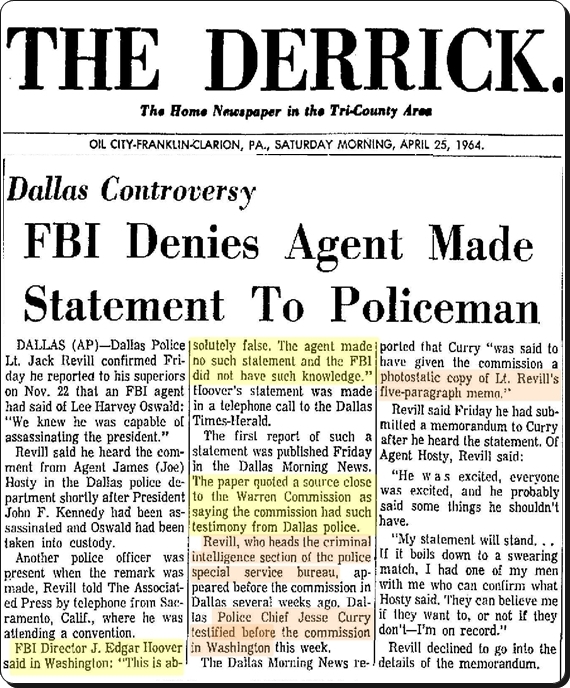
On April 24, 1964, the Dallas Morning News had contained an article concerning a "five-paragraph memo" prepared by Lieutenant Jack Revill, which had been passed along to Chief of Police Jesse Curry. Curry, who had testified before the Warren Commission (WC) during the third week of April, gave the Commission a copy of the memo. Following up on Curry's testimony, the Dallas Morning News quoted "a source close to the Warren Commission" about the evidence presented to the WC, including Revill's memo. The Associated Press called Lt. Revill at a convention in Sacramento, California, and were told that another Dallas policeman could confirm that FBI Agent James (Joe) Hosty had told the local police: 
"We knew he [Oswald] was capable of assassinating the president..."
Jack Revill had first appeared before the Warren Commission on March 31, three weeks before his Chief, but had been questioned only in regard to the shooting of Lee Oswald by Jack Ruby. Apparently the WC questioners were unaware of the Friday afternoon headlines which zeroed in on Oswald and quoted Revill's immediate superior, W. Pat Gannaway, saying that Oswald had been to the Soviet Union and had a Russian wife, even obtaining a 1959 photo of Oswald when he left Fort Worth, later ending up in Moscow.

While the AP contacted Revill in California, the rival paper of the Morning News, the Dallas Times Herald, contacted FBI Director J. Edgar Hoover. He furnished them a most amazing statement:
"This is absolutely false. The agent made no such statement and the FBI did not have such knowledge."
The only thing absolute in this flap was that somebody was lying. Was it a member of the local Dallas police, or was it a member of the FBI?

To discover the truth, Lt. Revill was called back to the WC on May 13 to testify about his conversation with Agent Hosty in the DPD. Revill said he had previously conducted a "systematic search" of the Texas School Book Depository offices (located at 411 Elm) along with numerous other detectives from his office. He went directly from that location to the basement of DPD, where he got out of his car and allowed it to be parked by a staff member. Before he could enter the headquarters building, he testified, Agent Hosty had run up to him, saying:
"Jack, a Communist killed President Kennedy....Lee Oswald killed President Kennedy....He is in our Communist file. We knew he was here in Dallas." 

 Both Gannaway and Revill have been discussed previously at this blog in connection with the framing of Candy Barr for narcotics possession. As undercover narcotics policemen in Dallas, they also knew George W. Owen, a man once married to Maurine Biner, the woman John Dean eventually married shortly after the Watergate break-in in Washington, D.C. Owen was said to have been present at the Murchison home on November 21, 1963, along with LBJ's girlfriend, Madeleine Duncan Brown, and others who overheard LBJ threaten that after the following day Johnson would not have to put up with Kennedy any more. Is it possible Owen's police friends heard about the plan from him and were prepared to release the background on Oswald quickly? Also according to Brown, George Owen had driven to Redbird Airport in Dallas the night of the 21st to meet J. Edgar Hoover's plane and deliver him to the Murchison party. She said Owen was ready to talk when he suddenly dropped dead. Read more on this story at the March 26, 2011 posting, "

George W. Owen, a Friend of LBJ's Mistress."

Sunday, June 19, 2011

Jack Ruby's Money Man

 If you believe, as I do, that all research is really about following the money, it seems quite significant that behind most of Jack Ruby's business enterprises in Dallas was another man whose family were Russian Jewish emigrants who arrived in New York in about 1912. Ralph Paul, son of a fruit peddler in New York City, arrived in Dallas in about 1947 and was always there with money whenever Jack needed it.

Jack Ruby's Personal Lender, Ralph Paul

RALPH PAUL, also known as Raphael Paul, which he advised is his true name, was a white male, said be was born at Kiev,  Russia, December 17, 1899. He attended Public School #109, New York City. Owner, Bull Pen, Arlington, Texas, being sole owner since 1/1/63, and president of the Texas Corp., which owns this drive-in restaurant.

He [Ralph Paul] was a former partner with CHRIS SEYOS [sic] in the Miramar Drive-In, located 1922 Ft. Worth Avenue, Dallas, from April, 1954 to February, 1956, at which time be sold out to CHRIS SEMOS for $15,000 and on which transaction SEMOS still owes him $3,500. Prior to the above business connection, he had owned the Blue Bonnet Bar, located in the Blue Bonnet Hotel, Dallas, being so engaged from November, 1948 to September, 1953, at which time he sold this business to JOE BONDS for $3,000, which amount was never paid by BONDS. They had a verbal agreement. Prior to that, PAUL was part-owner of the Sky Club, located on West Commerce Street, Dallas, being so employed between January 1948 until May l948.
RALPH PAUL said he had come to Dallas on December 27, 1947 from New York City, at which place he was owner of Ralph's Fruit Exchange, 161st Street, between Walton and Girard Streets, Bronx, New York . He was there twenty years. From 1919 to 1927, he was in partnership with his father in Paul's Fruit Exchange, 159th Street, off Amsterdam Avenue in New York City. Prior to 1919, he had worked for his father, SAMUEL PAUL in the retail fruit business in New York City at the above address ....

His father, SAMUEL PAUL, died in 1945. His mother, TILLIE [Loby?] PAUL, resides at 2265 Sedgwick, New York City, telephone Cy 5-1623. His brothers are DAVID PAUL, address unknown but living in the Bronx and operating a parking lot on Brook or Brooking Avenue, and LOUIS PAUL, whose address is unknown but who is employed as a salesman of women's belts. LOUIS formerly operated the Pleasant Finance Co., Inc., 25 Main Street, Lodi, New Jersey, New Jersey license 857. His sister is LEE BERRY, 2565 Sedgwick; her husband is deceased . His aunts are "BUNNY" (LNU) and ETI L. PAUL, widow of RAFAEL PAUL, a paternal uncle. He has a cousin, MACK PAUL, address unknown, employed as a clerk in a grocery store in the Bronx, New York .

Ralph Paul and Chris Semos
The Bull Pen Drive-In Restaurant located at 1936 East Abram, Arlington, Texas, was mentioned in Contract on America: The Mafia Murder of President John F. Kennedy by David E. Scheim. Chris Tom Semos operated a restaurant at 605 Fort Worth Avenue in Dallas, and was mentioned by Dallas MCA (Music Corp. of America) official Howard McElroy, who was contacted by the FBI a week following Kennedy's assassination. Since the Dallas MCA office closed in 1962, the FBI located McElmore (address given as 9033 Wilshire Boulevard Beverly Hills Calif.) in Las Vegas at the Desert Inn. He told them Ralph Paul could be reach through Chris Semos.

Tom Semos & Co. owned the Semos Coffee Shop & Cafe in the Jefferson Hotel (built by Carl Mangold, the "Man Who Visioned Oak Cliff") at 312 S. Houston between Jackson and Wood Streets, just a block or so from Dealey Plaza in which his father Victor H. Semos was a partner. Victor also sold coffee wholesale at 555 W. Commerce. Tom had returned from Europe in 1928 with his Greek bride, Catina, who a year later gave birth to a son, Chris Tom, the man named in the Warren Commission records, whose father, Tom Semos, died in May 1963, leaving Chris Tom the coffee shop and a drive-in restaurant on Fort Worth Avenue. He would later own a Greek restaurant as well.

He had grown up in an exclusive neighborhood at 3114 Cornell Ave. and went to Highland Park High School, so it's easy to see why he would not have wanted people to know he was in any way associated with the likes of Jack Ruby. At the time the FBI interviewed Semos, his address was another exclusive area of Dallas at 1630 Cedar Hill  (north Oak Cliff), and he owned a restaurant at 605 Fort Worth Avenue. He s
aid he knew Jack Ruby through the Sky Club, which was near his restaurant.
OAK CLIFF WILL SEEK LIQUOR SALE
DALLAS — (AP) Oak Cliff wets voted last night to seek a vote during the November general elections on the sale of alcoholic beverages in the dry Oak Cliff section of Dallas. The area went dry in 1956 prohibition vote. Attorney. Art Clifton told about 130 persons at the Sky Club that Oak Cliff was losing $200,000 a month in sales to residents who cross the Trinity River to Dallas to buy alcoholic beverages and other merchandise. The group named restaurant operator Chris Semos to head a committee to raise the $20,000 to $30,000 Clifton said was needed to put over the campaign. More than 9,500 signatures would be needed on petitions for the Dallas County commissioners court to call the election. (August 1960 ).
Semos had very low regard for Ruby, as he revealed to the FBI in this excerpt from a somewhat disingenuous 1964 interrogation:


A card showing he [Ralph Paul] was a member of the Estacado Investment Association, Dallas, which he claimed was a group of about 25 persons who were banded together for the purpose of making investments in the stock market. He was unable to furnish any definite address or names of any of the members except that of a Mr. Smith, who be said was employed as a salesman by the Lone Star Wholesale Grocery, Dallas.

In the billfold was found a duplicate copy showing the issuance of cashiers check #61186 dated February 13, 1963, by First National Bank in Arlington, Arlington, Texas, showing purchaser to be RALPH PAUL, the check being payable to S&R, Inc., in amount 2,200. PAUL identified S&R, Inc. as the Carousel Club, 1312-1/2 Commerce Street, Dallas. He stated that in addition to the above amount loaned to S&R, Inc., he has invested approximately $3,000, owning 50 percent of the stock in the Carousel Club, which is operated by S&R, Inc., a Texas corporation in which JACK RUBY gave to him 50 percent of the club stock in exchange for the approximately $8,200 which PAUL has invested. He declined any knowledge of names of incorporators of S&R, Inc....

RALPH PAUL stated he first became acquainted with JACK RUBY, also known to him as JACK RUBENSTEIN, in 1948 at Dallas, Texas and recounted the following manner in which they first became acquainted. RUBY had introduced himself to PAUL at the Mercantile National Bank, where he, PAUL, was then doing business. This he said was a chance meeting, at which time RUBY asked "Are you connected with the Sky Club" and when PAUL told him he was, RUBY asked if he could come out to see the show and PAUL extended the invitation. RUBY accepted this invitation, saw the show at the Sky Club, and then RUBY invited PAUL to see his show at the Silver Spur night club which was being operated by RUBY.
PAUL accepted this invitation.

Their relationship afterwards continued on a personal basis, each seeing the other often. RUBY sold the Silver Spur in 1956 and continued to operate the Vegas Club, Dallas, and is still owner of that night spot. About 1959 or 1960, JACK RUBY opened the Carousel Club, being a partner with JOE SLATON, a bar business owner in Dallas. SLATON and RUBY had been friends, however in the operation of the Carousel Club business they had disagreed and following this falling out, RUBY came to him (PAUL) and requested a loan of $1,000 with which to carry on the business of the Carousel Club. This was about 1960 or 1961. Since that time, RUBY has continued to ask for loans which were granted by PAUL without security, no note or any evidence of this indebtedness to him, except cancelled checks reflecting the amount of loans made. JACK RUBY has never repaid any money loaned to him and/or the Carousel Club.

PAUL stated he believes JACK RUBY transacts his business with the Bank of Commerce, Dallas, Texas [it was located at Elm and Poydras, not far from Ben Gold's Nardis of Dallas]. RALPH PAUL considers himself as the closest friend of JACK RUBY. Any acquaintances or friends of JACK RUBY he could not recall, advising the man had no close associates or friends except possibly the two following persons who have worked for RUBY: WALLY SYESTON and EARL NORMAN, both comics....

Ralph Paul, Bert Bowman and Austin Cook
Census records show that, before he came to Dallas, the Paul family lived on East 100th Street in Manhattan, and his father peddled his fruit out of a wagon. When he died in 1975, Paul's residence was 2614 Plaza Street in Arlington, but at the time of the JFK assassination in 1963, he was living in the basement of the home of the Bert Bowman family on Copeland Road in Dallas. Bowman and Austin Cook had originally started the Bull Pen drive-in on W. Illinois in 1950 and ran it under that name until 1958. When Bowman dissolved the partnership, he acquired the name as one of the assets of the business and moved it to 1936 East Abram, Arlington, Texas, located a few blocks south of the baseball stadium where George W. Bush's Texas Rangers team later played. Some eight to ten years before the Warren Commission hearings, Bowman had sold this drive-in to Ralph Paul, according to Mrs. Bowman's statement cited at page 42 in HSCA Report, Volume XII.

Strangely enough, the original Bull Pen location at 2321 West Illinois in Dallas (name changed to Austin's Barbecue  in 1958) employed J.D. Tippit two nights a week as a security guard up until his murder in November 1963. Tippit reputedly worked many security jobs. It's difficult to know when he had time to sleep or visit his family.  

 J.D. Tippit's Security Work and the Top 10 Record Shop
According to Bill Drenas' article "J.D. Tippit and the Top Ten Record Shop" in the Dealey Plaza Echo (Part I) Officer Tippit often came into the record shop at 338 W. Jefferson Blvd. while he was on duty to use the telephone. A Tip Top employee said Tippit made a call from there less than ten minutes before he was killed on November 22, 1963, but got no answer after dialing. He then rushed outside to his car and sped away across Jefferson going north on Bishop, shortly before the shooting occurred at about 1:106 p.m. Besides his work at Austin Cook's drive-in restaurant, Tippit also had a security/bouncer job at Ship's Grill at 2100 Fort Worth Avenue and another at the Theater Lounge (a strip joint owned by Barney Weinstein) at 1326 Jackson Street.

In Part II, Drenas states that Tippit had been a policeman for 11 years, patrolling various districts in the Oak Cliff area, and he changes the address of Ship's Grill (a private club) to 2138 Fort Worth Avenue, and he says "on Sunday afternoons J D Tippit worked security as a deterrent to trouble at the Stevens Park Theater, located at the next block at 2007 Fort Worth Avenue." In attempting to confirm earlier reports, Drenas associate, Earl Golz interviewed Bill Anglin, a Tippit colleague, whom he quoted to the effect that Tippit could not have worked at the Theater Lounge because the police code of conduct forbade officers to work off-duty at any location where alcohol was served; in addition he considered himself to be a good enough friend to Tippit to have bee told by him if he worked there. This story was also confirmed by Detective Morris Brumley. Nevertheless, these two sources were contradicted by the Top Ten employee, Cortinas and another unnamed source.

As for Austin's Barbecue, Tippit's employment there was corroborated by numerous sources, none of whom indicated whether or not alcohol was served there, and a person named W.R. 'Dub' Stark who thought Tippit was having an affair with an employee at the barbecue restaurant. Stark, who was owner of the Top Ten Record Shop also said he had seen Lee Oswald with Marina and the children shopping there, and he thought that Oswald and Tippit knew each other. Stark sold the record shop in 1965.


In Part III of the series on the Top Ten Record Shop, Drenas related his discussion with Dub Stark's niece, Wanda Barnard, who told him Stark had bought the shop in the early 50's. When he sold it in 1965, he opened the W. R. Stark Garden Center next door at 336 W. Jefferson. Eventually, he took the record shop back and resold it in the early 1980's. Wanda then relating various stories she had heard from Stark, in order to substantiate what information Stark had relayed to Drenas and Golz.

Saturday, March 26, 2011

George W. Owen, a Friend of LBJ's Mistress

Madeleine Brown has often been criticized for her claim that she first met Lyndon Johnson, the love of her life, at a victory celebration party in Dallas  around the first week of October, approximately three weeks before the official party at the Driskill Hotel in Austin on October 29, 1948. 

Barr McClellan, in his book,
confirms that LBJ was involved in litigation in the court of Judge T. Whitfield Davidson in the Dallas area at about that time frame. In the days when Texas was a one-party (Democrat) state, the November election was a mere formality; the political wrangling took place in the primary and run-off elections. LBJ's opponent in the 1948 Democratic run-off, Coke Stevenson, filed a lawsuit to prevent Johnson's name from appearing on the ballot for the November election. From the documentation below, one can easily infer that Johnson was in Texas for the litigation until he first appeared back at his Congressional desk in Washington, D.C. on October 11, 1948.

 In Blood, Money and Power (at page 94), McClellan writes:
"Johnson had a team of lawyers representing him in federal district court before Judge Whitfield. One was John Cofer, who would become Clark's attorney for all criminal matters. Angry at the order allowing masters to take further evidence, the legal team contacted Abe Fortas, an old friend and later Supreme Court judge, who happened to be at a conference in Dallas. Fortas made an illegal, off-the-record telephone call, to check with his former mentor, Justice Hugo Black of the United States Supreme Court. In that brief conversation, Fortas made certain Black would rule in Johnson's favor."

LBJ's having FDR's old fixer, Tommy the Cork, in his corner of course didn't hurt.

David B. Perry, alleged researcher into the JFK assassination, concluded on his website that the party where Madeleine Brown claimed she met Lyndon Johnson could not have occurred in Dallas three weeks prior to October 29. His logic was faulty, based as it was on the assumption that Coke Stevenson and Dan Moody did not concede defeat until October 12. 

But LBJ knew by September 29, when Justice Black ruled in his favor, and the state court refused to take jurisdiction of the matter, that he had won; he didn't need to wait for Stevenson to tell him it was party time.
The rest of what Dave Perry says is just as easily discounted.  He asks: "Would Johnson actually know in advance that voting problems in Jim Wells County would be called the 'Box 13' scandal and would he really want to celebrate this budding predicament with a gala at the Driskill on the 29th?"
Hell, yes he would. That's what made it even more fun for a man like LBJ, who sought power through secret connections and maneuvers. One of Johnson's lawyers, Donald B. Thomas, had been sent to the Valley by his law partner Ed Clark to take care of just that anticipated situation--and with enough cash to buy as many votes as necessary.

Barr McClellan tells us the initial vote count was accurate, showing that Johnson had lost. Three days after the polls had closed, while votes were still being counted, 
"Thomas added the fraudulent votes Johnson needed to win. Realizing the simple necessity for additional votes, he made up voters and added their names to the poll list and then to the ballot count."   -- Blood, Money and Power, p. 83.

THE CORSICANA (TEXAS) DAILY SUN,
THURSDAY, SEPTEMBER 30, 1948:
Dan Moody, attorney for Coke Stevenson, said at Austin today that Stevenson would appeal to the U. S. Supreme Court in his hot fight against Lyndon Johnson for Democratic nomination to the U.S. Senate. Moody, a former Texas governor, said Stevenson intends to file a motion in the U. S. Supreme Court asking that an unfavorable order by Supreme Court Justice Hugo Black be set aside. Black last Tuesday stayed an injunction issued by Federal Judge T. Whitfield Davidson which had prevented the name of Johnson from going on the general election ballot as the Democratic party nominee. The effect of Black's ruling was to allow Johnson's name to go on the ballot and to halt an Investigation of alleged vote fraud which Judge Davidson had launched in three South Texas counties, Duval, Jim Wells and Zapata. Commenting on Black's ruling, Judge Davidson said in Dallas today:
"The U. S. Supreme Court has altered my opinion, but it hasn't changed my mind."
The little gray-haired jurist said "There is nothing further I can do in the case. I must observe the ruling of a higher court."

... Asked what, if anything, he could do about the findings, the jurist said: "Nothing."

The ruling by Justice Black found that the federal district court had no jurisdiction in the case. Davidson, commenting on this, said that It had been the contention of Johnson's attorneys that the U. S. Senate was the proper place for the election tangle to be unraveled....

"This is not true," said Judge Davidson. "The senate can act in such cases only where there has been a general election. There has not been a general election in this case—only an election to determine a party nominee. No one has yet stood for election to the U. S. senate. Johnson and Stevenson only sought the Democratic party nomination." Therefore, the only thing the senate could do would be to declare, after the general election, that Johnson could not have a seat in the senate and this would not do Stevenson any good....

Johnson yesterday was certified by Secretary of State Paul B. Brown as the Democratic nominee. The State Democratic Convention had certified Johnson as the winner by 87 votes. Stevenson's appeal would be to the full supreme court. It meets next Monday.

Federal commissioners appointed by Davidson were ordered yesterday by the jurist to stop their investigations, just as the hearings were yielding some interesting developments. Out of 10 Jim Wells county ballot boxes opened over the bitter protests of Johnson's attorneys, one was empty. A precinct 13 box containing poll lists and tally sheets for the precinct was missing. It was this Precinct 13 that had occupied a prominent spot in Stevenson's application to Judge Davidson for an injunction, Stevenson had claimed that 200 votes were added to this box after the Aug. 28 second primary. It was his contention that vote frauds in the three counties had deprived him of a constitutional right to be the Democratic nominee.... The Supreme court must first grant permission for filing of the action, before it can pass directly on the mandamus petition. If it rejects the motion, that would have the effect of killing the suit.

Votes had been for sale in South Texas for many years, and Johnson, having worked in that Congressional District for Richard Kleberg, knew how it could be done. All that he needed was cold-blooded attorneys with no principles. He found that in Ed Clark and Donald Thomas. The only mistake they made was in revealing the secret scheme to their law partner, Barr McClellan, who had a sense of ethics and morality. The violence that was so commonplace in the South Texas lifestyle in those days has been further described in "What Can We Learn from Madeleine Duncan Brown?"

Madeleine Brown was relatively old by the time she began telling what she knew about the man she loved, about how he wielded power and had people killed without blinking an eye. Like all of us, her memory would have faded and been supplemented with a little creative writing. However, it's important to verify and document what she told us as much as possible because there are other statements she made that relate to events after Lyndon Johnson left office.

The most significant statement could possibly be about the meeting she described that took place at Murchison's house. Dave Perry says she always said the party took place at the home of Clint Murchison, Sr., but what she actually said is: "I attended a social at Clint Murchison's home. It was my understanding that the event was scheduled as a tribute honoring his long time friend, J. Edgar Hoover, whom Murchison had first met decades earlier through President William Howard Taft..." It is not clear whether those were her words or those of her ghostwriter, but the book does not specify that it was Murchison, Sr., although the description could not have applied to the younger Clint.

This description appears an article styled "Johnson's illegitimate Son":
When asked what time Johnson came in, Madeline said:

Well he came from Houston. It must have been 11:00 o'clock. The party was breaking up at that time. And it shocked everyone that he came in. Of course, I was thrilled to see him. Normally, I knew his agenda when he was in Texas, but that night, I did not know that he was coming. And they all went in to this conference room.
It gets a little bizarre when Madeline says, "He (George Owens) was there socially, and of course, Jack Ruby had brought one of the call girls to the meeting." When asked about the call girl, Madeline said, "Her name was Shirley. I know her, but she doesn't want to talk about this." Maybe, she's married now, and maybe, one day she will also tell her story.
When asked who picked up Nixon, Madeline said, "Nixon was already in town. He came in on Tuesday and met with Lyndon that no one knew anything about. But Lyndon met Nixon in Dallas on Tuesday."
What is most important in my opinion about what she has revealed about that social event is the fact that this man named George W. Owen (whom she calls Owens) was there. 

In a 2001 conversation she had on another occasion--an interview with John Delane Williams and Gary Severson--she revealed more information about Owen:
JDW: Now, the Murchison party. One of the things, I don't know that you ever heard this, but, what is his name, Brown, Walt Brown. One of things he's said is that everything we've heard about the Murchison party has come from you. And no one else  who was at the party has said anything.

MB: Gary Barker has come forth, I think. Galen Ross [sic], are you familiar with his new book?


JDW: Galen Ross?

[Note: This book is by Robert Gaylon Ross, Sr.]


MB: Some of them I'm not familiar with. But George Owens that worked for Clint Murchison. [Note from QJ: Owen worked for Clint JUNIOR, who owned the Cowboys team, not for Clint SENIOR.] He [Owen] passed away not long ago, and I've known George . . . George went to . . . we didn't have the DFW airport back then [1963]. Dallas only had about 450,000 people. He went out to the Bluebird [sic] Airport and George was going on camera to tell the story of what happened. And do you know the day we had that all set up he died suddenly. I mean a bunch of this . . . sometimes I feel bad.


***
GS:  Did you know of any family background of Mac Wallace?

MB: Well, I told him [George Owens?], one of our neighbors is Carl Wallace, and Carl and George Owens, who said he picked up Hoover out here at the airport, were close friends, and if George would have lived long enough, I might have got more information, you know, but this Carl Wallace's father owned the Wallace Plumbing Company here in Dallas, and the Wallace Plumbing Company was in Dealey Plaza that day, I don't know if John had.

GS: That was my next question.

MB:  Well anyway, not too long ago, I talked to Carl. He comes by once in a while with his little dog. And I said "Carl, what happened to your mother and father?" And he said, "My dad killed himself," and I wanted to say, when did he kill himself? and eventually, I want to know, why did he kill himself? Knowing what I know about the story, and the background, Big Time.

GS: Could the plumbing company be Wallace-Beard?

MB: I couldn't tell you.

GS: There is some evidence the truck in Dealey Plaza that day was Wallace and Beard.

***
GS: It's so mind-boggling.

MB: You know, I told you about this neighbor, Carl Wallace. He told me enough that in my mind, I keep thinking, George Owens died instantly, you know. What is the connection, really. Why would a man, a prosperous businessman in Dallas, Texas kill himself? You can't help but wonder.

~~~~~~~~
When Madeleine told us George Owens worked for Murchison, she would have been talking about George Washington Owen, Jr., who went to SMU on a basketball scholarship and later became a scout for the Dallas Cowboys. The team was mostly owned by Clint Murchison, Jr., except for a small percentage owned by Bedford Wynne.

We first meet George Owen through Texas Monthly's prolific writer, Gary Cartwright whose writing actually dates back in Texas journalism before TM magazine was created:
Mad Dog may have been founded in Mexico, and flourished in Austin, but its roots can be traced all the way back to Dallas, 1963, when [Bud] Shrake and Cartwright were noted young sportswriters for The Dallas Morning News who didn't think that sports were the most important thing in the universe. "Our apartment had become a late-night hangout for musicians, strippers, and other nocturnal creatures," Cartwright recalls in "1963: My Most Unforgettable Year," an essay in his recently published collection of articles, Turn Out the Lights: Chronicles of Texas During the 80s and 90s.
"One of our regular drop-bys was George Owen, manager of the University Club, a former SMU basketball player who had dated the fabulous Candy Barr before the Dallas power structure [Pat Gannaway] sent her away on a phony marijuana charge.
Two other regular visitors were Jack Ruby, the cheesy little hood who owned the
Carousel Club, and Jada, an exotic stripper. ... Her act consisted mainly of hunching a tiger skin rug while making wildly orgasmic sounds with her throat."

So George Owen managed the University Club? 

FBI reports reflect the address of George Owen’s University Club to have been 1413-1/2 Commerce, one block on the other side of the Carousel. 


Gary Cartwright also wrote the following article, using George Owen as his confidential source, in 1976:

Taking the wrapper off a Texas legend
by Gary Cartwright   
December 1976

The "Quintessence of Morality"
Juanita Dale Slusher encountered the joy of sex at age five with the aid and comfort of an eighteen-year-old neighbor named Ernest. She remembers that he was gentle, and not at all unpleasant. It wasn’t until she encountered the Dallas police force some years later that Juanita Dale associated sex with guilt.

When she was nine her mother died and her father remarried: Doc Slusher, brick mason and handyman, a whiskey-drinking harmonica player and all-around rowdy, already had five kids, and right away there were four more, then two more after that. With all those Slushers around, you’d think the work would get done, but it never seemed to…. 

At age thirteen and painfully confused, Juanita Dale took her baby-sitting money and grabbed a bus out of Edna, an independent decision that would become socially acceptable, even laudable, to future generations, but an act worse than rebellion in those days: it was the act of a bad girl. For a while she lived with an older sister in Oklahoma City, then a year or so later moved to live with another sister in Dallas. The Dallas sister soon hooked up with a man, and Juanita Dale was on her own…. 

To be technically correct, it was the old Liquor Control Board (LCB) that first discovered the girl who would become Candy Barr. They discovered her posing as an eighteen-year-old cocktail waitress—the minimum legal age. She wouldn’t be eighteen for another four years, but girls from tough backgrounds develop early, or they don’t develop at all. She kept changing jobs, and the LCB kept discovering her. Once they sent her home to Edna, but she caught the next bus back to Dallas…. 

Candy’s first husband, Billy Debbs, was a graduate of Shorty’s academy. Billy was a good lover but a poor student. He went to the pen, got out, then got shot to death. Somewhere in there—she can’t fix the exact time—a pimp
spotted her jitterbugging in a joint called the Round-Up Club and launched Candy’s movie career. She must have been about fifteen when Smart Aleck was filmed. The thousands (perhaps millions) who have seen this American classic will recall that she was a brunette then.  

Smart Aleck was America’s first blue movie, the Deep Throat of its era, only infinitely more erotic and less pretentious. It was just straight old motel room sex; the audience supplied its own sounds….
One of the fringe benefits of being in films was that Candy got invited to all the best stag parties. Several prominent and wealthy Dallas business and professional men, on my oath that their names would not be revealed, recalled a Junior Chamber of Commerce stag where Candy was the star attraction. One auto dealer told me, “She went for two hundred, three hundred, even five hundred bucks. There was a banker who paid five hundred every time he put a hand on Candy.” … 

The Colony was the Stork Club of Dallas, the Cocoanut Grove, the butterfly of the Commerce Street neon patch where Jack Ruby ran the sleazy Carousel and conventioneers intermingled with cops and hustlers and drug merchants.

…Nobody in the Dallas Police Department wanted to talk about a marijuana case from twenty years ago, and Pat Gannaway, who retired a few years ago to join the Texas Criminal Justice Division, wasn’t available for an interview. But I know this: Pat Gannaway spent a lot of man-hours bringing one stripper to justice. The confluence of these two forces—Candy Barr, desecrater of all that is decent, and Pat Gannaway, the terrible swift sword—is surely the quintessence of a morality frozen in time. 

Captain Pat Gannaway was referred to in newspaper accounts of the time as “Mr. Narcotics.” As a lad he had been so eager to join the Dallas Police Department that he lied about his age. For twelve years, until he was kicked upstairs (he was put in charge of rearranging the Property Room) in the 1968 department shake-up, he ran the special services bureau as his private fiefdom. He reported only to the chief. “His passion,” reporter James Ewell wrote in the Dallas Morning News on the occasion of Gannaway’s retirement, “was police work, down on the streets with his men.” 

He loved the Army, too. He served in Army intelligence and was an expert wiretapper. When he wasn’t swooping down on the vermin that afflicted his city, Gannaway and his entire force were making speeches to civic clubs, warning of the peril. Those recent 1000-year sentences that made Dallas juries such a novelty may have been the direct result of Pat Gannaway’s tireless crusade. Gannaway told James Ewell: “It was always a good feeling to see someone on those juries you recalled being at one of those talks. We always told our audiences if you got rid of an addict or pusher, you were also getting rid of a burglar, a thief, or a robber.”

In the autumn of 1957 Gannaway assigned Red Souter (now an assistant chief) and another of his agents, Harvey Totten (now retired), to rent an apartment near Candy Barr’s apartment and establish surveillance. A telephone repairman would testify later that he discovered a “jumper tie-up” connecting Candy’s telephone to the telephone in the apartment occupied by Souter and Totten, but the jury either ignored this or didn’t believe it. A few days after the surveillance began, Candy received a visit from a friend, a stripper named Helen Kay Smith, who laid out a story about her mother coming to visit and asked Candy Barr to hide her stash — the Alka-Seltzer bottle of marijuana. Candy agreed and slipped the bottle inside her bra, next to her big heart. 

Two hours later, as Candy was talking on the telephone to a gentleman friend (and therefore obviously at home, in case anyone with a search warrant wanted to drop in), there was a knock at the door. Candy’s defense attorneys claimed the search warrant was a blank that Gannaway filled in after the arrest, but the court didn’t buy that either.

So it appears from this article of Gary Cartright's that George W. Owen ("Candy's gentleman friend, who asked to not be identified") owed a big-time debt to both Revill and Gannaway--two vice detectives on the scene on November 22, 1963 in Dallas!

The Cartwright article continues:

I had heard from good sources that the reason that Cohen got rid of Candy was she was giving him a bad press. The vast majority of those agents were interested in Mickey Cohen, not his girl friend. Word came down from “the Eastern organization” that if Cohen didn’t drop Candy, they would. Somewhere between Catalina Island and Hawaii….