Sunday, November 30, 2025

Bernard Barker Deadend

Tying Up a Loose End 

My research into the ancestry and background of the Rebozo family was done in order to get a picture of where Bebe grew up in Florida and what kind of work his family members did; details were inserted into The Great Heroin Coup - Chapter 16  as editor's notes. One item which piqued my interest was the fact that Rebozo's older sister had married a man named Barker when Bebe was a child. My first thought was whether he may have been a relative of the Bernard Leon Barker, Jr. from Cuba whom E. Howard Hunt befriended in Coconut Grove years later. I researched both Barker families' ancestries and discovered, however, that  there was absolutely no connection between Bebe's Uncle Harold and the Bernard Barker family.

Flamingo at top left.

Harold Barker, Jr. and his mother the former Margaret Rebozo, in 1951 lived in Miami Beach on SW 21st Street, and she was a secretary at the Chase Federal Savings, which, like many of Miami's other first buildings, was designed by Carl Fisher's main architect, August (Gus) Geiger. Charles L. Clements had been a Miami banker associated with founder, Frank A. Chase, who lived at 5787 Bay Road, across the street from what would eventually become the La Gorce Golf Club. "Fisher’s ocean-front residence was the first edifice erected on Lincoln Road in 1915. It was followed in quick succession by his office on the corner of Lincoln and Washington in 1917, and by his star attraction, the Lincoln Hotel." Lincoln Road was where Chase Federal Savings was built near the Drexel intersection.  

Miami Beach grew quickly and was incorporated as a separate town in 1915 and as a city in 1917. Then Prohibition became law of the land in 1919, and revelers found Cuba to be a friendlier alternative. The crash of the real estate boom in 1926 not only brought bankruptcy to Fisher, but it brought Al Capone from Chicago in 1928 to oversee his bootlegging empire out of his mansion on Palm Island.  Carl Fisher had developed Miami and built the Flamingo Hotel in 1920.

Margaret Rebozo's father-in-law, Leon O. Barker, was a stone mason who moved to Miami from Michigan around 1907 and lived in the original part of Miami.

The Watergate burglar Barker's father, Bernard Sr., was born in Columbia, TN in 1890 to Jacob and Jeanette (Gundersheimer) Barker, the Russian-born son (or perhaps grandson) of an American shipowner for whom he was named, who supplied oil from Russia to American lighthouses in the early 1800s. In 1885 Jacob, who was in the coal business, married Jeannette, a girl of German descent, who had been born in Florida and as a teenager moved with her family to New Orleans. Bernard Sr. was born in Cuba in 1890 and there he married Alicia or Alice with whom he had two children in Cuba. 

He and Alice returned to Cuba in 1917 on an American passport to manage the Cuban Coal Co. In 1940 he traveled from Cuba to Florida with the entire family, including his second wife, Rosa Cobos Barker and his son Bernard Jr. By this time he gave his occupation as "contractor;" their names were listed on the alien manifest, which gave their address in the U.S. in care of Standard Dredging Co. at 80 Broad Street, New York. Their closest relative was her mother in Cuba, Mercedes Becerra at 20 Santa Catalina in Marianao. 

Standard Dredging had a contract "between July 1941 and January 1943 dredging of the seaplane landing and takeoff area" for the U.S. Naval Air Station in Key West, a seaplane base established by law in mid-December 1940. The Barkers may have been anticipating that project when Bernard Barker Sr. brought his family from Cuba to Key West in August of that year. The Standard Dredging Co. would still be working in Florida in 1956. The sole building contractor from June 1941 to July 1943, however, was Mackle Leach Construction Co. of Miami, but Standard Dredging company had a separate contract for the seaplane portion of the station. The Miami directory for 1942 shows the Mackle Co. address was 2818 SW 22nd Street (in or near Coconut Grove), while the three Mackle brothers each had a residence in Coral Gables, about three miles from their office.

The Mackle family came to Florida in 1908, and in Jacksonville Francis Elliott Mackle started a construction company, the Southern Erecting Company, but remained only three years. They lived in Atlanta for ten years, followed by numerous moves until settling in Florida permanently in 1938. The father died in 1941 after building a home in Coral Gables. He had just negotiated a contract to build 200 homes at Opa Locka for the men who would be stationed at the new naval air station.

In 1958 the Mackles merged their construction company with General Development Corp., controlled by Lou Chesler. Chesler's company had previously been known as Florida Canada, and before that Alan-H Investments, Ltd. of Toronto. 

In 1960 a lawsuit involving the allegedly defunct Ridgeway Corporation was decided in Delaware in which Chesler and two corporations (Florida Canada Corporation and Yellow-knife Bear Mines, Limited) were defendants. One of the plaintiffs was J.H. Buchanan Chesler and Maxwell Goldhar, his associate, were also involved in litigation that began when they were sued in Delaware by plaintiffs, who were stockholders of P. R. M., Inc., also known as Associated Artists Production Corp.   

The men had acquired a 1920 company, founded as American Bushings Corporation (name later changed to Pressed Metals of America, Inc.) in 1956 and adopted the name Associated Artists Productions Corp. to engage in the principal business of owning and managing libraries of motion picture films produced by Warner Brothers. Also included in the corporation's film library were a number of 'Popeye' cartoons produced by Paramount. The two men owned 41% of the stock of Associated Artists, whose assets were bought by United Artists Corporation under very unusual and complicated terms.

Chesler and Maxwell Goldhar, his associate, were also involved in litigation that began when they were sued in Delaware by plaintiffs, who were stockholders of P. R. M., Inc., also known as Associated Artists Production Corp. The men had acquired a 1920 company, founded as American Bushings Corporation (name later changed to Pressed Metals of America, Inc.) in 1956 and adopted the name Associated Artists Productions Corp. to engage in the principal business of owning and managing libraries of motion picture films produced by Warner Brothers. 
 
Also included in the corporation's film library were a number of 'Popeye' cartoons produced by Paramount. The two men owned 41% of the stock of Associated Artists, whose assets were bought by United Artists Corporation under very unusual and complicated terms.

Who Was Chesler?

A blog article called "An Informal History of the Grand Bahama Port Authority, 1955-1985" tells us: 

Louis A. Chesler, born in Belleville, Ontario in 1913, made his first million through Canadian mining stocks such as Loredo Uranium Mines between 1942 and 1946, before shifting his base of operations to Miami, Florida. Using the same sort of “corporate shell” financial shenanigans that had brought Wallace Groves low, he parlayed his way to control of several corporations. The General Development Company, for example, was involved in the infamous “Florida land deals” of the time, but it also constructed actual developments at Port Charlotte, Port Malabar, and Port St. Lucie, and was perhaps a model for what was to follow in Grand Bahama. However, it was the theatrical corporation that Chesler controlled, Seven Arts, that would play the primary role in the history of Freeport.
By the time Chesler was moving from Florida to deals in the Bahamas, both areas were the focus of the Central Intelligence Agency, which was much more concerned with communism (i.e., anti-capitalism) than it was with the dangers of organized crime. Meyer Lansky had lost his control of his Cuban casinos when Fidel Castro took them over, and he sought to move his gambling operations to the Bahamas with help from Chesler and possibly the CIA itself. During the Bay of Pigs operation planning, the CIA's JMWAVE headquarters was based in Coral Gables. Its office cover name was Clarence A. Depew.

Coral Gables 

Land development south of Miami is a fascinating subject involving the master craftsman George E. Merrick, who had hired two scam artists with intriguing connections to the Canadian mafia, as we mentioned previously:

Newkirk gave a brief biography of his life up to 1960, revealing that he was enticed into Coral Gables real estate sales by a man he met in Jacksonville--Telfair Knight--and says he went with Knight to work at George Merrick's Coral Gables development just outside Miami as early as 1921.
According to Arva Moore Parks' excellent book, George Merrick's Coral Gables: Where Your 'castles in Spain' are Made Real, Merrick began his real estate career at Realty Securities Corp. and then set out to develop land surrounding the family plantation into a Spanish village. Assisted at first by his mother's relatives, the Finks, Merrick used visionary vistas of Spanish residential scenes painted by his uncle, Denman Fink to attract buyers to Coral Gables. 

The landscaping and homes would be designed by architects Frank Button and H. George Fink, a cousin. The real sales campaign got into gear in 1921, and a year later he employed at least a hundred salesmen to sell the properties, as well as more architects to design the homes. Merrick had lived with his uncle Denman for a times in New Jersey, where he was an illustrator of stories published by Harper's magazine in 1913 and worked on propaganda campaigns for the U.S. government during WWI. His art was also selected in 1920 by the Interchurch World Movement, sponsored by John D. Rockefeller, Jr. 

In the middle of the plans for his development of Coral Gables, Merrick married Eunice Peacock, daughter of the owner of Peacock Inn in Coconut (or Cocoanut) Grove, a hotel which overlooked Biscayne Bay and touted itself to be "the most southerly hotel" on the U.S. mainland. They were, in fact, among the first residents of Coconut Grove:
A pioneer was "Jolly Jack" Peacock, an Englishman who settled in the south part of the Grove. He persuaded his brother Charles, then owner of a wholesale meat business in London, to join him. Charles Peacock, his wife Isabella and their three sons eventually settled in Coconut Grove and in 1882 opened the Bay View House, later called the Peacock Inn, the first hotel in the area.

Other original settlers of that area included the Trapp and Rhodes families, whose history is set out in a Report relating to the designation of the Trapp House located at 2521 S. Bayshore Drive as an historic site, giving us insight into how Merrick began acquiring land to the east of his father's fruit and vegetable farm, which was to become Coral Gables. 

Another pioneer in the area was Ralph Middleton Munroe, whose property is also a designated historic site. The question is how Bebe Rebozo began to get his hands onto the keys outside the mainland, and whether there are links back to the developers who worked with Merrick decades earlier.

As George Merrick became a large-scale developer, he needed more and more cash flow coming in to pay for the elaborate landscaping, infrastructure and attractions. One of those attractions was a "flying circus" show put on by an aviatrix named Mabel Cody.

We traced Maude Cody Fowler, who claimed a connection to Buffalo Bill Cody, to Jacksonville, Florida in 1913. As we explored the history of Florida's development, it took us back to oil baron Henry Flagler:

In the late 1890's Flagler [after building several hotels and a huge mansion for himself in Palm Beach] decided to keep going farther south to Miami. The mansion built for Mary Lily Kenan Flagler was completed in Palm Beach a year after their marriage.  By then Flagler envisioned more wealth through Cuba and Panama, former Spanish possessions acquired as a result of the Spanish American War which ended in 1898.
Henry Flagler's death in 1913 ended his contribution to Florida's land boom, but there were many others to take over his dream of making millions out of the shoreline leading to Florida's southern tip.

Mary Lily's father,  William Rand Kenan worked at the port in Wilmington, N.C. as an insurance agent and, like Paul Helliwell's father, a customs collector. Her brother, a student in Chapel Hill, was later employed by Union Carbide. Flagler hired William Rand Kenan, Jr. in 1899 as a consultant for all his Florida enterprises--including Miami Power and Water Company (later Florida Power and Light), and Flagler's will appointed him a trustee of his estate. 
 
Kenan soon became president of the Florida East Coast Railroad, Florida East Coast Hotel Company, Florida East Coast Car Ferry Company, Model Land Company, Miami Power and Water Company, West Palm Beach Water Company, and P. and O. (Peninsular and Occidental) Steamship Company.

Flagler's fortune was valued at between $60 and $100 million, and, within two years of his death, his widow married Robert Worth Bingham--on November 15, 1916. Ferdinand Lundberg wrote in The Rich and the Super-Rich, p. 143:
In 1968 the president of the Peninsular and Occidental Steamship Company was William Rand Kenan, Jr., the son of a founder of the Union Carbide Company. He was also president of the Florida East Coast Railway, Hotel and Car Ferry Companies, Perrine Grant Land Co., Florida Power and Light Company and numerous others, in addition to being chairman of the board of the Niagara County National Bank and Trust.


Sunday, November 16, 2025

JEFFREY EPSTEIN ESTATE Court Cases

Lisa Doe versus Darren K. Indyke and Richard D. Kahn, Coexecutors of Epstein Estate 
  • NES, LLC, 
  • Financial Trust Company, Inc. (FTC), 
  •  Darren K. Indyke and Richard D. Kahn, HBRK Associates, Inc. 

 ****************

Reuters  "Two of Jeffrey Epstein's close advisers can face victims' claims"
By Jonathan Stempel
August 5, 2024

U.S. District Judge Arun Subramanian in Manhattan rejected arguments by Epstein's former personal lawyer Darren Indyke and former accountant Richard Kahn that victims cannot pursue a class action because many agreed not to sue after settling claims against Epstein's estate.

"... Indyke's lawyer Daniel Weiner said they "emphatically reject" accusations they knew about or were complicit in Epstein's wrongdoing."

"Victims said Indyke and Kahn helped Epstein create a complex web of corporations and bank accounts that let him hide his abuses and pay victims and recruiters, while leaving them "richly compensated" for their work.
McCawley and another lawyer for the victims, David Boies, helped obtain $365 million of settlements with JPMorgan Chase (JPM.N)
, opens new tab and Deutsche Bank (DBKGn.DE), opens new tab after accusing them of missing red flags about Epstein, once a lucrative client.

*************** 

Business Insider, Feb 11, 2021,
"The executors of Jeffrey Epstein's Virgin Islands estate forced 3 of his accusers to marry to keep them under his control, prosecutors say"
By Jacob Shamsian  

Indyke and Kahn had "direct participation in virtually all of the business operations and financial activities" of what they describe as a sex-trafficking scheme run by the now-dead financier, prosecutors said in a new court filing.

"Indyke and Kahn were, in short, the indispensable captains of Epstein's criminal enterprise, roles for which they were richly rewarded," prosecutors wrote.

According to the filing, Indyke and Kahn helped lure young girls — some as young as 13 years old — into the sex trafficking scheme "with promises to help them and their families pay for school, health care, or other financial needs." 

 ****************


Second Amended Complaint (Marked Up) (Redacted) Virgin Islands vs Epstein estate 

DARREN K. INDYKE, in his individual capacity and as the EXECUTOR FOR THE ESTATE OF JEFFREY E. EPSTEIN and ADMINISTRATOR OF THE 1953 TRUST 

 RICHARD D. KAHN, in his individual capacity and n his capacity as the EXECUTOR FOR THE ESTATE OF JEFFREY E. EPSTEIN, and ADMINISTRATOR OF THE 1953 TRUST ESTATE OF JEFFREY E. EPSTEIN; THE 1953 TRUST; PLAN D, LLC; GREAT ST. JIM, LLC;NAUTILUS, INC.; HYPERION AIR, LLC; POPLAR,Inc.; SOUTHERN TRUST COMPANY, INC.;CYPRESS, INC.; MAPLE, INC.; LAUREL, INC.;AND JOHN AND JANE DOES

12.  Defendants reported the "value of the real and personal property in The Estate located in the Virgin Islands at $577,672,654.00 dollars."...

13. Assets included:  a. $56.5 million in cash;b. $127 million in fixed income and equity investments;c. $195 million in hedge fund and private equity investments; andd. $18.5 million in planes, boats, and automobiles....

14. The Estate also included shares of various corporate entities which hold residences and real property used by Epstein, namely:a. Brownstone in New York City valued at $56 million;b. Ranch in New Mexico valued at $72 million;  c. Gated home in Palm Beach, Florida, valued at $12 million;d. Seven units in an apartment building in Paris, valued at $8 million; and e. Great St. James and Little St. James, collectively valued at $86 million....

17. Defendant The 1953 Trust (“("The Trust”)") was created by Epstein, who“"amended and restated”" its terms only two days before his suicide. That same day, Epstein revised his Last Will and Testament, transferring all of his “"property, real and personal,wherever situated”" to The Trust. The Trust also contains Epstein’s Epstein's financial assets and is also responsible to pay damages for the acts committed by Epstein and the Epstein Enterprise described below. Defendants Indyke and Kahn, filed a Certificate of Trust in the Superior Court of the Virgin Islands for The Trust on August 26, 2019. ...

22. Defendant, Nautilus, Inc., is a corporation established and organized under thelaws of the Virgin Islands. It was incorporated on November 22, 2011. 

23. According to records of the Virgin Islands Recorder of Deeds, Nautilus, Inc. owns Little St. James,    a/k/a Parcel Number 109803010100, a parcel of 3.1 million square feet valued at $3.2 million, with buildings and improvements valued at $4 million. 

24. Epstein was president and director of Nautilus, Inc., which corporate filings describe as “"holding property for personal use.”." Defendants Indyke and Kahn are the secretary and treasurer of Nautilus, Inc., respectively. The Estate values Epstein’s Epstein's holdings of Nautilus, Inc., which holds title to Little St. James at $63.9 million.23.25. A deed recorded with the Virgin Islands Recorder of Deeds on December 30, 2011 reflects that the property was transferred from a Delaware entity, L.S.J.,  LLC, to Nautilus,Inc. for “"TEN DOLLARS ($10.00) and other good and valuable consideration.”." The quitclaim deed lists Jeffrey Epstein as the sole member of L.S.J., LLC, which it acquired Little Saint James via a warranty deed dated April 27, 1998 .

28. Defendant, Great St. Jim, LLC, is a limited liability company established and organized under the laws of the Virgin Islands. Great St. Jim, LLC was organized on October 26, 2015. Great St. Jim, LLC, according to records of the Virgin Islands Recorder of Deeds, owns at least three properties that make up Great St. James acquired on January 28, 2016: Parcel Number109801010100, consisting of 3.5 million square feet and valued at $17.5 million; Parcel Number109801010200, consisting of 450,000 square feet of land, valued at $2.8 million; and Parcel Number 109801010300, 1.2 million square feet of land, valued at $2.7 million. According to a warranty deed filed with the Virgin Islands Recorder of Deeds, Epstein, through Great St. Jim, LLC, acquired the last two parcels for $5 million each.. 

Epstein is listed as manager and a member of Great St. Jim, LLC and the nature of its business is described as “"holding assets.” 

30. Defendant, Poplar, Inc., is a corporation established and organized under the laws of the Virgin Islands. Poplar, Inc. was incorporated on November 22, 2011. Epstein was GVI’s  president and director of Poplar, Inc., and its purpose was described in corporate filings as“"holding property for personal use.” ." Defendants Indyke and Kahn are secretary and treasurer of Poplar, Inc., respectively....

33. ...Epstein's pilot, Larry Visoski, was listed as Plan D, ...

34. Upon information and belief, Plan D, LLC owns one or more of the airplanes and helicopters that Epstein used to transport young women and children to and from the Virgin Islands to carry out the criminal pattern of activity described below. Among the airplanes owned by Plan D, LLC is a Gulfstream with N-number N212JE. Flight logs and travel notices indicate that Epstein used this plane to traffic and transport and young women and underage girls to the Virgin Islands .

        The Gulfstream was listed for sale in 2020 

35. Defendant, Hyperion Air, LLC is a limited liability company established and organized under the laws of the Virgin Islands on October 19, 2012. Jeffrey Epstein is a manager/member of Hyperion Air, LLC, along with his pilot, Larry Visoski. The purpose of Hyperion Air, LLC is listed in its Annual Report as “"holding assets.” ."

36. Hyperion Air, LLC is the registered owner of a Bell helicopter with N-numberN331JE and a Keystone helicopter with N-number N722JE. Upon information and belief, Epstein used these helicopters to transport young women and underage girls between St. Thomas and Little St. James.

37. Defendant Southern Trust Company, Inc. was originally incorporated in the Virgin Islands on November 18, 2011 as Financial Informatics, Inc., but changed its name to Southern Trust Company in September 2012. Southern Trust Company is a tenant at American Yacht Harbor in Red Hook, St. Thomas, and Epstein is a “"passive investor”" in IGY-AYH, d/b/a American Yacht Harbor. By the end of 2013, according to its corporate filings, Southern Trust Company has assets of $198.5 million; four years later, its assets reached $391.3 million. From 2011 until at least 2018, Jeffrey Epstein was the President/Director of Southern Trust Company, and Defendants Kahn and Indyke were Treasurer/Director and Secretary/Director, respectively.Epstein was the sole owner of Southern Trust Company.

38. Defendant Cypress, Inc. is a Virgin Islands corporation that was formed and firstlicensed in or about November 2011. As of December 31, 2018, Epstein was listed asPresident/Director and Defendants and Co-Executors Indyke and Kahn were listed, respectively,as Vice President/Secretary/Director and Treasurer/Director of Cypress, Inc. Cypress, Inc. owns the property 49 Zorro Ranch Road in Stanley, New Mexico, which was transferred to it in or about December 2011, shortly after it was incorporated. 

39. Defendant Maple, Inc. is a Virgin Islands corporation that was formed and first licensed in or about November 2011. As of December 31, 2018, Epstein was listed as President/Director and Defendants and Co-Executors Indyke and Kahn were listed, respectively, as Vice President/Secretary/Director and Treasurer/Director of Maple, Inc. Maple, Inc. owns the property 9 East 71st Street in New York, New York, which was transferred to it on or about December 23, 2011, shortly after it was incorporated.40. Defendant Laurel, Inc. is a Virgin Islands corporation that was formed and first licensed in or about November 2011. As of December 31, 2018, Epstein was listed as President/Director and Defendants and Co-Executors Indyke and Kahn were listed, respectively, as Vice President/Secretary/Director and Treasurer/Director of Laurel, Inc. Laurel, Inc. owns the property 358 Brillo Way in Palm Beach, Florida, which was transferred to it in or about December 2011, shortly after it was formed. ...

 61. Another victim was flown by Epstein and his associates to New York or Palm Beach and then to the Virgin Islands dozens of times from 2004, when she was age 20, to 2017.She was repeatedly abused by Epstein and also was pressed to have sex with Epstein’s business colleagues.

62. During the latter part of this period, she was forced into an arranged marriage to another victim that was facilitated by Defendant/Co-Executor Indyke to prevent the other victim from being deported. Indyke and a New York immigration lawyer retained by Epstein prepared the victim for communications with U.S. immigration officials almost immediately after the wedding. Defendant/Co-Executor Kahn provided a letter of reference for the immigration proceeding. When the victim inquired about ending the marriage and leaving Epstein’s circle, Indyke repeatedly tried to talk her out of a divorce and threatened that she would lose Epstein’s and his associates’ protection.

63. The Epstein Enterprise forced at least three separate arranged marriages, in each case requiring American female victims to marry foreign victims to avoid their deportation. The victims were coerced into to participating in these arranged marriages, and understood that there would be consequences, including serious reputational and bodily harm, if they refused to enter a marriage or attempted to end it. In each instance, Indyke and Kahn knowingly facilitated the fraudulent and coerced marriages, performing and securing the legal and accounting work involved and enabling a fraud that would further bind Epstein’s victims to him and enable Epstein to continue to control and abuse these victims sexually....

B. The “Epstein Enterprise”Defendants and Co-Executors Indyke and Kahn were Instrumental to the Epstein Enterprise’s Human Trafficking and Financial Fraud.

76. Defendants Kahn and Indyke organized, controlled, and directed almost every aspect of the Epstein Enterprise. They were officers in virtually every corporate entity that Epstein created to fund and conceal his activities. They were deeply involved in the financial activities of the Epstein-owned entities, including those of Defendant Southern Trust Company, which made clear that Southern Trust did not provide the services described to the Government as the basis for tax incentives that allowed Epstein to fraudulently obtain more than $80 million from the Government. 

77. Defendants Indyke and Kahn also directed, approved, enabled, and justified millions of dollars in payments that fueled the Epstein Enterprise’s sex trafficking, including payments to women who were forced to have sex with Epstein and/or recruited others to be victimized. Defendants Indyke and Kahn obtained large and frequent stocks of cash for Epstein which, based on public knowledge, would have funded Epstein’s cash payments for“massages”—code for forced sex.

78. Defendants Indyke and Kahn participated with Epstein in coercing his sex trafficking victims, in at least three cases, to enter into arranged and forced marriages in order to obtain immigration status for the foreign women so that they could continue to be available to Epstein for his abuse – a doubly-deep assault on their will and dignity. Defendant Kahn provided a letter of reference for at least one immigration application and tax services to the spouses, and Defendant Indyke paid the immigration lawyer who applied for citizenship for the women and threatened at least one who indicated that she would seek a divorce. They used their professional skills and authority to carry out this abhorrent scheme.

79. Indyke and Kahn were, in short, the indispensable captains of Epstein’s criminal enterprise, roles for which they were richly rewarded.

80. Defendants Kahn and Indyke controlled and directed the activities of the other entities and personal bank accounts of Epstein accounts after they were funded. One, and frequently both, of them were officers or directors of Butterfly Trust; of companies holding Epstein’s real property (as laid out below); and of .;; FT Real Estate Inc.; Gratitude America, Inc.; ; J. Epstein Virgin Islands Foundation, Inc.; Jeepers, Inc.; Mort, Inc.; Nautilus, Inc.; and Zorro Development Corporation; among others .


Saturday, May 28, 2022

The Uvalde Connection to JFK Assassination

Back in 2015 (already seven years ago), I was following up for my own interest what I'd learned about Red Bird Airport in Dallas from Daniel Hopsicker's book, Barry and 'the Boys'. So much has happened since that time. I've gotten a lot older for one thing. 

Events keep happening that remind me of work I did that I never finished. The Uvalde Shooting was the recent event that reminded me of a project I started in 2015 and never finished. Here it is.

Dan Rather Got His Start in Uvalde

John Nance Garner

Our last post, which began with Dallas' Red Bird Airport, ended with the intimation that former U.S. Speaker of the House and Vice President John Nance "Cactus Jack" Garner had unseen political power that might be worth researching. As it turns out, the prickly politician also had a strange connection to the assassination of John Kennedy. He was the last person to talk to the President by telephone the morning of the assassination, made by the President at 10:15 a.m. from his Fort Worth hotel following an outdoor breakfast reception held in the rain. 

In 1988 People Magazine's coverage on the anniversary of the assassination included this paragraph:

An eager young television correspondent, Dan Rather, 32, is CBS News bureau chief in New Orleans. He has been assigned to set up the network's coverage of the President's visit to Texas, and after working through the night, he had been given an urgent, unrelated request. The CBS Evening News, with its anchorman, Walter Cronkite, has recently been expanded from 15 minutes to a half hour, and the editors were concerned about not having enough material to fill out the broadcast. At the last minute they called Rather and asked him to cover John Garner's birthday.
A Young Dan Rather
After flying at first light from Dallas to Garner's ranch in a small charter plane, Rather and his cameramen filmed an interview as Garner came out on his porch to greet Miss West Texas Wool and have his picture taken with her. As Rather looked on, the elder statesman, holding a glass of bourbon in one hand, reached over to pat Miss West Texas Wool on the backside with the other. Now, back in Dallas, Rather smiles as he remembers the scene.


Miss West Texas Wool for 1963-64 was Peggye Nan McNair, then a young college student at Midwestern University in Wichita Falls. Garner's 95th birthday was the reason Dan Rather gave for his being on the scene in Dallas on that same fateful day--although his autobiography referred to it as his 98th birthday. But we didn't get a chance to interview that year's Miss Wool about whether she remembered Dan Rather being at the birthday party. Her death was reported in January 2015 after she and a colleague were trampled to death by camels.

Rather's book relates that he had set up a new CBS southwestern bureau in Dallas the previous year, and had only recently been reassigned to organize the southern bureau chief in New Orleans (which eventually replaced both the Dallas and Atlanta offices). Having moved his family only that month to Louisiana, Rather would not have made a trip to Dallas, but for the request to fly out to Uvalde that morning to film Garner's birthday celebration, complete with the nineteen-year-old beauty queen. According to Rather (and Hershowitz):

Miss Texas Wool was waiting on the veranda when Garner made his appearance shortly after breakfast. He had a shot of bourbon in one hand and he tried to pat Miss Texas Wool on the fanny with the other, as only Cactus Jack could do. And that was how I happened to be in Dallas at midmorning, delivering an interview we had filmed on the occasion of a former Vice-President's ninety-eighth [sic] birthday, the morning of the day that John F. Kennedy would be murdered. [ The Camera Never Blinks (1976), p. 113]

Louis Baldwin, author of Turning Points: Pivotal Moments in the Careers of 83 Famous Figures, at page 167, repeated Rather's error, while also making a few more, in attempting to explain how Rather happened to be in Dealy Plaza and to be the first reporter to announce that JFK was indeed dead.

Baldwin made the mistaken assumption that Rather visited Garner in Dallas, where President Kennedy "was scheduled to visit during his brief stay in Dallas." [Baldwin, Turning Points, page 167.] The actual distance by interstate highway, which was not complete in 1963, is just over 360 miles. Rather stated in his book that he flew to Uvalde. He doesn't say from where, only that his planning work had been done from New Orleans--about 650 miles from Garner's ranch--and that the only reason he ended up in Dallas that day was to drop off the film from the Garner interview. He added that he was not assigned to cover the events as a reporter, but only as an editor of the film drops. Nevertheless, the weekend coverage was replete with the face of Dan Rather. David Von Pein, lone-nut advocate, can be commended, if not for his erroneous conclusions, for at least posting the KRLD radio and television coverage of that day at his You Tube channel.

According to CBS News and JFK Transcripts, Dan Rather did at least mention Garner's birthday in passing, as he reported:
Dan Rather:  The body is now now on route by plane to Washington. Also on route to Washington is the 36th President of the United States Lyndon Baines Johnson. It was quite a crowd at the Parkland Hospital about this time when the President’s body was taken away, but most of the crowd was away from that particular section of the hospital.

Earlier today down in Uvalde, Texas Former Vice President John Nance Garner celebrated his 95th birthday. Mr. Garner refused to grant any interview as such but in the course of a conversation with reporters this was some two hours before President Kennedy was shot and killed in Dallas. Former Vice President under Franklin Roosevelt John Nance Garner said he felt that President Kennedy might become one of the great Presidents of this country. Former Vice President Garner a long time friend of Lyndon Johnson. [President Kennedy called him with birthday wishes, from Fort Worth at 10:15.]
Midlothian Mirror owner, Penn Jones, Jr., who reviewed Rather's book, stated:
Rather reports he went to Uvalde, Texas for an after-breakfast meeting with former Vice President John Nance Garner at his home there, but he doesn't mention the distances involved. He does not bother to tell his readers it was a six hundred mile round trip and that he was back in Dallas before the President's parade. That kind of timing would have required a jet, we think. Whose jet, Rather didn't say.

 But for That Uvalde Interview...

After his reporting on Hurricane Carla in 1961, Rather was hired for a six-months "trial initiation" in New York City, beginning around March 1, 1962. The result was he was that at the end of that trial he was sent to Dallas as CBS Southwest Bureau Chief. One year later he was promoted to head the Southern Bureau in New Orleans. Yet he returned from New Orleans to Dallas to report on the President's visit there in late November of 1963. Why?

We have to wonder who at CBS assigned him to go to Uvalde to interview Cactus Jack Nance. Who wanted that filmed interview delivered to Dallas? Why, if his job finished was after delivering the film, did he have a film crew available when he accidentally witnessed the assassination?
 
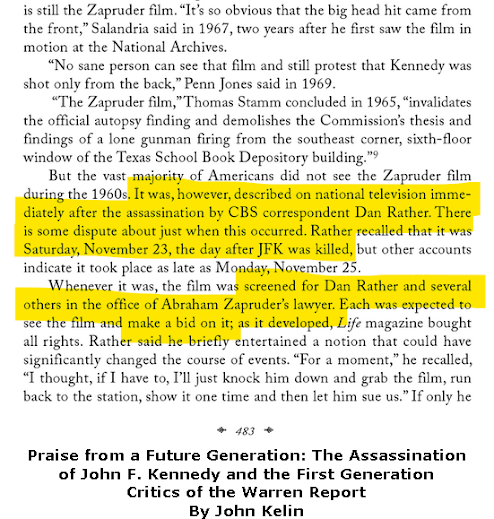
On the day of President Kennedy's funeral (Monday, November 25), Walter Cronkite, another Houston-bred newsman, allowed his younger colleague, Dan Rather, to report live in a halting fashion, referring repeatedly to notes, about his viewing of a film taken by Abraham Zapruder, though the cameraman was not named. 
 
Rather stated: "We have just returned from seeing a complete motion picture of the moments preceding, and the moments of, President Kennedy's assassination and the shooting of Texas Governor John Connally." He did not say who "we" was, nor did he say how he came to be invited to view the "motion picture," and by whom. At that time there clearly was, even while the nation was grieving, a bidding war going on for the rights to the pictures, both moving and still.


The Sixth Floor Museum's website once contained a timeline of events (see William Kelly post in January and February 2010) that mentioned the Zapruder film under November 25:
Life publisher C.D. Jackson, after viewing a copy of the Zapruder film in New York, instructed Stolley [Life magazine's Pacific Bureau editor, Richard Stolley] to purchase remaining television and movie rights for a price that eventually reached $150,000 plus royalties; the purchase included Zapruder's copy of the film made in Dallas the afternoon of the assassination.
The italics indicate that at that point Zapruder had only agreed to relinquish print rights, not the "motion picture" rights. Under that timeline on November 23,  we read:
Zapruder screened the film for Secret Service agents, then met with Stolley and agreed to sell only print rights of the film to Life. He expressed concern that the film not be exploited. Stolley left with the original film, which was couriered to Life's editorial office and printing center in Chicago (Zapruder kept the remaining print). Life personnel examined the film to decide which frames to publish. At some point, they accidentally damaged the original film in two places, and six frames were removed, leaving visible splice marks.
In February 1968:
Life hired a New Jersey film lab, Technical Animations, to make a 35mm film copy of the original 8mm Zapruder film. Vice President and General Manager Moses Weitzman made several copies, gave the best one to Life and kept the rejects.
The film was first shown in a public setting on February 13, 1969 during the Clay Shaw trial:
In New Orelans [sic], Zapruder testified for the prosecution in the Jim Garrison investigation into a possible Kennedy conspiracy involving Clay Shaw. During the film's first public showing, Zapruder confirmed its authenticity.
Robert Groden, who was employed by Technical Animations, "copied a Weitzman print and stored it in a bank vault. Over the next six years, using an optical printer, he made multiple copies with special effects, such as close-ups and repositioning, to remove shakiness and improve clarity."


Dan Rather's Co-Author, Mickey Herskowitz

He hired Mickey Herskowitz, a sports writer for the Houston Post, to help him write the book. Herskowitz had a column in the Houston Post in 1962 called "Letters from Lefty," ostensibly from a   baseball player writing to his girlfriend while at Houston Colt .45's spring training at Apache Junction, Arizona. By 1965 Mickey was covering the Astros playing in their new Astrodome.
Mickey, according to blogger Bill McCurdy, was a:
kid fan at Buff Stadium who became famous among members of the media for
his game time practice of updating player batting averages during games in progress at Buff Stadium in the late 1940s and early 1950s. His talents earned him an invitation to watch the games from the press box so the professionals could have the benefit of this information.
A journalism career was born.
After graduating from the University of Houston, Mickey Herskowitz continued his long career as a sports writer for the Houston Post, shifting over to the Chronicle in the 1990s, when the Post died. Herskowitz has since moved on to chaired position on the journalism-communications faculty at Sam Houston State.
In 1976 Herskowitz had then only recently finished ghosting a couple of biographies published by Playboy Press--the first, for Howard Cosell and later, for Jimmie "the Greek" Snyder. Carlton Stowers of Texas Monthly wrote in his April 1977 column:
Some of Herkowitz' projects have been delayed by pressure to finish The Camera Never Blinks, a collaboration with CBS newsman Dan Rather about his life in the arena of world events.
Why the pressure? The timing was telling. It was published just as the Zapruder film, which showed Americans how wrong Rather--who viewed it on November 23--had been in his description really was. How could he have reported the President's head being thrown violently forward? An explanation was needed, but Rather was too busy to do it himself. The publisher was William Morrow, the same as the publisher of George W. Bush's ghostwritten biography, A Charge to Keep: My Journey to the White House. However, after Russ Baker interviewed and quoted Herskowitz in Family of Secrets (2010), which revealed a different version of the Bush legacy, Herskowitz was avoided in future work for the Bush family.
In 1999, Herskowitz struck a deal with the campaign of George W. Bush about a ghost-written autobiography,... and he and Bush signed a contract in which the two would split the proceeds....Herskowitz was given unimpeded access to Bush, and the two met approximately 20 times so Bush could share his thoughts.
Dan Rather's second book, The Camera Never Blinks Twice, came out in 1994, the same year as In History's Shadow, which Herskowitz finished shortly after John Connally's death.

In 2003, Herskowitz wrote under his own name a sappy biography of Prescott Bush, Duty, Honor, Country: The Life and Legacy of Prescott Bush, and in the same year co-authored biographies with Joe Jamail and John Connally's widow and a book about the Houston Oiler franchise.


CBS and the Bush Family

In 1974 the Watergate scandal forced President Nixon out of office. A year later on March 6, 1975, the Zapruder film was brought to ABC network's "Good Night America" by Robert Groden, who appeared with Dick Gregory on Geraldo Rivera's late night show. At that point the film showed Dan Rather's blatant lie about a third shot throwing Kennedy's head violently forward. At that point, to explain his past actions, Dan Rather, who was much too busy to take time away from work at CBS to write an autobiography, hired Mickey Herskowitz to do it for him. Or, did another person hire Mickey to protect the interest of certain CBS officials, at whose request, we can only assume, Rather had lied?

Is it not a strange coincidence that Herskowitz, chosen to write Dan's book, The Camera Never Blinks, which was published in 1976, would later work for the Bush family? Perhaps not, considering the closeness of Prescott Bush to the CBS founder, William S. Paley. Consider this small detail from IMDb's biography of George H. W. Bush:
Prescott Bush (Yale 1917) made his fortune and name as an investment banker on Wall St., eventually becoming a partner of the white shoe brokerage Brown Bros. Harriman. He was a member of the Yale Corp., the principal governing body of Yale University, from 1944 to 1956 and was on the board of directors of the Columbia Broadcasting System (C.B.S.), after having been introduced to C.B.S. Chairman William Paley in 1932 by his friend and business partner [in investment bank, Brown Brothers Harriman] Averell Harriman, a major Democratic party power-broker.

C.D. Jackson, who headed Time, Inc., which owned Life magazine, had handled intelligence and propaganda assignments during WWII. In 1943 he was in Turkey for the State Department and Board of Economic Warfare before going to the Office of War Information with his friend William Paley. They were both assigned to Eisenhower’s command in Europe to operate the Psychological Warfare Branch of the Army.

After the 1952 election Jackson became Eisenhower’s special assistant for cold war planning and, while on leave from Fortune, a Luce publication, he handled clandestine propaganda operations in Eastern Europe within the National Committee for a Free Europe. He also participated in the report prepared by William Harding Jackson (no relation), which resulted in reorganizing Truman’s Psychological Strategy Board into a new “Operations Coordinating Board” within the National Security Council. [See Michael S. Mayer, The Eisenhower Years (2009).]

Walter Cronkite had been placed in charge of the CBS Evening News in 1962. Also a Texan, Cronkite had graduated from San Jacinto High School in Houston in 1933 before attending the University of Texas for just over two years, dropping out in 1935. 
 
Dan Rather finished high school in Houston Heights, managed to scrounge a football scholarship for a year before being ejected and then worked his way to graduation from Sam Houston State in Huntsville in 1953. At that point he volunteered for the US Marine Corps, which took him in early 1954 but discharged him for medical reasons. Rather revealed he got a job at a Houston television station KHOU after working at a Houston radio station five or six years, and continued:
I was making, I think, $9,200 a year, which was not good, but I was making it. The television job paid about the same, but it was guaranteed. The radio wasn't guaranteed, so I shifted to television more or less by accident. The television station in Houston that I went to work for was the third station in the market, but it was trying to build a news reputation. It was a team effort. We took the station from third to first in the ratings, which even then was a big deal. We covered the big hurricane fairly well. Somebody at CBS saw and heard it and they hired me at CBS.
Do you remember what they saw and heard?
Dan Rather: This was the largest hurricane on record, Hurricane Carla in the fall of 1961. I had taken our operation to Galveston Island, which was in the path of the hurricane, and we eventually became marooned on Galveston Island, and we broadcast around the clock from there. We were a CBS affiliate and because it was such a huge hurricane, CBS began monitoring what we were doing. That's about as much as I know about it. The hurricane was my great break. It was the break from a local affiliated station to coming to the network.
Dan Rather became news director of KTRH in 1956 and a reporter for KTRH-TV Houston in 1959. He was news director at KHOU-TV, the CBS affiliate in Houston before joining CBS News in 1962 as chief of the Southwest bureau in Dallas. At an unspecified date in 1963 Rather was appointed chief of CBS' Southern bureau in New Orleans, responsible for coverage of news events in the South, Southwest, Mexico and Central America. On 22 November 1963 in Dallas, Rather broke the news of the death of President John F. Kennedy. A few weeks after the assassination, he became CBS' White House correspondent. The order of his assignments is ambiguous in every biography we have read, including the following excerpt from a 2013 report in Variety:
Rather worked at CBS News for 44 years. His downfall came as a result of a 2004 story about President George W. Bush’s military service. Under criticism, the network concluded the story couldn’t be substantiated, but Rather has stood behind it. His tenure as anchor ended six months later and he left CBS in 2006, eventually filing a $70 million lawsuit against his old employers that was thrown out in 2010 by New York’s highest court.

As a young New Orleans bureau chief for CBS in November 1963, Rather had a mundane assignment in Dallas. He had arranged locations along the presidential motorcade route for film of the visit to be picked up and transmitted to CBS’ New York headquarters. He had no on-air assignment.

He sprang into action when it became clear something had gone terribly wrong. Rather described in his 1977 book, “The Camera Never Blinks,” that CBS radio went with his report that Kennedy was dead – based not on official confirmation but his phone conversations with men who identified themselves as a doctor and priest at the hospital where Kennedy was taken, and a colleague’s conversation with the hospital’s chief of staff.

It was an extraordinary risk: if Rather was wrong, he conceded his career in journalism likely would have ended there.

Days later, Rather was among the first people to see film of the assassination taken by Abraham Zapruder, and he later described it live on CBS, reading from a spiral notebook what it captured of the president and first lady at the moment of impact. CBS failed, however, to acquire rights to the film.

“I’m proud of what CBS News did at the time,” Rather said. “When the country needed it, CBS News was the best in the business.”


Conspiracies do happen. Assassinating President Kennedy required a well-planned conspiracy to pull it off. I am just now dredging this research drafted seven years ago up from the dustbin because a person on Facebook is starting to call the shooting in Uvalde another conspiracy. 

Who really knows anything any more? Do your own research. Do it before you speculate.