Thursday, October 10, 2013

John Birch Society Warning to JFK in 1958

Forewarning to JFK assassination? 
"... you will usually find him in church on Sunday morning, maybe even a Catholic church. But as a member of the United States Senate, running for the presidency, and smart enough to know the strong Communist support behind-the-scenes which he will have to get in order to have any chance of being nominated in 1960, such an amoral man can do a tremendous amount of ball-carrying on behalf of the Communist aims here in the United States... 
--Robert H.W. Welch, founder of John Birch Society (1958)

It was Rev. J. Frank Norris, who, using his seminary set up in the First Baptist Church of Fort Worth, was instrumental in teaching the Chinese language to John M. Birch in the short span of a year's time. The son of missionaries to northern India, John and his brother, Walter Ellis Birch, traveled aboard the S.S. Trafford Hall with their parents, George Snider and Ethel Birch, from Calcutta to Boston in 1920.

From Mission Fields to Fields of Poppies

Charlie Soong
The Birches were part of the "Jumna Mission" in Allahabad, first established by the Presbyterians in 1840. That area near the junction of the Jumna and Ganges rivers historically dates back to battles between the East India Company and the Moghul Empire before 1767. By 1773 the Honourable British Company had the monopoly on the Patna opium controlled by the Nawab of Bengal in this region, which was ultimately trafficked through Macao. This era in history was summarized by Sterling  Seagrave in his book about the Christian-educated Charlie Soong and his family, The Soong Dynasty:
Proper Englishmen like Dr.William Jardine, one of the greatest opium merchants, purchased raw opium from Indian growers for niggardly sums, and resold it to the Chinese through Hong Kong for ten times the amount. For a while, the British were successful in financing their imports of tea by smuggling opium to China, but as tea consumption rose, opium traffic had to be increased accordingly. Since the Manchu regime had banned opium trading, British ships carried their loads to the Portuguese colony of Macao, at the mouth of the Pearl River, unloaded the drug there, then sailed innocently into Canton harbor with legal cargoes. Later, when enough Manchu officials had become partners in the illicit trade, the opium was shipped directly into Canton, where it was stored brazenly in warehouses along the riverside.
Since the Manchus had banned opium, it became important for British and American merchants who traded in the drug to ensure that the Manchu dynasty was overthrown and replaced with a group they could control, possibly through a mutual religious frame of mind. Thus it was through the Protestant family of a young boy dubbed Charlie Soon that these Western merchants would ultimately control China.

It is not a coincidence that the Bengal area of India was an early location for Presbyterian missions since East India Company successor was created by Presbyterian Scots from Dumfriesshire. Dr. William Jardine (born in 1784) had been a surgeon aboard an East India Company ship and subsequently worked for and became a partner of Magniac and company, another opium trader in Canton. James Matheson and his nephew, Alexander Matheson, joined the firm Magniac and Co. in 1827, and joined the partnership in 1832 as Jardine, Matheson and company.

Matheson's interest in the firm ended up in the hands of his nephew:
Mr. Donald Matheson, of the Lews, worthily maintains the high reputation of his race. He was educated at the High School of Edinburgh, and being devoted to a business career proceeded to China as an assistant in the firm of Messrs. Jardine, Matheson and Co. Being of a deeply religious disposition his experience of the opium traffic was such that he became an intensely earnest anti-opiumist.
Donald Matheson
On his return to Scotland, he married, in 1849, Jane Ellen, daughter of Lieutenant Horace Petley, R.N., who is still a sympathetic partner of his domestic joys, and a helper in his public life. During the subsequent years Mr. Matheson has devoted himself mainly to mission work in Edinburgh and London. As an ardent Presbyterian he has rendered valuable service in the London Presbytery, and for a lengthened period acted as Hon. Secretary of their Presbyterian Mission in India. Mr. Matheson is also a Vice-President and Treasurer of the Evangelical Alliance; and he has done good service as a worker in the Foreign Evangelization Society. He gave evidence before the British Opium Commission at Westminster, and strongly denounced the sale of that drug in India under Government patronage. (emphasis added) {See note 1 below.}


Sir Robert Jardine had inherited a large portion of Jardine's interest in the the opium smuggling firm before 1865, when he entered Parliament and was created a baronet in 1885. Another portion was owned by William Johnston(e) "Tony" Keswick, a grandson of William Jardine's sister, who came into the firm in 1855 and became its head in London in 1886. Tony, was in charge of the Shanghai office until 1941. Tony and his brother John Keswick, served as senior intelligence operatives with the British Special Operations Executive (SOE) during WWII.

Du Yue-sheng
We learn from Douglas Valentine's excellently researched book, The Strength of the Wolf: The Secret History of America's War on Drugs, that William J. "Tony" Keswick (1903-1990), a director of Jardine Matheson Shipping Company, and who would be named to the board of the Bank of England and British Petroleum, also sat on the Shanghai Municipal Board (British International Settlement) with Du Yue-sheng. Du was given credit for facilitating Chiang Kai-shek's "bloody ascent to power in 1927," through a crime syndicate he controlled.

Chiang and his brother-in-law, T.V. Soong, were Du's "political protectors." According to Valentine, there was a connection between the Keswick brothers and America's Office of Strategic Services involving "drug-related espionage intrigues." (See also, Diplomacy and Enterprise: British China Policy, 1933-1937 by Stephen Lyon Endicott, which discusses W.J. Keswick's role in influencing British monetary policy in China during the appeasement phase.)

Mme Chiang (Meiling Soong)
American narcotics agent Garland Williams took command of the Army's reorganized Counterintelligence Corps six months prior to the Pearl Harbor attack. A year later he joined the OSS and was sent to London to confer with Tony Keswick, then chief of the British Special Operations Executive (BOE), whose brother, John Keswick, was then working with Chiang's spy chief, Gen. Tai Li, in Chungking, Du's new headquarters since 1941. With information manuals received from Keswick, Garland Williams returned to the U.S. to set up OSS training schools, and, by 1944, he was back in China with a top secret position at the Flying Tiger base in Kunming. All the details about how this relationship affected America's drug policy are provided in The Strength of the Wolf: The Secret History of America's War on Drugs.

Security training was provided by none other than "privateer," William D. Pawley, who would reappear again in the 1960's, helping to finance the fight against Fidel Castro. (See also Maochun Yu, OSS in China: Prelude to Cold War, relating to Gen. Tai Li and Keswick's secret China Commando Group; and The Dragon's War: Allied Operations and the Fate of China, 1937-1947, which states that John Keswick was "an intimate friend to T. V. Soong and Madame Chiang," formerly known as Meiling Soong. With reference to China and the Soong family, all the books by Peggy and Sterling Seagrave are highly recommended and now available to borrow free through Amazon Prime or purchase on Kindle.)
Pawley's 1918 passport (Ancestry.com). Click to enlarge.

Dulles Family of Presbyterian Missionaries

What serious students of government drug policy have learned over the years is that the government officials who make the policy are, for the most part, members of families with ties to either India, China, Persia, or other parts of the world where opium is grown, refined or sold lucratively. As mentioned above, the Keswick family were not only made wealthy through their inherited company, Jardine, Matheson, but were instrumental in directing British policy to their own benefit in China. In addition, they operated at a high level within the BOE in New York (also known as British Security Coordination), with headquarters at 630 Fifth Avenue, Room 3603the same address for Allen Dulles when appointed to run the New York office in 1940.

In the words of Peggy and Sterling Seagrave in the New Epilogue to  Gold Warriors:
Once OSS was set up, Donovan became heavily involved in opium and heroin, mingling narcotics with espionage during the war. [footnote: Seagrave interviews with General Ray Peers. Detachment 101 used opium to pay agents. Ray Peers: “If opium could be useful in achieving victory, the pattern was clear. We would use opium.” Valentine, at page 47, quoting from The Burma Road.]

He learned a lot from the Brits. In China, he worked with SOE’s William and John Keswick of Jardine-Matheson, Britain’s biggest opium cartel in Asia, with a controlling interest in Hongkong and Shanghai Banking Corporation, and ties to the Oppenheimer family through the giant mining firm Rio Tinto Zinc.

(HSBC was one of the main repositories of Santy’s gold, and has blocked all efforts by his heirs to access it.) Together, Donovan and the Keswicks arranged deals with KMT spy-boss General Tai Li and his underworld business partner, druglord Du Yueh-sheng. So did Commander “Mary” Miles of SACO, the Sino American Cooperative Organization set up by Donovan’s old friend Navy
Secretary Frank Knox, as cover in China for the Office of Naval Intelligence (ONI). Their currency in covert operations was drugs, gold, and diamonds.
Our own research into the background of John Birch (below) unearthed the fact that the missionary's parents had worked out of the Ewing Christian College on behalf of the American Board of Foreign Missions based in New York. Their passport application in 1918 included an affidavit signed by Mr. and Mrs. D.W. Griffin, Presbyterian missionaries in India, who reported on the application to the State Department of having known Birch and his wife for four months. Don W. Griffin had also been associated with Allen Dulles at that same location, according to annual report for Presbyterian Church in the U.S.A. Board of Foreign Missions
Excerpt from James Srodes, Allen Dulles: Master of Spies (Regnery Publishing Co. 1999):

The first of the [Dulles] line to arrive in America was a Joseph Dulles, who arrived in Charleston, South Carolina, during the Revolutionary War. ...The son, also Joseph Dulles, went to Yale and became a minister....

John Welsh Dulles, Joseph's son, also a Presbyterian minister, answered the call of missionary work that had so gripped the American Protestant churches of that time. The Reverend John Dulles and his wife went to India to preach at a mission in Madras [southeastern tip of India] and stayed there for years before health problems drove them home to Philadelphia. His wife, Harriet Lathrop Winslow, had income of her own, which helped this Reverend Dulles ascend into the hierarchy of the Presbyterian Missions Board. He became something of a celebrity for his memoirs of his work in India and his tours of the Holy Land. ... Since the Presbyterian church was such an important part of the family's identity, it was only natural that later generations of Dulles sons were educated at Princeton College, which was founded by Presbyterians. When it was his turn, Allen Macy Dulles [father of John Foster and Allen Welsh Dulles] graduated with honors from both the undergraduate college and the seminary....

Edith Foster Dulles [their mother] was a ... daughter of a diplomat....He [John Watson Foster] was the valedictorian of his class of 1855 at Indiana University, and his stint at Harvard Law School was followed by a year of reading law with Algernon Sullivan, an established attorney in Cincinnati.... In the 1872 presidential campaign, President Grant's tolerance of the corruption of his inner circle nearly cost him reelection. Yet despite the thousand faults and worries that beset Grant, General Foster, who was chairman of the Indiana Republican Party, stuck loyally to his wartime commander....In 1873 Grant rewarded his old friend by naming him minister to Mexico....

The seven-year tour of duty in Mexico was the first of nearly thirty years of assignments that took [their maternal grandfather] Foster and his family far away from Indiana forever. The next stop was an appointment by President Rutherford B. Hayes in 1880, as minister to the court of Russian Czar Alexander II.
John Welsh Dulles, Jr. was a brother of John Foster and Allen Dulles' father (Allen Macy Dulles), and his son, whose name is often given as William Dulles, Jr., was an attorney before serving as treasurer of the Presbyterian Foreign Mission Board for eight years. John Welsh, Jr. and two other siblings of Allen Macy were born in southern India, before their parents returned from the mission field to live in Philadelphia.

Their brother, Perrit, married into an influential family: Mallet-Prevost. Julia A. Mallet-Prevost had been born in Brownsville, Texas in 1854, while her father Dr. Grayson Mallet-Prevost of Philadelphia was serving as a diplomat in Mexico. Although born in Philadelphia in 1823, Grayson was a great grandson of the Frenchman, Henri Mallet, and his Swiss wife, Jeanne Gabrielle Prevost, whose last names were combined when they married in 1753. Jeanne's brother, Jacques Marc Prevost married Theodosia Bartow, shortly before the revolutionary war began in America; they became the parents of John Bartow Prevost and Augustine James Frederick Prevost. Shortly after their father died, fighting on the British side in the revolutionary war, Theodosia married Aaron Burr, tried but not convicted of treason.

John Birch Society--Another False Flag?

The future head of the Central Intelligence Agency, Allen Dulles arrived at his first paying job as an English teacher at Ewing Christian School, the same school where George Birch taught agriculture for three years, 1917-20 at the school which evolved into the Sam Higginbottom Institute {See Note 2 below}. Ethel May Ellis Birch had been the one to apply for the passport for herself in the summer of 1917 with George's passport being something of an afterthought. Two of their children would be born while they lived in Allahabad.

John Birch, a toddler, returned with his parents and infant brother from India in August 1920. Then between 1922 and 1930, five more siblings would be born in Vineland, New Jersey, where Ethel had been born and reared. Her parents were Walter Haskell and Liberty "Bertie" Cosman Ellis. When her father died before 1930, Ethel's mother went to live with a maiden sister, and the Birch family moved back to Georgia, where John's father's family had lived for generations. George Birch had obtained a teaching job at the Martha Berry College near Rome, Georgia, but in 1935 his name appeared in the Macon, Georgia city directory at the County Agricultural office where he supervised the screw worm program there.

By 1946 George Birch's employer was shown as the State Typhus Fever Control Service, and his supervisor would most likely have been Frank S. Hemmings, Jr., who had an office on the 7th floor of the federal building at 544 Mulberry in Macon. Georgia had a strong interest in public health. The Communicable Diseases Center in Atlanta was founded July 1, 1946 as the successor to the World War II Malaria Control in War Areas program of the Office of National Defense Malaria Control Activities. Preceding its founding, organizations with global influence in malaria control were the Malaria Commission of the League of Nations and the Rockefeller Foundation. The Rockefeller Foundation greatly supported malaria control, sought to have the governments take over some of its efforts, and collaborated with the agency.

Ironically, the "Communists" whom the John Birch Society was organized to warn against were the very people for whom George Birch worked, i.e., the organized public health organization supported by the Rockefeller Foundations. The second irony is that, though Welch repeatedly called John Birch a "fundamentalist Baptist" (page 41) in his Indianapolis speech (see The Blue Book), his parents reported to the same Presbyterian missionary network in Allahabad, India, for which Allen W. Dulles (who then headed the CIA) worked for a year. It is as though Robert Welch was a propaganda tool operating on behalf of the very elite clique he seemed to be attacking. Using the word "fundamentalist" ten times in his speech, Welch rang an alarm about the diminishing numbers of evangelicals attempting to convert the heathen:
Some have merely watered down the faith of our fathers, and of theirs, into an innocuous philosophy instead of an evangelistic religion. Some have converted Christianity into a so-called "social gospel," that bypasses all questions of dogma with an indifference which is comfortable to both themselves and their parishioners; and which "social gospel" becomes in fact indistinguishable from advocacy of the welfare state by socialist politicians.
But Welch also inserted a very ominous paragraph into his 1958 speech, which we have to look back on, after what happened in November 1963, with amazement:
But on our own side of the fence, among the millions who either are, or pretend to be, non-Communists, the amoral man, who has no slightest inner concern with right or wrong, is one of the greatest causes of our constant retreat, and one of the greatest dangers to our survival. And he doesn't wear any label. He usually lives up to the appearance of excellent morals, because it is expedient for his purposes, and you will usually find him in church on Sunday morning, maybe even a Catholic church. But as a member of the United States Senate, running for the presidency, and smart enough to know the strong Communist support behind-the-scenes which he will have to get in order to have any chance of being nominated in 1960, such an amoral man can do a tremendous amount of ball- carrying on behalf of the Communist aims here in the United States; and he can do an almost equal amount of damage to anti-Communist morale in other parts of the world, by his well-publicized speeches against Chiang Kai-shek or in favor of the Algerian rebels. Or an amoral man, as the head of a great so-called Republic, may have no slightest scruples or concern about its fate or the fate of other nations, in the face of Communist conquest and of the cruel tyranny of their rule. And any similarity of characters in this story to any living persons is not coincidental. [emphasis added]
Welch also quoted the poet Alfred Noyes, a former Princeton professor, calling him a "good friend." Noyes had worked during World War I in the British propaganda office of Ambassador Spring-Rice who worked closely in Washington with the Dulles brothers' uncle Robert Lansing. 

Noyes had a role in falsely convicting a man named Roger Casement (later hanged), who was discredited by use of a forged diary for acts of homosexuality. Noyes in 1957 had himself been castigated by the poet Yeats into admitting his part in the offensive British policy:
In 1957 Alfred Noyes made full amends for his previous harsh judgement when he published The Accusing Ghost; or, Justice for Casement in which he argued that Casement had indeed been the victim of a British Intelligence plot. His conversion, and Yeats' protest in verse, cemented the idea that the diaries were forgeries.
We have to wonder. Were Welch and Noyes working together in propaganda and intelligence operations during WWI? Was the John Birch Society a continuation of the British-American propaganda effort on behalf of the Nationalist Chinese?


Bombs Over Tokyo

Many years after George and Ethel Birch returned from their three years in the mission field in India, their eldest son John, having graduated from Mercer University in Macon, Georgia, had decided to attend a Bible Baptist institute in Fort Worth, Texas to learn to be a missionary to the Chinese people. According to a brief bio of Birch, he was already at his mission four months after Pearl Harbor Day when he took on a more active role in history:
Chuchow location near Formosa
In April 1942, he aided the Doolittle Raiders after they crash-landed in Japanese-controlled areas of China [30 miles north of Chuchow China] by helping them get to friendly territory. Jimmy Doolittle recommended John to Gen. Claire Chennault for service with the Army Air Forces and Chennault awarded Birch a commission on July 4, 1942.


I Could Never Be So Lucky Again: An Autobiography
Chennault used Birch as an intelligence officer and he served with the Military Intelligence Service with Headquarters 14th Air Force when it was activated on March 10, 1943. Capt Birch also worked for the Office of Strategic Services (OSS) during World War II, but managed to continue his missionary work to the Chinese people at the same time. On August 25, 1945, Capt. Birch was murdered by Chinese Communists while traveling to reach Allied personnel in a Japanese prisoner of war camp. He was buried in a cemetery near Hsuchow, China. The John Birch Society was named in his honor on December 9, 1958, and he is considered to be the first casualty of the Cold War.


What Can Be Documented

At the time of the 1940 census, John Birch, age 21, lived as a boarder in a rented house at 915 West First Street in Fort Worth with a fellow student of his same approximate age, Oscar Wells, nephew of Martha Thomson, the widow of J.B. Thomson. Birch reported his birthplace as British India. By the time the 1942 directory was issued, the house was vacant.

Birch address in Fort Worth, 1940 census
Birch's roommate, Oscar Wells came to Fort Worth from an isolated area of the Texas Panhandle, east of Amarillo, near the Oklahoma border and would also serve as a missionary to China. Shortly after leaving Fort Worth, Wells married Myrtle Huizenga under a certificate signed by F. Russell Engdahl of the American Consular Service in Shanghai, China in June 1942. {See Note 3}

The Wellses had a daughter born in Shanghai, later-astronaut Shannon Wells Lucid:
Shannon Lucid was born in Shanghai, China on January 14, 1943. Shortly after her birth Lucid with her parents were interned in a Japanese concentration camp in northern China during the Second World War. The camp was referred to as the Shantung Compound, and the internees were not freed until 1945. A book has been written about the trying conditions in the compound by a University of Chicago theologian Langdon Gilkey [son of Hyde Park Baptist Church pastor and the first dean of the University of Chicago's Rockefeller Chapel]. The title of the book is “Shantung Compound.” Lucid’s parents were Baptist missionaries Oscar and Myrtle Wells.
Fighting in Chuchow, 1927
Norris {See Note 4} had long been a great supporter of the mission work of his friends, Rev. and Mrs. Fred Sheldon Donnelson, who set up the Shanghai Baptist Tabernacle, after the Japanese began attacking the Chinese in this area, the same area which had been the subject of Sun Yat-sen's Boxer Rebellion years earlier.
In 1937, Japan and China were at war. Hangchow [45 miles northeast of Chuchow] was continually under Japanese air attack. When the Japanese infantry landed troops nearby, the Donnelsons fled to Shanghai. They reluctantly left for a trip home and a furlough, but not before becoming burdened for the city of Shanghai. They vowed to return as soon as possible.

When the Donnelsons returned to the United States, they found the independent Baptist landscape had changed. The protest-based Baptist Bible Union had given way to the missionary vision-based World Fundamental Baptist Missionary Fellowship. Churches and preachers were attracted to a system of missionary support that showed signs of organization yet lacking the features of denominational control and bureaucratic inefficiency. ... The pages of J. Frank Norris’s Fundamentalist constantly encouraged readers to send support for the new work to be built when the Donnelsons returned to Shanghai.

They did return in the fall of 1938. In the next three and a half years, they established Shanghai Baptist Tabernacle and a Bible school with dormitories for housing resident students.

Other Fundamentalist World Mission Work

Jerry Falwell
One-time Director of World Missions for the Baptist Bible Fellowship, Rev. Fred Sheldon Donnelson would in 1972 be offered a position by Rev. Jerry Falwell (founder of the "Moral Majority") at Lynchburg Baptist College in Virginia. Falwell knew Donnelson through his son, Paul Frederick Donnelson, pastor of the Park Avenue Baptist Church in Lynchburg, whose preaching "brought him [Falwell] to the altar" in 1952.

This miracle of salvation occurred only three short years after the Donnelson family, after being interned by Japanese soldiers in China, had to leave China for the second and final time in 1949. In 1952 J. Frank Norris, died, and the Baptist institute in Fort Worth which John Birch had attended for a brief time was relocated to Arlington, Texas at the site of a former gambling casino. But that's another story in itself.
[Side note: Investigative journalist Daniel Hopsicker has documented more than one strange connection between Donnelson's "convert," Falwell, and a flight school at Venice, Florida, airport owned by Wallace Hilliard, a school that "trained" alleged Saudi student pilots connected to the 9/11 attack at the World Trade Center.]

From the John Birch Society (JBS) document, The Blue Book, we learn the names of the founding Council of the JBS in 1958. These directors did not include General Jimmy Doolittle, but the list did include Lt. Gen. Charles Bertody Stone III, who came from a military family from Georgia. Stone had earlier been stationed at Wright Field as chief of the supply branch, Air Service Command, and in June 1945 (two months before John Birch was "assassinated" by Red Chinese) was assigned the task of organizing a new headquarters for the Flying Tigers, which was absorbed into the 14th Air Force. He assumed command two months later.

The Saturday Evening Post in 1955 contained this statement:
After the Japanese surrender, Captain Birch headed a mission which proceeded north from Anhwei Province toward Tsingtao, apparently to straighten out some difficulty which Chinese-communist troops had created in the surrender of Japanese units. Because the file on Captain Birch's mission has been classified as secret, there is no way of knowing just what the purpose of the mission was. According to Robert H. W. Welch, Jr., in The Life of John Birch (Regnery), the captain himself felt that "it is of utmost importance that my country learn now whether these people are friend or foe."
When U.S. Secretary of State Dean Acheson ridiculed the idea that the U.S. was losing face in Asia in 1949 as the result of State Department policy toward China, he was taking a slap at Chinese Nationalist lobby in the U.S. One of the lobby's sparkplugs is a New York [textile] importer named Alfred Kohlberg. Operating through the American China Policy Association, Kohlberg is a fount of propaganda for the Nationalist cause, sending masses of material to a list of 2,000 editors. Though Kohlberg is not registered as a Congressional lobbyist, Capitol Hill is flooded with his pro-Nationalist material. In at least one instance the Chinese embassy itself has lobbied against a Presidential appointment. In July 1949 a high embassy official met secretly with a group of ten U.S. Senators to urge the defeat of W. Walton Butterworth as Assistant Secretary of State for the Far East. Nation. 12/24/1949, Vol. 169 Issue 26, p619-620. 2p
The article focuses on China lobbyist Alfred Kohlberg. Kohlberg would indeed be either the very last person or the very first person one would expect to discover trafficking in Communist Chinese merchandise. The U.S. customs authorities apparently saw it the latter way when, in December, 1954, they impounded 30,800 embroidered linen handkerchiefs, worth $90,000, which Kohlberg had imported from Hong Kong. Kohlberg protests they were not made in Communist China but in Hong Kong. Kohlberg will be remembered as the voluble New York propagandist who seven years ago led the China Lobby's attack on the State Department's now-exiled China hands. New Republic. 6/25/56, Vol. 134 Issue 26, p6-6. 1/2p. [emphasis added]

Gen. Claire Chennault with Madame and Generalissimo Chiang Kai-shek

Birch's death, occurring just days after WWII ended, would be waved like a bloody shirt by the John Birch Society, created  in 1958, as the first American killed in WWIII. But, we are told, the JBS was not affiliated with Norris, who had died in 1952.

~~~~

NOTES:

{Note 1}
 Donald Matheson's son Duncan was a Major in the Inniskilling Dragoons, which we cannot help but notice was the regiment connected to the Hargreaves branch of the Alexander Brown banking family. Sir William Brown's daughter Grace Brown Hargreaves was mother of Thomas Hargreaves, and his daughter Annie in 1877 married Frederick Eustace Arbuthnott Wollaston, whose father was a Major in the Irish Jacobite 6th Inniskilling Dragoons. An uncle, William Wollaston, was in the 47th Bengal Native Infantry, the army assigned to the East India Company in northern India, an area that has once been more Muslim than Hindu. Another relative was Arthur Naylor Wollaston, author of several books about Islam, who was in the India Office's Revenue Department.

{Note 2} 
Obituary, THE NEW YORK TIMES, June 12, 1958:  Dr. Higginbottom came to the United States in his youth. He attended Amherst College and received an M.A. at Princeton University. He began service in Allahabad in 1903 as an economics teacher at the Christian College and soon began his campaign to improve the living standard of the Indian country folk, or, as he put it, "to save men's souls by saving their bodies first".

In 1909 Dr. Higginbottom returned to this country to study scientific farming at Ohio State University. He received a B.Sc. degree in agriculture there in 1911 and raised $30,000 from church groups to develop his farm school plans.

Indian princes and British Indian officials repeatedly visited the Higginbottom establishment to study his methods and invite him to lecture before representative bodies. Princeton University, in 1923, awarded a Doctorate of Philanthropy to him, and in 1952 he won the national award of the American Agricultural Editors' Association.

His "The Gospel and the Plow", published by Macmillan's, became an outstanding book in its field. He also wrote "What Does Jesus Expect of His Church?" and "Sam Higginbottom, Farmer".


{Note 3}
Engdahl had married Elizabeth Lockhart in a Catholic ceremony soon after being posted in Shanghai in 1937. A 1941 article identified her as the daughter of Dr. Oliver Cary Lockhart, who had been serving for the past twelve years as "financial advisor to the Chinese government." Dr. Lockhart began a teaching career at Ohio State University in Columbus in 1908 (living in upper Arlington near the more ostentatious Marble Cliff community where Prescott Bush's family lived), where he taught, among other classes, "banking and foreign exchange." By the time WWI rolled around, in addition to teaching, Lockhart also held a position in Manhattan with the Morgan-affiliated National Bank of Commerce as an auditor and eventually moved his family to an apartment across the street from Columbia University.

Dr. Lockhart authored an article that appear in the Feb. 1924 issue of the Quarterly Journal of Economics entitled "The Denominations of the Currency in Relation to the Gold Problem," which begins with the following paragraph:
The monetary gold stock of the United States has more than doubled since July 1, 1914. It is now well above four billion dollars, and is increasing at the rate of twenty-five or thirty millions per month. The greater part of this accumulation is directly or indirectly the outgrowth of the World War. The principal currency problem before the country to-day relates to the influence of this accumulation on total monetary circulation and on the volume of bank credit.
Things would change, however, after the stock market crashed in 1929, and Lockhart would be sent to China as an adviser until 1941. Upon his return he was employed by the Office of Price Administration in Washington, D.C., while his wife, the former Joanna Kenyon Mix, remained at their home in Greens Farms, Connecticut. Their daughter, wife of Consul Russ Engdahl, would be interned in the Japanese camp, where her husband died allegedly from an accidental fall, but Elizabeth, a graduate of Cornell, lived until 1995, working in various consular posts:
'33—Elizabeth Lockhart Engdahl of Mill Valley, CA, formerly of Washington, DC, Dec. 16, 1994; retired head of field operations division of visa office, US State Department; former Foreign Service officer who served in Shanghai, Teheran, Paris, and Vienna; active in professional affairs.
While in Shanghai, Engdahl's boss, also named Lockhart, came from Texas. Consul General Frank Pruit Lockhart was U.S. Consul General in Hankow, 1925-31; Tientsin, 1931-35; Shanghai, 1940-42 . Also interned in the same camp with the Engdahls, he was returned to the U.S. aboard the S.S. Gripsholm in 1942. Intriguingly, we note that the consular post he held would be filled by John Moors Cabot.

{Note 4}
Norris had been waging a battle against Russian communism since 1935, long before Senator Joe McCarthy joined the bandwagon (see sermon which begins at page 201 of the file; also Turley, p. 292). Here is an excerpt from that sermon, quoting from a 1935 resolution of the Northern Baptist Convention held in Colorado Springs:
Now, I am going to make a charge that the Social Action Commission [of the Northern Baptist Convention] and Russian Communism, especially two principal American branches are identical. Let me quote from the report:
We are convinced that the economic system as it has been operated has also created serious obstacles to Christian living. There are multitudes of Christians in high and low positions in our economic and industrial life who desire to express their Christianity in these relations but who find it impossible within the system.

The church has a responsibility to them. It is futile to bring up generations of youth in Christian ideals which they are compelled to discard when they go out to make a living. Christians owe it to themselves and to their fellows to work for an economic order in which Christian motives have freer chance for expression and in which Christian ideals have larger hope of realization.


The possibility of change for the better must be accepted as a fact by the Christian. The economic system has been man-made and it can be changed by men. Changes must begin with the individual and an improved operation of any system rests with the individuals. 'No gain can be achieved by society that is not supported by human wills.'
"In view of these conditions, what may be done by our denomination to effect the changes which are necessary to provide more opportunity and encouragement for men and women to live as Christians in their economic and industrial relations and to secure fundamental justice for all?
"It is clear that the denomination corporately cannot prosecute particular measures for social change. It should, however, have a constant program of education on these matters for its constituency which will enable them to act in accordance with Christian standards in these relations.
"We therefore recommend that such a program be conducted by the denomination through the local churches with the following definite objectives:
"I.  To create social attitudes based on these fundamental considerations.
"II.  A second definite objective of such a program of education should be to keep before our constituency certain basic issues, among them being:
" (l)  Economic security for all. This would involve general education on the need of unemployment, sickness and accident insurance and old age pensions; assembling and distributing the facts relative to specific measures for economic security; making available lists of information sources and agencies; and co-operation with other denominations and agencies for the furtherance of economic security.

" (2) Collective bargaining in industry. This would involve a program of education for a better understanding of the relative positions and problems of employers and employees in bargaining over wages, hours and conditions of work; and further the provision for a social action committee in every church, or in cooperation with other churches, to ascertain and publish the facts in the event of conflict and to encourage the exercise of moral judgment; and finally the support of whichever party in a dispute is in the right by purchasing the products of the industry or by contributions to the needs of the workers of funds, moral encouragement and places of meeting where needed.


" (3) More adequate representation of consumer interest in the determination of economic policies. This would involve the study of how the government may safeguard the consumer and promote his welfare and how consumers themselves may be informed so as to buy for their real needs and best interests instead of being at the mercy of the producer's and seller's advertising.


" (4) Keep open the channels of discussion of controversial economic and industrial issues. This would involve the dissemination of information about anti-sedition legislation designed to prevent the discussion end advocacy of legitimate economic changes and the organization of sentiment and effort for the defeat or repeal of any such laws as infringe upon the constitutional liberties. It would also involve giving moral and financial support to those who have been the victims of discrimination.
"III.  A third definite objective of such an educational program for the denomination should be to inculcate in individuals worthy economic motives and incentives that through them the basis of the economic system may be shifted from that of acquisitiveness to that of service.
 "IV.  A fourth definite objective should be to impress upon our individual members the importance of effecting changes in the economic order by the exercise  of their three-fold citizenship — political, civic and economic.

" (l) By political citizenship support should be given to whatever political party or candidate represents, on the whole, the most favorable disposition and opportunity to effect the desired changes. Since, however, the major political parties have not come to be in any considerable measure parties of clearly avowed and continuously held social principles, political effectiveness through them in the direction of the desired economic changes must involve support of smaller interest and pressure groups whose intelligent and persistent advocacy may lead to the espousing of social principles and programs from time to time by these major parties. Such pressure groups are numerous and range in point of view in our country from the American Liberty League to the League for industrial Democracy".
Now we have the whole thing out. Two of the principal Russian Communistic organizations in this country are "The American Liberty League" and "The League for Industrial Democracy".

Tuesday, October 8, 2013

Tommy the Cork Links to Forbes Family Network

Excerpt from Henrik Kruger, The Great Heroin Coup – Drugs, Intelligence, and International Fascism (1980 out of print, pages 129-139):
 
Chapter Fourteen
HEROIN IN SOUTHEAST ASIA

The place was Kunming in the South China province of Yunnan. The time was the end of World War II. Amid the chaos of war, opium and gold became the primary media of exchange [or, a specie substitute], and cult‑like bonds were forged among a small staff of Americans and high‑ranking Chinese. Yunnan was a center of Chinese opium cultivation and Kunming [see inset map] was the hotbed of military operations, among them Claire Chennault's 14th Air Force and Detachment 202 of the Office of Strategic Services (OSS).

Among Detachment 202's notorious collection of special agents, one in particular – E. Howard Hunt – has needed no introduction since the Watergate break‑in. In Kunming, the spy novelist who later became a comrade of Cuban exiles and China Lobbyists befriended an equally intriguing character, the French Foreign Legionnaire turned OSS agent, Captain Lucien Conein.[1] Although not part of Detachment 202 proper, Conein frequented Kunming while awaiting parachuting over Indochina.[2]
Ambassador Lodge

Indochina remained Conein's base of operation after World War II, when, like Hunt, he slid over from the OSS to its successor, the CIA. He then operated throughout South and North Vietnam, Cambodia, and Burma, and became the top U.S. expert on the area-‑as well as on the opium‑smuggling Corsican Mafia. He was Ambassador Henry Cabot Lodge's middle-man in the 1963 plot to overthrow South Vietnam's President Ngo Dinh Diem (who was assassinated along with his brother Ngo Dinh Nhu, the Corsicans' partner in the drug traffic).

A decade later, Conein and Hunt, working for the Nixon White House Plumbers, would attempt to make it appear that the plot had been ordered by JFK. Both Conein and William Colby, mastermind of the CIA's Phoenix assassination program, were recalled to the U.S. at the start of the seventies.

C.V. Starr
After Mao Tse‑tung's rise to power in China, OSS veterans formed a number of firms that would be linked both to the CIA and to its reactionary client regimes in the Far East. With financial assistance from his friends in Asia, OSS China hand C.V. Starr gained control of several U.S. insurance companies. As brought to light during the McClellan hearings, Jimmy Hoffa awarded one of them, U.S. Life, and a smaller company, Union Casualty‑whose agents Paul and Allen Dorfman were among Hoffa's links to the underworld[3]—a Teamsters Union contract despite a lower bid from a larger, more reputable insurance firm.[4]

Starr's attorney was the powerful Washington‑based Tommy "The Cork" Corcoran. Corcoran's law partner [1941-49], William Youngman [Jr.], was a director of U.S. Life [Insurance]. Corcoran's other clients included
  • the United Fruit Company, 
  • Chiang Kai‑shek's influential brother‑in‑law T.V. Soong, and 
  • the mysterious airline, Civil Air Transport (CAT), of which 60 percent was owned by the Taiwan regime and 40 percent by the CIA.[5] 
What Kruger Did NOT Say
What Henrik Kruger did not say here, which is, in fact, crucial, is that the wife of Tommy the Cork's partner--attorney and former Republican politician in Massachusetts, William S. Youngman--was Elsie Hooper Perkins, a member of the Perkins/Forbes/Higginson opium trading network. We have traced this opium network back to the shipping firm set up by Thomas and James Handasyd Perkins (two sons of James Perkins and Elizabeth Peck). The author of Quixotic Joust has written about that network repeatedly at Where the Gold Is, each of which has taglines and a search engine to help locate additional articles.

Brief Sketch of Mrs. William Sterling (Elsie Hooper Perkins) Youngman's family: 
Elsie Perkins (center) with mother and brother in 1923
Elsie and her brother, Robert Jr.,were born to Robert Forbes Perkins and his second wife. Her father had married Annie Rodman Bowditch in 1891, with whom he had four children, before divorcing her in 1910. By then the children were mostly grown, but the youngest remained with their father. The following year Perkins married Elsie's mother, Evelyn Morancy Gray of Louisiana, who was 25 years his junior, and at about the same time, ex-wife Annie married Bronson Case Rumsey, heir to a leather fortune. Rumsey's granddaughter, Ruth Rumsey, married William J. "Wild Bill" Donovan around the same time as well.

Elsie and Robert, Jr.'s older half siblings grew up in the same historic pink mansion, Owl's Nest, in Framingham, Massachusetts, where Elsie grew up, and shared the same paternal grandparents, Charles Elliott Perkins and Edith Forbes, both of whom were descended from the family this blogger wrote about in "Following the Forbes Money Trail," a family tree incidentally shared with our current Secretary of State, John Forbes Kerry.

Tracing John Kerry's ancestry back to James and Elizabeth (Peck) Perkins has been a long process duplicated by other researchers, such as the author of smokershistory, from whose research we learn even more about this financial network. It all just goes to show how America's original drug-running families have over the last two centuries commingled profits from opium with other investments into "legitimate business," while at the same time they have been placed in charge of America's intelligence agencies. 

Noted historian Eustace Mullins, in his book, The World Order, has also written that Bronson Case Rumsey, the stepfather of Elsie Youngman's older siblings, was also grandfather to Charles Cary Rumsey, who was killed in a car accident in 1922. In 1910 Charles Cary married Mary Harriman, elder sister of Averell and Bunny Harriman. All these marriages help to explain why the Harriman brothers merged their family banking enterprise with the old Brown Brothers investment bank of New York a few years later into Brown Brothers, Harriman.
Back to What Kruger Did Say

On behalf of United Fruit, Corcoran triggered a CIA plot — in which E. Howard Hunt was the agency's chief political action officer — to overthrow Guatemala's President Jacobo Arbenz in 1954.[6]

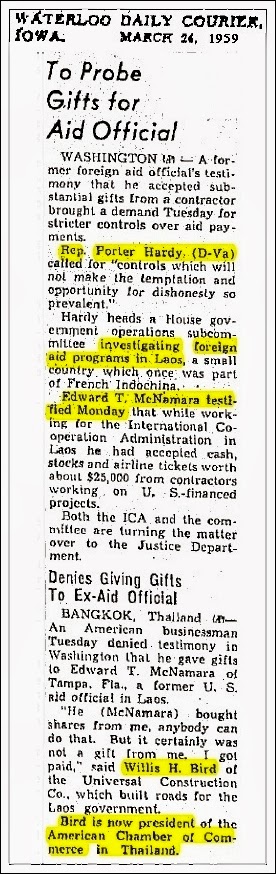
Bird ran Thai Commerce
OSS China hand Willis Bird settled in Bangkok, Thailand to head an office of Sea Supply, Inc., a CIA proprietary headquartered in Miami, which furnished weapons to opium‑smuggling Nationalist Chinese (KMT) troops in Burma. One William Bird, representing CAT in Bangkok, coordinated CAT airdrops to KMT troops and ran an engineering firm that constructed short airstrips used for the collection of Laotian opium.[7]

Sea Supply also provided arms and aid to Phao Sriyanonda, the head of Thailand's 45,000‑man paramilitary police force and reputedly one of the most corrupt men in the history of that corruption‑ridden nation. For years his troops protected KMT opium smugglers and directed the drug trade from Thailand.[8]

When President John F. Kennedy in 1962 attempted a crackdown on the most hawkish CIA elements in Indochina, he sought the prosecution of Willis Bird, who had been charged with the bribery of an aid official in Vientiane. But Bird never returned to the U.S. to stand trial.

Upon returning to Miami, the OSS Chief of Special Intelligence and head of Detachment 202 in Kunming, Colonel Paul Helliwell, was a busy man. In Miami offices of the American Bankers Insurance Co. he functioned simultaneously as the Thai consul, and the counsel for Sea Supply as well as for insurance companies run by his former subordinate C.V. Starr.[9]

American Bankers Insurance was itself a most unusual firm; one of its directors, James L. King, was also a director of the Miami National Bank through which the Lansky syndicate reportedly passed millions en route to Geneva's Swiss Exchange and Investment Bank. One of the Swiss bank's directors, Lou Poller, also sat on the board of King's Miami National Bank.[10]

Moreover, in the fifties and sixties, Thai and Nationalist Chinese capital was invested in Florida's explosive development, much of it by way of the General Development Corporation controlled by associates of Meyer Lansky.[11] It's important to note the dubious alliance of Southeast Asian power groups with those concerned with Florida and Cuba. This early mutuality of business interests is the key to all that follows, and Miami is the nerve center to which we will continually return.

The alliance was comprised of the China Lobby, OSS China hands, Cuban exiles, the Lansky syndicate, and CIA hawks pushing for all‑out involvement in Indochina and against Castro's Cuba. It coalesced between 1961 and 1963, and its members had three things in common:
  1. a right wing political outlook, 
  2. an interest in Asian opium, and 
  3. a thirst for political might. 
The last factor led to another common denominator in which the alliance invested heavily: Richard M. Nixon.

Anna Chennault
Some people effectively overlap the entire spectrum of the alliance. Among them are Howard Hunt and Tommy Corcoran, the man behind United Fruit's dirty work. United Fruit was a client of the Miami‑based Double‑Chek Corp., a CIA front that supplied planes for the Bay of Pigs invasion.[12] Corcoran was the Washington escort of General Chennault's widow Anna Chen Chennault, erstwhile head of the China Lobby, the key to Southeast Asian opium.[13]

Pawley in Haiti during WWI
Another key figure in the China Lobby was weapons dealer/financier William Pawley, the American cofounder of Chennault's Flying Tigers.[14]

Pawley's name was the password to intrigue:
  • OSS China, 
  • Tommy Corcoran,[15] 
  • CIA cover firms,[16] and 
  • arms shipments to KMT Chinese on Taiwan in defiance of a State Department refusal of authorization.
All were either directly or indirectly connected to Pawley. He also rubbed elbows with the U.S. heroin Mafia when, in 1963, he, Santo Trafficante, Jr. and Cuban exiles took part in one of the countless boat raids on Cuba.[18]
The China Lobby's Southeast Asian connection naturally went via the Taiwan regime, which controlled the opium‑growing Chinese in the Golden Triangle and, with the CIA, owned the opium‑running CAT airlines. As Ross Y. Koen wrote in 1964:
"There is considerable evidence that a number of Nationalist Chinese officials are engaged in the illegal smuggling of narcotics into the United States with the full knowledge and connivance of the Nationalist Chinese government. The evidence indicates that several prominent Americans have participated in and profited from these transactions. It indicates further that the narcotics business has been an important factor in the activities and permutations of the China Lobby." [19]
British writer Frank Robertson went one step further in 1977:
"Taiwan is a major link in the Far East narcotics route, and a heroin producer. Much of the acetic anhydride-‑the chemical necessary for the transformation of morphine into heroin-‑smuggled into Hong Kong and Thailand, comes from this island, a dictatorship under the iron rule of the late Chiang Kai‑shek's son, Chiang Ching-kuo."[20]
When the Communists routed Chiang Kai‑shek's forces in 1949, some 10,000 KMT troops fled to Southeast Asia and settled in a remote part of Burma. Heavily armed, they soon assumed control of the area and intermarried with the local population. Under General Li Mi they continued to infiltrate China proper, but each time they were repulsed. While awaiting Chiang's signal for a final, two‑front onslaught, Burma's KMT army needed a source of income. Many had grown opium in Yunnan and so the poppies, which flourished on the hillsides, became the force's cash crop.

Around 1950 the CIA became interested in the KMT troops. With General Douglas MacArthur pushing to arm them for an attack on Red China, the agency secretly flew them weapons in CAT airplanes. But when the KMT instead used the weapons against the Burmese army, Burma protested before the UN, where it was decided that 2000 KMT troops would be flown by CAT to Taiwan by 1954. Those who eventually made the trip, however, were only farmers and mountain people in KMT uniforms, and the weapons they took out were obsolete.[21] Nonetheless, with help from the Red Chinese army, Burma drove most of the KMT forces into Thailand and Laos, though many later returned. The Kuomintang and their kin now number over 50,000. Though only a fraction are soldiers, the KMT still controls hundreds of thousands of Chinese occupying the region, especially in Thailand.

"It's opium."
The junction of Burma, Thailand, and Laos, the Golden Triangle, is the site of the bulk of the world's opium production and thereby the source of enormous fortunes for the French and later the Americans. The French held effective control over the Southeast Asian opium traffic until 1965. Between 1946 and 1955 the Mixed Airborne Commando Group (MACG) and the French Air Force managed the shipment of opium from Burma to Laos. A guerilla corps comprised mostly of Laotian Meo tribesmen and led by Colonel Roger Trinquier, MACG remained unusually independent despite its direct connections to the SDECE and Deuxieme (Second) Bureau. To finance their secret Indochina operations, these organizations turned to the smuggling of gold and opium, with MACG in charge of the latter. Large quantities of opium were shipped to French Saigon headquarters and passed on to the Corsican Mafia, who in turn smuggled the drug to Marseilles.

When the French withdrew from Indochina in 1955 after their defeat by the Vietminh, and after the CIA pushed aside the SDECE, MACG leaders communicating through CIA agent Lucien Conein offered the Americans their entire guerilla force. Against Conein's advice they refused.[22] History would cast doubt on the wisdom of that decision.

In 1955 CIA agent General Edward Lansdale began a [fake] war to liquidate the Corsican supply network. While Lansdale was cracking down on the French infrastructure, his employer the CIA was running proprietaries, like Sea Supply and CAT, that worked hand‑in‑hand with the opium‑smuggling Nationalist Chinese of the Golden Triangle, and with the corrupt Thai border police.[23]

Conein
The Lansdale/ Corsican vendetta lasted several years, during which many attempts were made on Lansdale's life. Oddly enough, his principal informant on Corsican drug routes and connections was the former French Foreign Legionnaire, Lucien Conein, then of the CIA. Conein knew just about every opium field, smuggler, trail, airstrip, and Corsican in Southeast Asia. He spent his free time with the Corsicans, who considered him one of their own. Apparently they never realized it was he who was turning them in.[24]

When Lansdale returned from Vietnam in the late fifties, the Corsicans recouped some of their losses, chartering aging aircraft to establish Air Opium, which functioned until around 1965. That year, the Corsicans' nemesis Lansdale returned to Vietnam as an advisor to Amabassador[sic] Lodge. There was also an upheaval in the narcotics traffic, and perhaps the two were connected. CIA‑backed South Vietnamese and Laotian generals began taking over the opium traffic — and as they did so, increasing amounts of morphine and low‑quality heroin began showing up on the Saigon market.

The first heroin refineries sprang up in Laos under the control of General Ouane Rattikone. President Ky in Saigon was initially in charge of smuggling from the Laotian refineries to the South Vietnamese; and Lansdale's office, it is to be remembered, was working closely with Ky. Lansdale himself was one of Ky's heartiest supporters, and Conein went along with whatever Lansdale said.[25]

One result of the smuggling takeover by the generals was the end of the Corsicans' Air Opium. The KMT Chinese and Meo tribesmen who cultivated raw opium either transported it themselves to the refineries or had it flown there by the CIA via CAT and its successor, Air America, another agency proprietary. Though the Corsicans still sent drugs to Marseilles, the price was becoming prohibitive, since they were forced to buy opium and morphine in Saigon and Vientiane rather than pick up the opium for peanuts in the mountains.

Air America, Inc.


In 1967 a three‑sided opium war broke out in Laos between a Burmese Shan State warlord, KMT Chinese and General Rattikone's Laotian army. Rattikone emerged victorious, capturing the opium shipment with the help of U.S.‑supplied aircraft. The KMT, for its part, managed to reassert its dominance over the warlord. The smuggling picture was becoming simplified, with Southeast Asian opium divided among fewer hands, and most of the Corsicans out of the way.

General Lansdale returned to the U.S. in 1967, leaving Conein in Vietnam. The next year Conein greeted a new boss, William Colby. Since 1962 Colby had run the agency's special division for covert operations in Southeast Asia, where his responsibilities included the " secret" CIA war in Laos with its 30,000‑man Meo army. He shared that responsibility with the U.S. ambassador [sic] in Laos, William H. Sullivan, who would later preside over the Tehran embassy during the fall of the Shah.

Many of the agents who ran the CIA's war in Laos had earlier trained Cuban exiles for the Bay of Pigs invasion, and afterward had taken part in the agency's continued secret operations against Cuba.[26] Since exiles were furnished by the Trafficante mob,[27] intelligence agents had intermingled with representatives of America's number one narcotics organization. The same agents would now become involved with the extensive opium smuggling from Meo tribesmen camps to Vientiane.[28]

In 1967 Colby devised a plan of terror for the "pacification" of Vietnam. Operation Phoenix organized the torture and murder of any Vietnamese suspected of the slightest association with Vietcong. Just as Lansdale was travelling home, Colby was sent to South Vietnam to put his brainchild to work. According to Colby's own testimony before a Senate committee, 20,857 Vietcong were murdered in Phoenix's first two years. The figure of the South Vietnamese government for the same period was over 40, 000.[29]

It was during Colby's tour in Vietnam that the heroin turned out by General Ouane Rattikone's labs appeared in quantity, and with unusually high quality. The great heroin wave brought on a GI addiction epidemic in 1970; Congressional reports indicated that some 22 percent of all U.S. soldiers sampled the drugs and 15 percent became hooked.[30]

Former Air Marshal, then Vice President, Nguyen Cao Ky (now alive and well in the United States) and his underlings still controlled most of the traffic. President Nguyen Van Thieu and his faction, comprised mostly of army and navy officers, were also in it up to their necks. According to NBC's Saigon correspondent, Thieu's closest advisor, General Dang Van Quang, was the man most responsible for the monkey on the U.S. Army's back. But the U.S. Saigon embassy, where Colby was second in command, found no substance to the accusations, Ky's record notwithstanding: Ky had been removed from U.S. Operation Haylift, which flew commando units into Laos, for loading his aircraft with opium on the return trips.

In the face of skyrocketing GI heroin abuse, the Army Criminal Investigation Division (CID) looked into General Ngo Dzu's complicity in the heroin traffic and filed a lengthy report at the U.S. embassy.[31] The embassy ignored the report and chose not to forward it to Washington.[32] The BNDD also investigated the roots of the heroin epidemic, but was impeded in its work by the CIA and U.S. embassy. In 1971, however, a string of heroin labs were uncovered in Thailand, and a number were closed down.

In 1971, furthermore, Colby and Conein were recalled to the United States. Colby became the Deputy Director of Operations, the man in charge of the CIA's covert operations. More remarkable, though, was Conein's homecoming after twenty‑four years of periodic service to the CIA in Indochina, raising the question of why the U.S.'s foremost expert on Indochina had been brought back to Washington just as the crucial phase of Vietnamization was about to begin.[33] Ironically, Corsican friends still around for Conein's departure presented him with a farewell gold medallion bearing the seal of the Corsican Union.

At the war's cataclysmic end, the CIA admitted that "certain elements in the organization" had been involved in opium smuggling and that the illegal activities of U.S. allies had been overlooked to retain their loyalties. In reality, the agency had been forced to confess because of its inability to refute the tales of returning GIs, among them that of Green Beret Paul Withers, a recipient of nine Purple Hearts, the Distinguished Service Cross and Silver and Bronze Stars:
"After completing basic training at Fort Dix in the fall of 1965 [Withers] was sent to Nha Trang, South Vietnam. Although he was ostensibly stationed there, he was placed on 'loan' to the CIA in January 1966 and sent to Pak Seng, Laos. Before going there he and his companions were stripped of their uniforms and all American credentials. They were issued Czechoslovakian guns and Korean uniforms. Paul even signed blank sheets of paper at the bottom and the CIA later typed out letters and sent them to his parents and wife. All this was done to hide the fact that there were American troops operating in Laos.

"The mission in Laos was to make friends with the Meo people and organize and train them to fight the Pathet Lao. One of the main tasks was to buy up the entire local crop of opium. About twice a week an Air America plane would arrive with supplies and kilo bags of opium which were loaded on the plane. Each bag was marked with the symbol of the tribe."[34]
The CIA, reportedly, did not support any form of smuggling after 1968. Del Rosario, a former CIA operative, had something to say about that:
"In 1971 I was an operations assistant for Continental Air Service, which flew for the CIA in Laos. The company's transport planes shipped large quantities of rice. However, when the freight invoice was marked 'Diverse,' I knew it was opium. As a rule an office telephone with a special number would ring and a voice would say 'The customer here'‑-that was the code designation for the CIA agents who had hired us. 'Keep an eye on the planes from Ban Houai Sai. We're sending some goods and someone's going to take care of it. Nobody's allowed to touch anything, and nothing can be unloaded,' was a typical message. These shipments were always top priority. Sometimes the opium was unloaded in Vientiane and stored in Air America depots. At other times it went on to Bangkok or Saigon.[35]
Even while the CIA trafficked in opium, President Nixon ranted on TV against drug abuse and lauded the crackdown against French smuggling networks.

Notes
1. E.H. Hunt: Undercover (Berkeley‑Putnam, 1974).
2. Another of Conein's OSS sidekicks, Mitchell WerBell III, was years later indicted in a major drug conspiracy case (T. Dunkin: "The Great Pot Plot," Soldier of Fortune, Vol. 2, No. 1, 1977), and now runs an antiterrorist training school in Georgia (T. Dunkin: "WerBell's Cobray School," Soldier of Fortune, Vol. 5, No. 1, 1980).

3. D. Moldea: The Hoffa Wars (Charter Books, 1978).

4. U.S. Congress, Senate, Select Committee on Improper Activities in the Labor or Management Field, Hearings, 85th Cong., 2nd Sess. (cited in P.D. Scott: The War Conspiracy, Bobbs‑Merrill, 1972).

5. CAT, which became Air America, was also identical with the "CATCL" that emerged from Claire Chennault's Flying Tigers.

6. D. Wise and T.B. Ross: The Invisible Government (Random House, 1964); Hunt, op. cit.

7. Scott, op. cit.

8. F. Robertson: Triangle of Death (Routledge and Keagen Paul, 1977); A. McCoy: The Politics of Heroin in Southeast Asia (Harper & Row, 1972).

9. Scott, op. cit.

10. New York Times, 1 December 1969; H. Messick: Lansky (Berkeley, 1971). 11. Carl 0. Hoffmann, the former OSS agent and general counsel of the Thai king in New York in 1945‑50, later became the chairman of Lansky associates' First Florida Resource Corp.

12. L. Gonzalez‑Mata: Cygne (Grasset, 1976).

13. R.Y.Koen: The China Lobby in American Politics (Harper& Row, 1974). 14. Pawley, the ultraconservative former Pan Am executive and Assistant Secretary of both State and Defense, set up the Flying Tigers under a secret order of President Franklin D. Roosevelt exempting him from U.S. neutrality provisions; see A. Chan Chennault: Chennault's Flying Tigers (Eriksson, 1963).

15. Corcoran assisted in the establishment of the Flying Tigers and later Civil Air Transport; see Scott, op. cit.

16. Lindsey Hopkins, Jr., whose sizable investments included Miami Beach hotels, was an officer of the CIA proprietary, Zenith Technical Enterprises of Bay of Pigs note. He was also an officer of the Sperry Corp., through whose subsidiary, the Intercontinental Corp., Pawley helped found the Flying Tigers in 1941. Pawley was Intercontinental's president. See Scott, op. cit.

17. U.S. Congress, Senate, Committee on Judiciary, Communist Threat to the United States through the Caribbean, Hearings, 86th Cong., 2nd Sess. (cited in Scott, op. cit.).

18. See chapter fifteen; it has also been revealed that a prominent Chinese American, Dr. Margaret Chung of San Francisco, who was a major supporter of the Flying Tigers, trafficked in narcotics together with the Syndicate; see P.D. Scott: "Opium and Empire," Bulletin of Concerned Asian Scholars, September 1973.

19. Koen, op. cit. 20. Robertson, op. cit.. After a one‑year suspension, the U.S. State Department recently approved the sale of $280 million in military weaponry to the repressive Taiwan regime (New York Times, 20 January 1980), the same regime whose disdain for human rights was most recently expressed by the preparation of cases of sedition against sixty‑five opposition demonstrators (New York Times, 24 January 1980). The CIA's Taiwan station chief in the late fifties and early sixties, when the unholy alliances were forged, was Ray S. Cline. Closely associated with the China Lobby, Cline became famous for his drunken binges with Chiang Ching‑kuo, currently the president of Taiwan (see V. Marchetti and J.D. Marks: CIA and Cult of Intelligence, Jonathan Cape, 1974). A CIA hawk, Cline also helped a gigantic Bay of Pigs‑style invasion of the Chinese mainland which was rejected by President Kennedy. Cline is currently the "director of world power studies" at Georgetown's Center for Strategic and International Studies (CSIS), which, according to writer Fred Landis ("Georgetown's Ivory Tower for Spooks," Inquiry, 30 September 1979), "is rapidly becoming the New Right's most sophisticated propaganda mill." In testimony before the House Select Committee on Intelligence, Cline defended CIA manipulation of the press, saying "You know that first amendment is only an amendment."

20. [William] Pawley eventually built five large airplane factories around the world. It is also likely that he was involved in the CIA's Double Chek Corp. in Miami, as he had similarly been in the Flying Tigers. The CIA's air proprietaries are said to stick together. When in 1958, CIA pilot Allen Pope was shot down and taken prisoner in Indonesia, he was flying for CAT. When he was released in 1962 he began flying for Southern Air Transport, another agency proprietary, which operated as late as 1973 out of offices in Miami and Taiwan. Southern's attorney in 1962 was Alex E. Carlson, who a year before had represented Double Chek when it furnished pilots for the Bay of Pigs invasion; see V. Marchetti and J.D. Marks: CIA and the Cult of Intelligence (Jonathan Cape, 1974). On 23 March 1980, just as Iran's revolutionary government was about to request that Panama extradite Shah Reza Palevi, the ex‑dictator who had been installed on his throne in 1953 by a CIA coup, he was flown off to Cairo on an Evergreen International Airlines charter. As reported by Ben Bradlee of the Boston Globe, (20 April 1980), in 1975 Evergreen had assumed control over Intermountain Aviation, Inc., a CIA proprietary. George Deele, Jr., [sic; Doole] a paid consultant for Evergreen, controlled the CIA's worldwide network of secret airlines for nearly two decades.

21. McCoy, op. cit.

22. D. Warner: The Last Confucian (Angus & Robertson, 1964). 23. McCoy, op. cit.

24. Conein told writer McCoy: "The Corsicans are smarter, tougher and better organized than the Sicilians. They are absolutely ruthless and are the equal of anything we know about the Sicilians, but they hide their internal fighting better." (McCoy, op. cit.).

25. McCoy, op. cit.

26. T. Branch and G. Crile III: "The Kennedy Vendetta," Harper's, August 1975.

27. U.S. Congress, Senate, Select Committee to Study Governmental Operations with respect to Intelligence Activities, Alleged Assassination Plots Involving Foreign Leaders, Interim Report, 94th Cong., 1st Sess. Senate Report No. 94‑463, 1975.

28. C. Lamour and M.R. Lamberti: Les Grandes Maneuvres de l'0pium (Editions du Seuil, 1972); McCoy, op. cit.; Committee of Concerned Asian Scholars: The Opium Rail (New England Free Press, 1971).

29. Marchetti and Marks, op. cit.

30. Congressman M.F. Murphy and R.H. Steele: The World Heroin Problem (U.S. Govt. Printing Office, 1971).

31. Like Nguyen Cao Ky, Ngo Dzu came to the U.S. as a refugee after the final debacle in South Vietnam. Though accused by Rep. Steele of responsibility for the addiction of thousands of GIs to heroin, Dzu went about as a free man until his 13 February 1977 death in Sacramento of apparent heart failure.

32. McCoy, op. cit.

33. Conein's summons home coincided with Howard Hunt's recruitment by the White House and the creation of the special narcotics and Plumbers groups. 34. Committee of Concerned Asian Scholars, op. cit. 35. Lamour and Lamberti, op. cit. (quote retranslated from the French).

Sunday, September 15, 2013

The Battle of the Baptists


"The Christian church must be a 'propagandist society'."
Dr. Louis Entzminger

Air Lines and Air Waves in Fort Worth

Working for Brown Brothers Harriman?
When we look behind the corporate curtain to find the money and personnel involved in Elliott Roosevelt's radio station, we uncover much more than meets the eye. The radio station the President's son acquired in 1938 had been owned since 1926 by A.P. Barrett and C.R. Smith of Texas Air Transport, who had used KTAT radio in connection with their own business interests. In 1929 Barrett expanded by incorporating Southern Air Transport (SAT), which absorbed Texas Air Transport, and retained Smith as vice president and treasurer. Later that year, SAT became part of the Aviation Corporation (AVCO), whose chairman was Bonesman W. Averell Harriman, who had recently combined his investment banks with that of the old established Brown Brothers bank of New York.

As mentioned earlier, the attorney for the radio station and the airline which owned it was Raymond E. Buck.

Attorney Buck's father, Judge R.H. Buck, in 1909 was head of the First Baptist Church committee responsible for bringing preacher, John Franklyn Norris, to Fort Worth. Norris described the church in this way:
Millionaires hung in bunches. It was known as "The Home of the Cattle Kings".... I had a literal contempt for the whole machinery. (page 85-86 of file)
Jesse T. Pemberton, who would become Norris' great friend and supporter, was president of the local Farmers and Mechanics National Bank and was quoted (page 84 of file), quite prophetically, as saying:
"I am not opposed to J. Frank Norris; I am for him, but this church is not in condition for his type of ministry. If he comes there will be the all-firedest explosion ever witnessed in any church. We are at peace with the world, the flesh, and the devil, and with one another. And this fellow carries a broad axe and not a pearl handle pen knife. I just want to warn you. But now since you have called him, I am going to stay by him."
As Norris tells his story, he raised no shackles among the congregation for two years. That, however, would change. He says, in his self-deprecating manner, that it began by his telling his wife in 1911 (page 87):
Rev. J. Frank Norris
"I am going to quit the ministry."
She said, "When did you ever begin?"
Such unkindness!...

I didn't care what happened. Mark you there was perfect peace in the church just as there is in a grave yard. The only difference between that church and the grave yard was the people in the grave yard were buried and everybody knew it, but in the church they were dead and unburied and didn't know it. 
Reading the Entzminger book much of which is a reprint of Norris' book, Inside the Cup, one has difficulty understanding the chronology of events, as they shift between 1912, 1926 and 1945 as though mere days had elapsed. The author often referred to his antagonists in Tarrant County only with labels (like the district attorney) rather than names. At one point, however, the book does state that Norris' attorneys were Lattimore and Doyle, and it is easy to identify them as Offa Shivers Lattimore (Judge Buck's brother-in-law) and D.M. Doyle, who were engaged in Southern Co-operative Life Insurance together in 1915 (pages 143-144 of file).

The year Norris became active against gambling, liquor and prostitution in Fort Worth, Texas was clearly the year 1911 the same year the U.S. Supreme Court handed down its Standard Oil opinion requiring Rockefeller and his big oil cronies to split up their oil trust. Fundamentalists like Rev. William Bell Riley, a close friend of Norris, speaking at the Moody Memorial Church in Chicago, charged that the Rockefellers were trying to "standardize" religion, much as they had the oil industry.

Gerard Colby and Charlotte Dennett write in Thy Will Be Done: The Conquest of the Amazon; Nelson Rockefeller and Evangelism in the Age of Oil:
Fundamentalist distrust of the Rockefellers evolved into a near-pathological conviction that the Rockefellers were not religious at all, but promoters of a vast communist conspiracy to seize control of their churches and impose atheism on their schools.
The Liberal Baptistsa/k/a Rockefeller Funds

"Christians are supposed not merely to endure change, nor even to profit by it, 
but to cause it. " Harry Emerson Fosdick

Rev. Fosdick
The Rockefellers and their liberal ministers would wage years of battles against the likes of Milton and Lyman Stewart of Union Oil of California, who used Rev. Riley to attack the Rockefellers from his Chicago pulpit. The fundamentalist Stewarts made their donations to the Northern Baptist Convention conditional upon its adherence to the Fundamentalist Creed. When advised of this approach made by his competitors, Rockefeller, Sr. took steps to modify the terms of his own gifts, threatening to revoke them if used to the benefit of Fundamentalist ideas.

Colby and Dennett state that in Thy Will Be Done that "the Fundamentalist Controversy" then ensued with Rev. Harry Emerson Fosdick taking the position for the Modernists, along with Rockefeller-sponsored Beardsley Ruml.

After Fosdick preached a sermon in 1924 called "Shall the Fundamentalists Win?" he was ejected from his Presbyterian Church pulpit but would rapidly be hired by the Park Avenue Baptist Church, whose membership included Rockefeller, Jr. Under Fosdick's leadership it would become the interdenominational Riverside Church, moving into an architecturally magnificent new building overlooking the Hudson River in 1930.

Junior had five sons who, utilizing the money from charitable and educational foundations already set up by their grandfather (Senior) and by Junior, further increased the institutional power of their social network. David Rockefeller joined the Rockefeller and Aldrich family banking empire at Chase National Bank in 1946. John D. III coordinated the Rockefeller philanthropic interests, sitting on the boards of dozens of educational, cultural and social foundations into which Rockefeller money was poured. Laurance had a seat on the NYSE and focused on venture capital, setting up Rockefeller Brothers Fund for that purpose in 1940. He was fascinated by aviation, helping to organize Eastern Airlines and McDonnell Aircraft.

John D. Rockefeller, Sr., born and reared in New York, was a Baptist from the American Baptist Society. He believed in molding the minds of his own family, as well as the world, and he set up the General Education Board for that purpose, under Frederick T. Gates:
From the start, the GEB had a mission. A letter from John D. Rockefeller Sr. specified that his gifts were to be used "to promote a comprehensive system." You might well ask what interests the system was designed to promote, but you would be asking the wrong question. Frederick Gates, the Baptist minister hired to disburse Rockefeller largesse, gave a terse explanation when he said, "The key word is system." American life was too unsystematic to suit corporate genius. Rockefeller’s foundation was about systematizing us.
 

In 1913, the Sixty-Second Congress created a commission to investigate the role of these new foundations of Carnegie, Rockefeller, and of other corporate families. After a year of testimony it concluded:
The domination of men in whose hands the final control of a large part of American industry rests is not limited to their employees, but is being rapidly extended to control the education and social services of the nation.
Foundation grants directly enhance the interests of the corporations sponsoring them, it found. The conclusion of this congressional commission:

The giant foundation exercises enormous power through direct use of its funds, free of any statutory entanglements so they can be directed precisely to the levers of a situation; this power, however, is substantially increased by building collateral alliances which insulate it from criticism and scrutiny.
Foundations automatically make friends among banks which hold their large deposits, in investment houses which multiply their monies, in law firms which act as their counsels, and with the many firms, institutions, and individuals with which they deal and whom they benefit. By careful selection of trustees from the ranks of high editorial personnel and other media executives and proprietors, they can assure themselves press support, and by engaging public relations counselors can further create good publicity. [emphasis added]
Planning Society's Future

Senior and Junior
Junior, not one to question his father's strong beliefs, had his children educated along lines his father laid out. In 1919, Senior had commissioned John Dewey, a Columbia Teachers College professor, to found the Progressive Education Association, and it was in this experimental program that Nelson Rockefeller obtained his primary school education. The Lincoln Experimental School at Columbia Teachers College was:
testing ground for Harold Rugg’s series of textbooks, which moved 5 million copies by 1940 and millions more after that. In these books Rugg advanced this theory: "Education must be used to condition the people to accept social change....The chief function of schools is to plan the future of society." Like many of his activities over three vital decades on the school front, the notions Rugg put forth in The Great Technology (1933), were eventually translated into practice in urban centers. Rugg advocated that the major task of schools be seen as "indoctrinating" youth, using social "science" as the "core of the school curriculum" to bring about the desired climate of public opinion.  [emphasis added]
John D. Rockefeller, Sr. died in 1937. In March of the following year Mexican President Lazaro Cardenas expropriated the assets of nearly all of the foreign oil companies operating in Mexico, and this same Nelson Rockefeller, educated to believe in using education to condition the minds of people to acceptance of social change, was introduced to Harry Hopkins in the Roosevelt administration by his advance man, Beardsley Ruml, as being willing to negotiate terms of compensation for the seizure of American oil assets by Mexico. Nelson was then only 30 years old. Listening to Cardenas tell him his own version of Mexico's history of being subverted by the United States government and its leaders was an education in itself, but a teaching experience showing him the need to work covertly within these South American countries which contained a huge reservoir of oil his family would like to capture and control.

Cardenas did not relent to young Nelson's weak plea that foreigners be allowed to retain control over assets they had acquired in Mexico, and the U.S. embargo against buying Mexico oil continued. When Mexico began selling oil to Germany, which was then at war against the British, measures to be taken became more pressing.

The next time Nelson spoke to FDR's adviser Harry Hopkins he spoke about the need to open Mexico up to American corporate investment and augment the consular service with programs in culture, education and science to stimulate production, his requests would magically materialize. The advisory committee that he requested be set up with a person to coordinate the programs who had direct access to the White House would soon be incorporated into a Presidential Executive Order.

Who Slew John in Dallas?

The author of this blog — Linda Minor — has been conducting research for the last two decades from every direction around a core hub, that hub being the role of Texans who came together in 1963 to kill John F. Kennedy. That role did not emerge overnight; it had been building up for more than a hundred years, as detailed throughout this blog. Understanding that historical context is necessary before one can really answer the question: "Who slew John in Dallas?"

Thomas E.Mahl, author of Desperate Deception: British Covert Operations in the United States, 1939-44, has contributed much more on this subject than he has been given any credit for, especially by his recognition of how British intelligence has recruited spies within the American government and set up its own intelligence system within the inner workings of the United States. He writes:
British intelligence had certainly infiltrated Benjamin Franklin’s American embassy in France. Franklin’s chief assistant, Dr. Edward Bancroft, was a British intelligence agent who passed all the information he could gather on to England. In the period 1778–83 the problem was how to get out of a war with the Americans, but in 1916–17 it was how to get the United States into a war. Intrepid’s World War I counterpart had been Sir William Wiseman (1885–1962). His family background, sense of taste, good manners, and discretion highly recommended him to Edward M. House, President Woodrow Wilson’s closest adviser. 
“Colonel” House liked to associate with the famous and titled, and Wiseman could trace his lineage back to the time of Henry VIII and his baronetage to 1628. As Wilson had favored the British in World War I, Franklin Roosevelt was quite willing to work with British intelligence in World War II. One of the unnoticed consequences of Roosevelt’s cooperation was that British intelligence promoted the creation of two American intelligence organizations. Most well known of these organizations was the Coordinator of Information, which became the Office of Strategic Services. The other intelligence organization was so well camouflaged that it was not until 1976 that the first hint appeared that the “Rockefeller Office,” or more properly the Office of the Coordinator of Commercial and Cultural Relations Between the American Republics, later the Coordinator of Inter-American Affairs, had been an intelligence operation. The book A Man Called Intrepid by William Stevenson (no relation to Intrepid) was, for all its flaws, the first to reveal that the Rockefeller Office was an intelligence operation—one that brought the soothing balm of Rockefeller dollars to Intrepid’s ambitious but money-short Latin American operations. [NotePaul Kramer, “Nelson Rockefeller and British Security Coordination,” JCH 16 (January 1981): 76.]
Another writer has dealt with the role of the British in using secret agents to subvert American opinion and seduce our nation into war. An anonymous author of "The Council on Foreign Relations (CFR) and The New World Order," known only as W.E.B., published at Terry Melanson's Illuminati Conspiracy website, wrote with a great degree of insight that provides links between the British and Texans as far back as WWI:
Woodrow Wilson was elected President in 1913, beating incumbent William Howard Taft, who had vowed to veto legislation establishing a central bank. To divide the Republican vote and elect the relatively unknown Wilson, J.P. Morgan and Co. poured money into the candidacy of Teddy Roosevelt and his Progressive Party. 

According to an eyewitness, Wilson was brought to Democratic Party headquarters in 1912 by Bernard Baruch, a wealthy banker. He received an "indoctrination course" from those he met, and in return agreed, if elected: to support the projected Federal Reserve and the income tax, and "listen" to advice in case of war in Europe and on the composition of his cabinet. 

The Texas 'colonel'
Wilson's top advisor during his two terms was a man named Colonel Edward M. House. House's biographer, Charles Seymour, called him the "unseen guardian angel" of the Federal Reserve Act, helping to guide it through Congress. Another biographer wrote that House believed: "...the Constitution, product of eighteenth-century minds...was thoroughly outdated; that the country would be better off if the Constitution could be scrapped and rewritten..." House wrote a book entitled Philip Dru: Administrator, published anonymously in 1912. The hero, Philip Dru, rules America and introduces radical changes, such as a graduated income tax, a central bank, and a "league of nations." 


World War I produced both a large national debt, and huge profits for those who had backed Wilson. Baruch was appointed head of the War Industries Board, where he exercised dictatorial power over the national economy. He and the Rockefellers were reported to have earned over $200 million during the war. Wilson backer Cleveland Dodge sold munitions to the allies, while J.P. Morgan loaned them hundreds of millions, with the protection of U.S. entry into the war. 

While profit was certainly a motive, the war was also useful to justify the notion of world government. William Hoar reveals in Architects of Conspiracy that during the 1950s, government investigators examining the records of the Carnegie Endowment for International Peace, a long- time promoter of globalism, found that several years before the outbreak of World War I, the Carnegie trustees were planning to involve the U.S. in a general war, to set the stage for world government. 

The main obstacle was that Americans did not want any involvement in European wars. Some kind of incident, such as the explosion of the battleship Main, which provoked the Spanish - American war, would have to be provided as provocation. This occurred when the Lusitania, carrying 128 Americans on board, was sunk by a German submarine, and anti-German sentiment was aroused. When war was declared, U.S. propaganda portrayed all Germans as Huns and fanged serpents, and all Americans opposing the war as traitors.
What was not revealed at the time, however, was that the Lusitania was transporting war munitions to England, making it a legitimate target for the Germans. Even so, they had taken out large ads in the New York papers, asking that Americans not take passage on the ship.

The evidence seems to point to a deliberate plan to have the ship sunk by the Germans. Colin Simpson, author of The Lusitania, wrote that Winston Churchill, head of the British Admiralty during the war, had ordered a report to predict the political impact if a passenger ship carrying Americans was sunk. German naval codes had been broken by the British, who knew approximately where all U-boats near the British Isles were located. 

According to Simpson, Commander Joseph Kenworthy, of British Naval Intelligence, stated: "The Lusitania was deliberately sent at considerably reduced speed into an area where a U-boat was known to be waiting...escorts withdrawn." Thus, even though Wilson had been reelected in 1916 with the slogan "He kept us out of war," America soon found itself fighting a European war. Actually, Colonel House had already negotiated a secret agreement with England, committing the U.S. to the conflict. It seems the American public had little say in the matter. 

With the end of the war and the Versailles Treaty, which required severe war reparations from Germany, the way was paved for a leader in Germany such as Hitler. Wilson brought to the Paris Peace Conference his famous "fourteen points," with point fourteen being a proposal for a "general association of nations," which was to be the first step towards the goal of One World Government the League of Nations. 

Wilson's official biographer, Ray Stannard Baker, revealed that the League was not Wilson's idea. "...not a single idea in the Covenant of the League was original with the President." Colonel House was the author of the Covenant, and Wilson had merely rewritten it to conform to his own phraseology. 

The League of Nations was established, but it, and the plan for world government eventually failed because the U.S. Senate would not ratify the Versailles Treaty. Pat Robertson, in "The New World Order," states that Colonel House, along with other internationalists, realized that America would not join any scheme for world government without a change in public opinion.[emphasis added]

The CIAA Coordinator of Inter-American Affairs

On July 30, 1941 President Franklin Roosevelt signed Executive Order 8840, whose purpose was:
to provide for the development of commercial and cultural relations between the American Republics and thereby increasing the solidarity of this hemisphere and furthering the spirit of cooperation between the Americas in the interest of hemisphere defense, it is hereby ordered as follows:
1. There is established within the Office for Emergency Management of the Executive Office of the President the Office of the Coordinator of Inter-American Affairs [CIAA], at the head of which there shall be a Coordinator appointed by the President.
Nelson, the Coordinator
The Coordinator FDR appointed to his newest bureau was none other than Nelson Rockefeller himself, then only 33 years old. One year after this appointment, the Mexicans agreed to pay roughly $29 million in compensation to several American oil firms, including Jersey Standard and Socal, whose properties had been seized by Mexico. In the meantime, Nelson Rockefeller's dreams of dominance over South and Central America proceeded unabated.

Fort Worth would become a major recruiting ground for the CIAA's network, as we will see in the next episode. The conservative Baptists under Norris, though ostensibly fighting Rockefeller's liberal programs, were used by the CIAA as spies and covert operatives to fight further expropriation of capitalists' assets within the American hemisphere, as well as in other parts of the world.