Sunday, October 2, 2011

In Search of Sam Houston Burris

According to the Torbitt Document, two men from Mexico--Sapet and Alfredo Cervantes--had, eleven years prior to the assassination of President Kennedy:

Texas sought extradition from Mexico
positioned themselves in a field adjacent to the rear of [anti-George Parr attorney, Jake] Floyd's house and when Buddy Floyd, Jake's 19 [sic] year old son who resembled his father, started out of the house to the garage, Cervantes mistakenly shot Buddy through the head, killing him. Cervantes, Sapet and Nago Alaniz, George Parr's personal lawyer, were indicted for the assassination and for conspiracy to murder. Sapet was caught before he could cross the Mexican border and was given a 99 year sentence.
Division Five's various names
Cervantes crossed back into Mexico where he found his Division Five assassination group and although Mexican authorities arrested him, political pressure was brought to bear and Alfredo has remained a free man in Mexico despite sixteen years of constant effort to extradite him by Sam Burris, the Alice District Attorney. Burris and Bill Allcorn, Special Assistant Attorney General of Texas, were unable to convict Nago Alaniz, but one of the conspirators gave Bill Allcorn pertinent information.
The accomplice told Allcorn that there were twenty-five to thirty professional assassins kept in Mexico by the espionage section of the U. S. Federal Bureau of Investigation; that these men were used to commit political assassinations all over North, South and Central America, the East European countries and in Russia; that these men were the absolute world's most accurate riflemen; they they sometimes took private contracts to kill in the United States; that the contact man for employment of the riflemen was a man named Bowen posing as an American Council of Christian Churches' missionary in Mexico; that you could reach Bowen through the owner of the St. Anthony's Hotel in Laredo, Texas.
Buddy Floyd's Killing

The shooting occurred on Monday night, September 8, 1952, shortly after Buddy left the house to work on his car in the garage behind the home, and the body was discovered by his mother half an hour later. Buddy was a 22-year-old student at the University of Texas law school in Austin.

Jacob S. "Jake" Floyd, Sr. was an avowed enemy of George Parr's political and criminal empire in south Texas, who was working on behalf of the write-in campaign for District Judge Sam Reams, a losing opponent of the Parr machine in the July Democratic primary election.

Nago Lucio Alaniz

In addition to extraditing Cervantez from Mexico, officials also tried to make a case against Audenago "Nago" Lucio Alaniz, the law partner of Raeburn Norris, the man who had won the primary election for district attorney.

Nago was born in Berclair, Goliad County, Texas in 1913 or 1914 (records exist for him in Ancestry for the same day of both years). His name first appeared in newspapers in early June of 1934 while he was living at 2102 Guadalupe St. in Austin, Texas--an address, which was directly opposite the Newman Center, a Catholic service group for college students, of which he was a member.

Nago and a female passenger, Gail Sperry of Hubbard, Texas, had been kidnapped in his rented car in Austin and forced to drive to San Antonio. The alleged abductor, Aaron Burleson, was tried and convicted the following September after both victims testified.

A few months after that trial, Nago's photo appeared in the 1936 yearbook of Lebanon law school at Cumberland University in Tennessee:
In 1871 Cumberland University took the revolutionary step of instituting a one-year law course. The Bachelor of Laws degree was awarded after two semesters of study, examination, Moot court, and debate. Students were taught one subject at a time for the entire three-hour class period. Cumberland University followed this very successful method until 1938-39, when the school returned to a two-year course.

He married Leila Saenz, from a local family in Beeville. Eventually he moved to Benavides in Duval County, about halfway between Alice and Hebbronville. He had enlisted in the Army 22 Apr 1943 and was discharged 6 Aug 1943.

By 1947 he had formed a criminal defense partnership with Raeburn L. Norris in Alice, Texas. Norris had already by that time lost at least two elections for county and district attorney.

In December 1952 Alaniz was released from jail on bond, awaiting trial alongside Mario Sapet, a tavern keeper from San Antonio, for the murder.


Burris Family Background

Young attorney, Sam Burris, arrived in Jim Wells County only the year before, and was destined to spend 16 years in an attempt to have Alfredo Cervantes extradited from Mexico to stand trial for the murder of Buddy Floyd. Mexico rejected the extradition for two main reasons: First, disputing that Cervantes had become a U.S. citizen while in Texas and second, refusing to extradite him because he would face the death penalty not available in Mexico. Who was Sam Burris, and what can be learned about him?

Sam Houston Burris graduated, first, from Texas A and I in Kingsville and then obtained a law degree from the University of Texas in 1951; he then returned home to Alice, Texas located in Jim Wells County near the famous King Ranch. He wasted no time in becoming county attorney and ran for district attorney in 1954. Once he took office as D.A., he wrote a letter to conservative John Ben Shepperd, the Texas Attorney General, appointed by Governor Allan Shivers, concerning certain actions of George Parr's political cronies, which he suspected were violations of Texas law.
According to his 2008 obituary, Sam Burris was born in Pleasanton, Texas (about 40 miles or so south of San Antonio) to Jean Holland (sometimes called John H.) and Anna Ruth Burris.  A Texas birth record indicates a son younger than Sam, named Jean Howard Burris, was born in Bexar County to Jean H. and his wife, Ruth La Reaux (or LaRoe?) in 1934; later public records indicate that this John H Burris, lived in Alice, Texas in the early 1990's. (Possibly he changed the spelling of his first name from the French spelling "Jean" to John, as members of her family spelled their names as LaRoe, rather than the "La Reaux" spelling shown on the birth record.) 

Further evidence of the family's history is presented in a January 1938 notice in the Laredo Times: Mrs. J. H. Burris (Sam's mother) was in attendance at the celebration of her grandparents' 65th wedding anniversary--Aaron L. and Hettie J. (Wilson) Hale. The Hales had two daughters married to men named A.E. LaRoe and Daniel Reid LaRoe, both of San Antonio. The notice reported that Mrs. Burris (actually the daughter of Dan R. and Mary E. Hale Laroe) had three children named "Connie Jean, Sammy and John Burris," of Alice, Texas. There were two other Hale daughters named in the society item, living near the Hales, in Laredo--Mrs. J.B. [Emma Hale] DaCamara and Mrs. Ross Swisher. 

The LaRoe family seemed to congregate around the Atascosa County arena, where Mrs. Burris' uncle, James Laroe, had tragically killed himself and a son in 1937. 


After this horrendous event, however, Mrs. Burris may have been more amenable to leaving Pleasanton. It was at about that time that Sam's family had moved from Atascosa County to Alice, where he attended grade school and had graduated from high school. 


Census records reveal that his father, Jean Burris, and a brother named Carlos were engaged in farming in Atascosa County in 1920. It would have been during that farming venture that he had met and married Ruth La Reaux/LaRoe. For a time they lived in San Antonio with their first two children--Sam, or Sammy as he was called, and Connie Jean, before the subsequent birth of John Holland Burris, Jr. in 1934. Sammy's maternal grandfather, Dan LaRoe was a railroad engineer and had taken his young family to Mexico after young Ruth (Mrs. Burris) was born around 1897. Undoubtedly Ruth had learned to speak fluent Spanish living in the foreign country during her youth. Her younger siblings, Dan Jr. and John H. LaRoe, were actually born in Mexico in 1920 and 1922, but the family returned to Texas before the youngest child, Emma Lou, was born in 1925 and later married John Victor Huntress, Jr. of San Antonio.


Ruth LaRoe's grandparents, the Hales, lived in Lockhart (Caldwell County), Texas before 1900 and later moved to Laredo. Ruth's aunt, Emma Hale, had married J.B. (Bernie) DaCamara in Laredo.  The Laredo Times reported in 1931 that they owned a cottage in Corpus Christi named "J. B. Emma," located close to the "Breakers Hotel on North Beach, and is a mecca for friends to visit. For many years, Mr. and Mrs. DaCamara have entertained groups of intimate friends for a week at a time throughout the vacation months."


Emma Hale's mother-in-law, Laura Gravis DaCamara, had been born in Corpus Christi, Texas in 1848 to John Allen Freeman (and Irenah Hall) Gravis. Seemingly an official in the Republic of Texas, he was born in Germany in 1810, though some of the family genealogists locate his family in Pennsylvania rather than Germany; perhaps he was a traveling diplomat. 
He was, however, a hotel proprietor according to this Corpus Christi Caller's website entry:
J.A.F. Gravis, a [Battle of] San Jacinto veteran, opened the California House in 1849, a hotel for Gold Rush prospectors coming through. His hotel was at Chaparral and William. Gravis, a bricklayer, and his partner H.W. Berry built many of the early shellcrete structures. After Gravis died of yellow fever, his widow Irenah married Berry and they turned the hotel into a boarding house. Mrs. Berry’s sons would ring a bell to summon boarders when meals were ready.


Irenah had married Henry W. Berry by the time of the 1870 census. In the interim between 1870 and 1880, Laura Gravis had married Jose Bernardino DaCamara, a dentist, had two children--Harrison and Marie (also called Harry and Mamie in some records)--and moved to Brownsville, Texas. Five years later, the Florida census recorded Laura residing in Volusia County (without her husband), in a household with her three children and a 75-year-old woman named E.A. DaCamara, presumably her mother-in-law. By 1900 she had returned to Texas, where she reared the children with help from her spinster sister, Hettie, in Corpus Christi. In 1898 Harry Da Camara was reported to be a member of the Texas Treasury department.


The following item appeared in the December 19, 1909 edition of the Laredo Times:
Mrs A. L. Haile [sic], mother of Mrs. J. B. DaCamara who with her daughter Miss Jessie [Hale], have been on a several weeks visit to Mr. J. B. DaCamara and family, left yesterday for their home in Monterrey.
Bernie's father had been born in Massachusetts in 1837, his own father having emigrated to America from the Portuguese archipelago of Madeira and married a young Baltimore girl named Eliza Wheeler. Born in Maryland in 1882 before his parents headed west for Texas, Bernie's father was one of many DaCamara men who bore the name of Jose Bernardino. In fact, one J.B. DaCamara was even reflected in the 1860 census in Texas. DaCamara, like Gravis, was a very old family in Texas.


Sam Burris' Mother's First Cousins

Bernie DaCamara's older brother, Harrison Gravis DaCamara, worked as a railroad agent in Laredo (the International & Great Northern), and the wedding announcement in 1930 for his son, Randolph Lawrence DaCamara, revealed that the newlyweds planned to live in Mexico City, where the groom ran a Dodge Brothers car dealership. Harry's eldest son (Randolph's brother) had the unfortunate first name of Shirley--given to him by his mother, the former Martha Shirley, whose father, Richard J. Shirley, had arrived in Texas from the Isle of Man in 1859. Mrs. DaCamara's brother was also a businessman in Mexico, proprietor of the Shirley Courts, as revealed in this news item from 1936:


James Shirley Of
Mexico City Here
Laredo Times

MARCH 13, 1936
"In 90 days I predict you will be able to leave Mexico City at five o'clock in the morning and be in Laredo by ten that night'', was the prediction of James G. Shirley, Mexico City business man who is here with Mrs. Shirley visiting her sister Mrs. H. G. DaCamara. Shirley is the owner of Shirley Courts, one of the finest tourist accommodation spots in Mexico City. He and Mrs. Shirley will leave here for visits in Detroit and Rochester, Minn. Shirley drove from Mexico City to Laredo and reported the finishing touches being put on the highway.


Other sources reveal that the Shirley Courts had a catering contract with Pan American Airlines and that it was the favored spot for Americans to stay in Mexico City. Mr. Shirley died in December 1945--with a short obituary appearing in the Laredo newspaper--but 30 years later the courts were seemingly still being operated by his heirs:
James G. Shirley, 57, operator of the Shirley Courts in Mexico City and one of the best known members of the American colony there, a brother of Mrs. Harry G. DaCamara of Laredo, died in Mexico City Friday, according to a dispatch from Mexico City to The Times Saturday night. He was a native of Corpus Christi, son of the late R J. Shirley. He established the Shirley Courts in Mexico City a number of years ago and among his many patrons were many acquaintances from Laredo, where he frequently visited as a guest of his sister.


The sister's son, unfortunately named Shirley DaCamara, was a teacher and coach of the Laredo High school until 1928, when he moved to Mexico City to work for with the Dodge Motor company where he was employed at the time of his marriage to Florence McGregor in April 1930. After their first daughter, Patricia, was born in Laredo later that year, the family moved back to Texas. They had another daughter named Priscilla.


Patricia studied at the University of Texas at Austin and joined the Alpha Chi Omega Sorority, and, after graduation in 1952, Patricia worked briefly for the United States Department of State in Washington, D.C. Marrying Lieutenant Austin R. Bryan, USAF, she would travel with her husband on assignments across the United States and around the world. With her education degree, she was able to teach Spanish, French, and ESL in the United States and abroad. She taught in Department of Defense Schools in Europe, in Hanau and Ramstein Germany; in International Schools in Athens, Greece, and Dhahran and Riyadh, Saudi Arabia; and in public schools in Laredo and San Antonio, Texas.  Her husband in 1971 was a lieutenant colonel--in charge of the "entire aircraft maintenance effort at Webb [AFB] and control of 728 military men and 198 civilians," according to news reports in Big Spring, Texas.


Patricia, based on the important role her ancestors played in the history of Texas, was also a member of the Daughters of the Republic of Texas. Because an ancestor, J.A.F. Gravis, fought in the Battle of San Jacinto, her male ancestors and siblings in that lineage would have also qualified to be members of the Sons of the Republic of Texas and be chosen as Knights of San Jacinto, a secret order on a par with Skull and Bones.


That is not to say, however, that the only Texas heroes that existed in Sam Burris' lineage could be found in the parentage of his mother's kin. There were equally impressive members of his father's side of the gene pool, even though he may not have socialized with them to the same extent. That, however, must be reserved for a later day.

Wednesday, September 28, 2011

What Was Double-Chek Corporation?

Newspapers in 1961, shortly after the failed Bay of Pigs operation in Cuba, were full of reports of four pilots from Alabama's Air National Guard, who had been killed in two B-26's.  Recruited by the CIA in view of her experience of these devices, the men were Thomas Willard Ray, Leo Francis Baker, Riley W. Shamburger, Wade C. Gray--all from Birmingham --part of the hundred members of Brigade 2506 who died. 

A family history of Shamburger appears at Ancestry.com:


Riley W. Shamburger, Jr., the oldest of the four fliers, was born in Birmingham on November 17, 1924. He married Marion Jane Graves, his childhood sweetheart. They had dated for twelve years before their marriage, through grammar school and Woodlawn High. After Pearl Harbor, Shamburger quit high school to join the Air Force. (When the war ended he returned and got his diploma.) A combat pilot in World War II and Korea, Shamburger was a big breezy extrovert who loved to fly.

He was a 209-pounder, six feet tall, with 15,000 hours in the air and eighteen years of flying experience by 1961. A test pilot at Hayes, he was also a major in the Alabama Air National Guard, and was its operations officer at the Birmingham airfield. He was also a good friend of General [George Reid] Doster [commander of the 117th Tactical Reconnaissance Wing at Birmingham Municipal Airport in Alabama]. Shamburger did well; he owned a substantial home in East Lake.

The Shamburgers were part of a beer-and-barbecue, happy-go-lucky crowd of Air Guardsmen and their wives who frequently socialized together. Aside from flying, Riley liked nothing better than to sit in front of the TV set with a case of beer, eating his favorite food, "parched" (roasted) peanuts. And he liked to barbecue pork chops.

Early in 1961 Riley told his wife: "I'm going to be away at school for three months." He did not say where he was going, but about once a week he returned to Birmingham. He and Doster would fly in together.

Sometimes they would bring news of other Birmingham acquaintances -- such as Colonel Joe Shannon -- who were part of the mysterious operation. Once, when Riley returned for a visit, he told how the boys had rigged up a beer joint in Central America named after their favorite bar in Birmingham. Over the makeshift saloon a pair of red panties flew in the breeze as a cocktail flag.

Shortly before the invasion, Marion sent Riley a present -- a whole cigar box full of parched peanuts.

This, then, is the background of Riley and of how he came to be in Happy Valley on Wednesday, April 19, 1961. On that day four Alabama Pilots volunteered to fly B-26s over the beaches to relieve the exhausted Cuban pilots.

What happened has already been described: Shortly before they took off, the four CIA fliers were told they would receive air support from the carrier-based Navy jets. (The word had been flashed to Happy Valley by Richard Bissell after the President authorized the unmarked Navy jets to fly for one hour at dawn.) Because of the mix-up over time zones, the B-26s got to the Bay of Pigs after the Navy jets had already gone.

Exactly how the two planes were shot down is a subject of varying accounts, but most versions agree that Shamburger and Gray crashed at sea and that Ray and Baker crashed inland.
Part of what happened was told by James Storie, written by Allan T. Duffin, in "Above and Beyond--Mission: Cuba. Status: Top secret," Air & Space Magazine, May 01, 2011. He said that the major recruiter for the mission was Gen. Doster and that the personnel interviewed were from the Hayes Aircraft Corporation in Birmingham, or else active Guardsmen.
We used first names only. I was given a picture of a woman and two kids to go in my billfold—I had no idea who they were—along with other documents that would create a fake identity.
At first we were given just a few vague details about our mission. At each step, a candidate remained only if he continued to sign more secrecy documents. I became pretty sure that we were dealing with the CIA, but this was never acknowledged. We were told how we would be paid and that we could tell no one—not a soul—or we would be prosecuted for revealing classified information.

Finally I learned the truth, and why the Guard needed aircraft technicians: We would be training Cuban exiles to fly B-26s for an invasion of Cuba, with the goal of triggering a revolution to overthrow communist dictator Fidel Castro. Since Castro had B-26s in his air force, the theory went, the Cuban population would think that their own military was revolting against Castro and would join the uprising.

After a week of briefings and paperwork, we reported to Eglin Air Force Base near Pensacola, Florida. We left Eglin at midnight in a Douglas C-54 with blacked-out windows, flying 50 feet above the water for a very long time. We still did not know where we were going.

The next morning we landed on a dusty airstrip. This was our base. There was nothing there except the runway. It turned out to be Puerto Cabezas, Nicaragua. I was told that the ground troops for the invasion were being trained in Guatemala while we trained B-26 crews here....
The pilots and crew volunteers were people I had worked with at Hayes Aircraft, except for Joe Shannon. In earlier days I had flown with two of them: Riley Shamburger and Pete Ray, whom I considered a friend.

On April 19, we launched six B-26s, four of them piloted by U.S. crews. Wade Gray was flying with Shamburger and was the first American to go down, in the water. The B-26 piloted by Pete Ray and Leo Baker was the second, going down on land. Both airmen survived but were shot by Castro’s soldiers. Only Shannon returned in one piece. The Cuban exiles were unable to sustain the beachhead at the Bay of Pigs and surrendered to Castro’s forces....
We returned to Florida in much the same manner we arrived, on a C-54. But the transport’s windows weren’t blacked out and it flew at a much higher altitude. We were reminded that the operation and our involvement in it were still top secret. We were to use the cover stories originally given us and had the name of a person with the Air Guard to contact in case we thought we were being watched or noticed something unusual. Otherwise, we were told to keep quiet and go on with our regular routines.
Widows of four of the pilots killed reported they were receiving bi-weekly checks from a corporation called Double-Chek, headed by a man named Alex E. Carlson. Two years later it was revealed that the pilots had been in the Central Intelligence Agency, and that anti-Castro donors had set up a trust fund for volunteers who participated in the attempted coup to get rid of Castro.
Carlson had been born to a Swedish emigrant named Alex Gottfried Carlson who arrived in the United States at the Juarez border-crossing in El Paso, Texas in 1911 with his father, Henrik Leopold Carlson, and a brother. By 1930 Alex G. was married to a fellow Swede Olga Josefina Johansson and lived in Coronado, San Diego County, California, working as a horse trainer. Their Cuban-born son (Alex E., the eventual Double-Chek executive), was five years old in 1930, with two older sisters (Olga and Florence) who had been born in New York in the early 1920's. 

The family moved to Marquette, Michigan after 1930, where Alex E. met his wife, Katherine "Kay" Hornbogen, daughter of Dr. Daniel P. Hornbogen; but they were divorced in Miami in 1954. He died in 2005 in the Miami area. 

It seems unquestionable that Carlson was working for the Central Intelligence Agency as paymaster of the operation, since Air America and Civil Air Transport were also involved:

It is known that most of the pilots who flew the B-26s in the Bay of Pigs operation against Cuba in April 1961 were Cuban exiles who had been engaged by the Double-Check [sic] Corporation. It is also known that the Cuban exile pilots were trained for the Bay of Pigs operation at Retalhuleu, Guatemala (“Rayo Base”) between July 60 and April 61, using at least 6 of the 8 B-26s delivered to the Fuerza Aérea Guatemalteca in the summer of 1960 (Source: Hagedorn / Hellström, Foreign Invaders, pp.89-91, for details and for the identities of those B-26s; a Cuban pilot, whose log book is in the possession of Leif Hellström, notes FAG 400, 404, 408, 412, 420, and 424 as training aircraft: e-mail dated 22 February 2004, kindly sent to the author by Leif Hellström).


Other documents equally published by the CIA, however, reveal that CAT/Air America pilots Connie Seigrist, William Beale, and Douglas R. Price also flew B-26 missions. While William Beale seems to have flown the B-26 only on training flights out of Retalhuleu, Guatemala (“Rayo Base”) on 14 and 15 November 1960, Connie Seigrist flew B-26 training missions out of Retalhuleu on 14 and 15 November 1960 as well as attack missions during the Bay of Pigs invasion, that is on 18 and 19 April 1961, and Doug Price also flew combat missions on 18 and 19 April 61.


 Bem Price and Theodore A. Ediger, Associated Press Writers, on April 16, 1963, described the "Flop at the Bay of Pigs" as follows:

After a series of diplomatic humiliations in which the movements of U.S. ambassador to Cuba, Philip Bonsal, were restricted to a small area of Havana and all but 11 U.S. Embassy employes ordered to leave, former President Dwight D. Eisenhower severed relations with Cuba Jan. 4, 1961 [less than three weeks before JFK's inauguration]. Now reports of military activities began flowing out of the gossipy refugee colony in Miami with the persistence of truth. These reports—later confirmed—said anti-Castro refugees were training in Guatemala; paratroopers and pilots at the 5,000-foot-long airstrip at Retalhuleu; infantry at Trax, La Finquita and Garrapatinango.
During January 1961, unmarked planes began making frequent night flights from long unused airfields at Clewiston and Opa-Locka, Fla. As it turned out, they were carrying volunteers to Guatemala. It was in January that four members of the Alabama National Guard, all former pilots of the World War II light bomber, the B26, were recruited. These men were paid $2,250 a month each, plus $200 monthly for expenses, so their survivors reported.
In all, apparently, about 21 pilots were hired to train Cubans. Gov. Orval E. Faubus of Arkansas disclosed just this year that most came out of his state's Air National Guard. The Alabama fliers were hired by a man who identified himself as Alex E. Carlson of the Double Chek Corp., of 1045 Curtis Parkway, Miami Springs, Fla. [near the Miami Springs airport and where the country club is today. The street was named for "Glenn H. Curtiss [who] thought the area desirable for starting a flying school in 1916 with his partner, James Bright. Together they purchased 17,000 acres of scrub and pasture land that years later would become Miami Springs, Hialeah, and Opa-Locka."]. Double Chek was formed May 12, 1959, by Carlson with a capital of $500 to engage in a wide variety of business activities. After the invasion Carlson said he was simply acting as an employment agency for an unidentified Latin-American concern. 

When we review a map of the area around Miami Springs, it is impossible not to notice that, just as Curtiss Parkway bisects the Miami Springs Country Club, which is situated directly north, almost abutting, the Miami International Airport, a short distance to the west of the country club is a divided boulevard designated north and south Melrose Drive--leading us to wonder whether that name may have been derived from Paul Helliwell's law partner at Helliwell, Melrose and DeWolfe--Mary Jane Melrose. The two partners are mentioned in numerous books about the CIA's real estate activities in Florida:

  • Masters of Paradise by Alan A. Block; 
  • Nemesis: The True Story of Aristotle Onassis, Jackie O, and the Love Triangle That Brought Down the Kennedys by Peter Evans;
  • In Banks We Trust by Penny Lernoux;
  • Married to the Mouse by Richard E. Fogelsong; and
  • American War Machine: Deep Politics, the CIA Global Drug Connection, and the Road to Afghanistan by Peter Dale Scott.

The Double-Chek Corporation would be accused of being the paymaster for the the assassination of President Kennedy by a man who long used the alias of William Torbitt to cover his true identity. In the next post, his identity will be examined.

Thursday, September 8, 2011

News Traveled Fast on Nov. 22, 1963

Click photo for enlarged version.

Notice the date of publication. November 22 (Third Edition). California would have been two hours behind Texas, making the time of the assassination 10:30 instead of half past noon. But still, to have these quotes from Dallas Police and a photo of Lee by the end of the day is quite amazing. Did the information Gannaway furnished the press come from the FBI or from some other source?


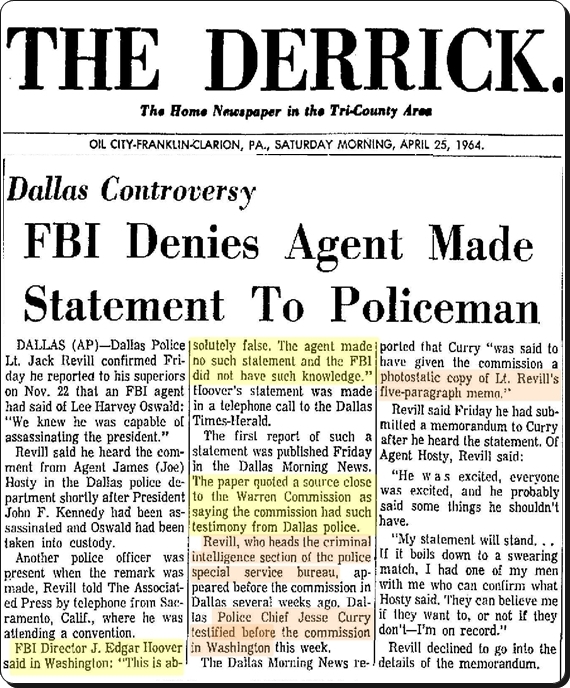
On April 24, 1964, the Dallas Morning News had contained an article concerning a "five-paragraph memo" prepared by Lieutenant Jack Revill, which had been passed along to Chief of Police Jesse Curry. Curry, who had testified before the Warren Commission (WC) during the third week of April, gave the Commission a copy of the memo. Following up on Curry's testimony, the Dallas Morning News quoted "a source close to the Warren Commission" about the evidence presented to the WC, including Revill's memo. The Associated Press called Lt. Revill at a convention in Sacramento, California, and were told that another Dallas policeman could confirm that FBI Agent James (Joe) Hosty had told the local police: 
"We knew he [Oswald] was capable of assassinating the president..."
Jack Revill had first appeared before the Warren Commission on March 31, three weeks before his Chief, but had been questioned only in regard to the shooting of Lee Oswald by Jack Ruby. Apparently the WC questioners were unaware of the Friday afternoon headlines which zeroed in on Oswald and quoted Revill's immediate superior, W. Pat Gannaway, saying that Oswald had been to the Soviet Union and had a Russian wife, even obtaining a 1959 photo of Oswald when he left Fort Worth, later ending up in Moscow.

While the AP contacted Revill in California, the rival paper of the Morning News, the Dallas Times Herald, contacted FBI Director J. Edgar Hoover. He furnished them a most amazing statement:
"This is absolutely false. The agent made no such statement and the FBI did not have such knowledge."
The only thing absolute in this flap was that somebody was lying. Was it a member of the local Dallas police, or was it a member of the FBI?

To discover the truth, Lt. Revill was called back to the WC on May 13 to testify about his conversation with Agent Hosty in the DPD. Revill said he had previously conducted a "systematic search" of the Texas School Book Depository offices (located at 411 Elm) along with numerous other detectives from his office. He went directly from that location to the basement of DPD, where he got out of his car and allowed it to be parked by a staff member. Before he could enter the headquarters building, he testified, Agent Hosty had run up to him, saying:
"Jack, a Communist killed President Kennedy....Lee Oswald killed President Kennedy....He is in our Communist file. We knew he was here in Dallas." 

 Both Gannaway and Revill have been discussed previously at this blog in connection with the framing of Candy Barr for narcotics possession. As undercover narcotics policemen in Dallas, they also knew George W. Owen, a man once married to Maurine Biner, the woman John Dean eventually married shortly after the Watergate break-in in Washington, D.C. Owen was said to have been present at the Murchison home on November 21, 1963, along with LBJ's girlfriend, Madeleine Duncan Brown, and others who overheard LBJ threaten that after the following day Johnson would not have to put up with Kennedy any more. Is it possible Owen's police friends heard about the plan from him and were prepared to release the background on Oswald quickly? Also according to Brown, George Owen had driven to Redbird Airport in Dallas the night of the 21st to meet J. Edgar Hoover's plane and deliver him to the Murchison party. She said Owen was ready to talk when he suddenly dropped dead. Read more on this story at the March 26, 2011 posting, "

George W. Owen, a Friend of LBJ's Mistress."

Olean Times Herald - Sept. 14, 1949
Turkey Field Day Planned Near Titusville
TITUSVILLE. Pa — Turkey growers of northwestern Pennsylvania will have a field day starting at 1:30 p m on Thursday, September 22 at Bob Lowers' Valley View Turkey Farm. Lowers' place is located four miles south of Titusville just off Route B. Turkey growers and scientists have learned to surmount many obstacles. One of their latest is to stimulate turkeys to put on more flesh and fat by a biological chemical process. This is one by injecting two small white pellets under the loose skin of the turkey's head. These pellets are smaller than kernels of wheat and chemically are known as diethylstilbesterol.When Injected into toms 19-21 weeks of age they stimulate the birds to put on more flesh and fat. This fine finish allows early hatched  toms to be marketed earlier.


 THE GETTYSBURG TIMES, JULY 2, 1988
By ROBERT C. PARK, M.D., President, 
The American College of Obstetricians And Gynecologists
For the past several years, there have been different opinions on how frequently you should have a Pap smear. In January, several national medical organizations formulated one set of guidelines for you and your physician to follow. The American Cancer Society, the National Cancer Institute, the American Medical Association and The American College of Obstetricians and Gynecologist were among the groups that agreed to the new guidelines. Those guidelines state that all women who are 
  • at least 18 years old, or 
  • who are sexually active before age 18, 
should have a Pap smear once a year. If three consecutive annual smears are negative, and you are not at high risk for any of the conditions that could lead to cervical cancer, then your doctor can decide if you need to continue having the test every year, or if you can have it on a less frequent basis. 

Many women should continue to have the exam every year, even if three consecutive smears are negative.
These women are considered to be at high risk for cellular changes on their cervix. They are 
  • women who have had more than one sexual partner, or 
  • whose partner has had more than one partner, 
  • those who were sexually active before age 18, 
  • those with a history of human papillomavirus or other vaginal infections, and 
  • those women whose mothers took diethylstilbesterol (DBS) during their pregnancies.
If a woman is in one of these high-risk groups, an annual Pap test will provide an early warning system to protect her health and her life. If an abnormal condition exists on your cervix, the Pap smear can detect it in the beginning stages when it can be treated and cured. If you are not sure whether you fall into a highrisk
category, it is a good idea to continue to have a Pap smear every year.
THE OGDEN (UTAH) STANDARD-EXAMINER - DECEMBER 5, 1954
NEW YORK (AP)—Daily doses of a sex hormone, diethylstilbesterol, look promising for preventing sex gland complications in men attacked by mumps, Lts. William T. Hall and Raymond N. F. Killeen, U. S. Naval Hospital here, write in the U.S. Armed Forces Medical Journal.

The hormone is given before there are any signs of involvement of the sex glands by the mumps virus. Only nine out of 63 men getting the hormone developed the complication, compared with one-third of 34 men not getting the hormone treatment.


THE DAILY GLOBE, Ironwood, Mi. - Friday, March 2, 1984
Wart-causing virus linked to cervical cancer 
DETROIT (AP) — Researchers say they have linked a sexually transmitted virus that causes genital warts to cervical and other cancers. Further studies could could lead scientists to a vaccine for human cancer, a gynecologist at Detroit's Sinai Hospital said Thursday. 

"The exciting thing about this is that it's likely, before the end of the decade, to build a vaccine for this virus and introduce a program for the prevention of a primary human cancer," said Dr. Richard Reid.
The "human papillomavirus" has been linked to cervical and other cancers in studies conducted in Detroit and at the German Cancer Institute in West Germany, Reid said. In samples of vaginal skin, 95 percent of the cancers and 88 percent of "precancers" showed the virus, compared with only 12 percent in normal specimens, Reid said. The virus causes visible genital warts around the penis or anus of men, but in women, "the lesion can't be seen with the naked eye," he said. 

In a separate study conducted by German virologist Harald Zurhausen, the DNA in 89 percent of the 55 cancerous specimens tested reacted positively to the virus, indicating that the virus was present, Reid said.
"At this time, it's true to say the number of deaths from cervical cancer has been falling," he said. "The death rate in young women is actually increasing rather than decreasing, and the number of people with this virus has also increased.
"If not for the pap smear program, we'd have a tragic epidemic of cervical cancer." 

Other factors contributing to cervical cancer include smoking, herpes infection and a person's immune system!
Women are at high risk if they were under 20 years old when they had their first sexual experience, had more than three sexual partners or had intercourse with a man who had had multiple partners, according to the American Cancer Society.
"Another factor that is important is that there are at least five of these viruses that are sexually transmitted,"
Reid said.

"For both males and females, this is a persistent virus, and getting this virus often means a lifelong infection,"
he said. "Or some people are lifelong carriers, and so they can have no awareness, themselves, of the disease and yet infect other people, or ... slowly have a malignancy grow in this area of chronic infection."
The virus may also be involved in other squamous cancers, or cancers involving the skin or epidermal cells, said Reid. "It is suspected also in cancers of the mouth, throat, larnyx, and bronchus."

Monday, August 29, 2011

America's Krypto-History: What we don't know does matter

To follow the excellent logic of Peter Dale Scott relative to what is truth and what is true history first requires us to take a short course in a language invented by Dr. Scott himself, as he discusses in the article excerpted below, in which all underlining, bolding and italics have been inserted by me, unless otherwise noted,  for emphasis. Scott embeds the terms and definitions within his essay, but for clarity they are set out here for ease of reference:
  • neologisms--invented terms
  • parapolitics--manipulative covert politics; "a system or practice of politics in which accountability is consciously diminished"
  • deep political processes--political interactions that emanate from plural power sources which are only occasionally visible, usually repressed rather than recognized; these sources of power that affect political actions are not subject to direct control by anyone whose power or intentions are clearly defined
  • parahistory--an account of suppressed events, at odds with the publicly accepted history of this country; reconstructed account of events denied by the public records from which history is normally composed
  • kryptocracies--agencies of government which (in contrast to conventional bureaucracies) operate secretly and are not accountable for their actions and procedures, with the power to control US politics through the manipulation of truth. A kryptocracy's power comes in part from its ability to falsify its own records, without fear of outside correction.
  • kryptonomy--the power of the independently wealthy, and of the banks that cater to them; a small group of about 100 people who know each other, and in addition often have connections to both the CIA and to organized crime

 ['krypto' derived from Greek kruptos hidden, from kruptein to hide]


Excerpt from OVERVIEW: THE CIA, THE DRUG TRAFFIC, AND OSWALD IN MEXICO


By Peter Dale Scott
December 2000

Kryptocracies, Kryptonomy, and Oswald: the Mexican CIA-Mob Nexus 


Those who have spent years trying to assess the role of the Kennedy assassination in US history are accustomed to the debate between structuralists and conspiratorialists. In the first camp are those who argue, in the spirit of Marx and Weber, that the history of a major power is determined by large social forces; thus the accident of an assassination, even if conspiratorial, is of little historical import. (On this point Noam Chomsky and Alex Cockburn agree with the mainstream US media they normally criticize.) 


The Secret Team: The CIA and Its Allies in Control of the United States and the World (Second Edition)At the other end of the spectrum are those who talk of an Invisible Government or Secret Team, who believe that surface events and institutions are continuously manipulated by unseen forces. For these people the assassination exemplifies the operation of fundamental historical forces, not a disruption of them. 


For years I have attempted to formulate a third or middle position. To do so I have relied on distinctions formulated partly in neologisms or invented terms. (I apologize for this: neologisms, like conspiracies, are not to be multiplied beyond necessity.) Thirty years ago I postulated that our overt political processes were at times seriously contaminated by manipulative covert politics or parapolitics, which I then defined as "a system or practice of politics in which accountability is consciously diminished."[1] In Deep Politics and the Death of JFK, I moved towards a less conspiratorial middle alternative. I discussed instead the interactions of what I called deep political processes, emanating from plural power sources and all only occasionally visible, all usually repressed rather than recognized. In contrast to parapolitical processes, those of deep politics are open-ended, not securely within anyone's power or intentions. 


In 1995 I brought out Deep Politics II, which I thought of at the time as a case study in deep politics: how secret U.S. government reports on Oswald in Mexico became a reason to cover up the facts about the assassination of JFK. But it was also a specialized study, since in this case most of the repressed records of events, now declassified, occurred within the workings of the CIA, FBI, military intelligence, or their zones of influence. It was hence largely a study in parapolitics. It verged into deep politics only near the end, when it described how a collaborating Mexican agency, the DFS (Direcciòn Federal de Seguridad) was deeply involved in the international drug traffic. Deep Politics, in contrast, looked continuously at the interaction between government and other social forces, such as the drug traffic. 


Both books represented an alternative kind of history, or what we may perhaps call parahistory. Parahistory differs from history in two respects. First, it is an account of suppressed events, at odds with the publicly accepted history of this country. (One might say that history is the record of politics; parahistory, the record of parapolitics.) Second, parahistory is restored from records which were themselves once repressed. In short, parahistory is a reconstructed account of events denied by the public records from which history is normally composed.[2] Thus the parahistory of Oswald in Mexico tells of events, not just ignored by official histories, but at odds with the official record: i.e. officially suppressed and denied. 


A key example concerns a tape of someone calling himself "Lee Oswald," talking on a Soviet Embassy phone about having met a consul there by the name of Kostikov, a KGB agent. As we shall see, this tape should have been preserved and investigated as a prime piece of evidence to frame Oswald as an assassin. We have documentary evidence that one day after the President's murder this tape was listened to by FBI agents in Dallas, who determined that the speaker was in fact not Lee Harvey Oswald. Yet almost immediately this event was denied by other reports, including cables claiming -- falsely -- that the tape had already been destroyed before the assassination. 


A brief but important digression here about history. Most people assume that "history" simply refers to what has happened but is now gone. In fact the dictionary reminds us that the word (cognate to the word "story") refers primarily to a narrative or record of events, and only after that to "the events forming the subject matter of history."[3] What of events whose records are destroyed or falsified? These dictionary definitions seem to assume that what is true is also what is recorded. 


There is thus a latent bias in the evolution of the word "history" that is related to the structuralist, rationalist assumptions referred to in my first paragraph. It is no accident that, with respect to Oswald in Mexico, historians as a class have opposed the parahistory we shall unfold here. History has always been the way a culture chooses to record and remember itself; and it tends to treat official records with a respect they do not always deserve. We shall return to the role of history in our concluding section. 


Deep Politics II only verged from parahistory into deep political history when (as we shall see) it situated actions and reports from the CIA in Mexico City in the social context of actions of a sister agency (the Mexican Federal Security Directorate, or DFS ) which was deeply enmeshed in the unrecorded operations of the Mexican-U.S. drug traffic. Note the methodological distinction here. Parahistory can be partly recovered by the disclosure of previously repressed records. Deep political history must attempt to reconstruct what happened in areas where there are few if any records at all. 


It is reasonable to talk about the CIA records in this book as repressed, as so many of them were never allowed to reach even the Warren Commission. Thus neither the Commission nor the American public were allowed to hear allegations that Oswald had had sexual relations with one or two employees of the Cuban Embassy in Mexico City, that at least one of these liaisons (with Silvia Durán) had been part of an international Communist plot against Kennedy, and that Durán had admitted this (albeit under torture) in response to questions from the Mexican DFS or secret police. 


More importantly, the CIA and FBI conspired to suppress a major clue to the existence of a pre-assassination conspiracy. This was that an unknown person had falsely presented himself as Lee Oswald in a phone call to the Soviet Embassy in Mexico City. The FBI initially reported that the person making the recorded call "was not Lee Harvey Oswald" (AR 249-50). Later the FBI and CIA conspired, swiftly and clumsily, to conceal both the falsity of the impersonation and the fact that FBI agents had exposed the falsehood by listening to the tape. The Warren Commission learned nothing about these two facts. 


Thy Will Be Done: The Conquest of the Amazon : Nelson Rockefeller and Evangelism in the Age of Oil
Rockefellers in Mexico
It is important to understand that this suppression was entirely consistent with intelligence priorities of the period. This important clue had been planted in the midst of one of the most sensitive CIA operations in the 1960s: its largest intercept operation against the telephones of an important Soviet base. One can assume that this clue was planted by conspirators who knew that the CIA response would be to suppress the truth. As a result the CIA protected its sources and methods (in accordance with the responsibilities enumerated in its enabling statute). The result was obstruction of justice in a crime of the highest political significance.


In an open society, all of the Oswald facts and allegations would have reached the Warren Commission, whether or not they were true. The absence of objective evaluation and review allowed these facts and allegations about Oswald in Mexico to become enabling instruments of power: first to create the Warren Commission, and later to curtail its investigations. 


The power of these covert agencies to control US politics through the manipulation of truth is only one more reason for us to refer to them as kryptocracies, agencies of government which (in contrast to conventional bureaucracies) operate secretly and are not accountable for their actions and procedures. At this stage, I shall refer to kryptocracies in the plural, to make it clear that I am not talking about some single omnipotent Secret Team. On the contrary, we shall see in Part Three of this book that different kryptocracies or intelligence agencies, and even different branches within these agencies, were in conflict with each other over the matters raised by Lee Harvey Oswald.


Drug Wars and Coffeehouses: The Political Economy of the International Drug Trade The point is rather that, in major powers like the United States, bureaucratic behavior, which in principle is publicly  recorded and accountable, is in some respects determined by the kryptocratic behavior at its center.  As we shall see in the following pages, one of the important sources of the kryptocracies' power is their ability to falsify their own records, without fear of outside correction. 


But even if we concede the autonomy of kryptocracies, how important are they in determining the course of history? I believe the evidence in this book will justify a limited answer to this question: 
The kryptocracies, and the CIA in particular, were powerful enough to control and defuse a possible crisis in U.S. political legitimacy. They did so by reinforcing an unsustainable claim: Oswald killed the President, and he acted alone.

Kryptocracies and the Kryptonomy (International Drug Traffic)


Policing America's Empire: The United States, the Philippines, and the Rise of the Surveillance State (New Perspectives in Se Asian Studies)But the power of kryptocracies to influence history became even greater when, as we shall see, they acted in concert with forces allied to the powerful international drug traffic. Most people are unaware of the size of this unrecorded drug economy. In 1981 U.S. Government analysts estimated that the annual sales volume of illicit drugs exceeded half a trillion dollars.[4] The total of legitimate, recorded international trade, in all commodities, was in the order of one trillion dollars, or twice the estimate for drugs. While estimates of the unrecorded drug traffic remain questionable, it is obvious that this traffic is large enough to be a major factor in both the economic and political considerations of government, even while it does not form part of recorded economic statistics. [italics in original]


For this reason, I propose the word kryptonomy, to name this unrecorded, illicit, but nonetheless important shadow economy. It is no accident that kryptocracies and the kryptonomy work in concert. The kryptonomy is so large, and so powerful, that governments have no choice but to plan to manage it, even before attempting to suppress it.[5]
 

There is a third factor contributing to the invisible alliance of kryptocracies and the kryptonomy: the power of the independently wealthy, and of the banks that cater to them. Informed observers of American politics have more than once commented to me that most of the hundred wealthiest people in the US know each other, and in addition often have connections to both the CIA and to organized crime. There is no shortage of anecdotal examples: James Angleton of CIA Counterintelligence delivering the sole eulogy at the small private funeral of Howard Hughes, or Joseph Kennedy Sr. being a point-holder in the same casino (the Cal-Neva) as Sam Giancana.[6]  More relevant to the milieu of the JFK assassination is the example of Clint Murchison, Sr. Murchison paid for the horse-racing holidays of FBI Director J. Edgar Hoover at the same time as he sold stakes in his investments to mob figures like Jerry Catena, and enjoyed political influence in Mexico.[7]


These connections are no accident. More often than not the extremely wealthy became that way by ignoring or bending the rules of society, not by observing them. In corrupting politicians, or in bypassing them to secure unauthorized foreign intercessions, both the mob and the CIA can be useful allies. In addition drug profits need to be laundered, and banks can derive a significant percentage of their profits by laundering them, or otherwise bending or breaking the rules of their host countries.[8] Citibank came under Congressional investigation after having secretly moved $80 million to $100 million for Raul Salinas de Gortari, brother of former Mexican president Carlos Salinas.[9]
 

When operating within their guidelines, kryptocracies are less powerful than generally believed. Likewise the power of the biggest drug traffickers is not autonomous, but depends on their government connections. But when kryptocracies and kryptonomy work in concert, as they must to sustain the status quo, they share in a source of deep political influence that affects us all. A good example of this is the collaboration in Mexico, between the CIA and the corrupt DFS, to influence history by presenting false stories about Oswald. But it would be wrong to think of the CIA-DFS collaboration as a simple alliance.


One of the most crime-ridden CIA assets we know of is the Mexican DFS, which the US helped to create. From its foundation in the 1940s, the DFS, like other similar kryptocracies in Latin America, was deeply involved with international drug-traffickers. By the 1980s possession of a DFS card was recognized by DEA agents as a "license to traffic;" DFS agents rode security for drug truck convoys, and used their police radios to check of signs of American police surveillance.[10] Eventually the DFS became so identified with the criminal drug-trafficking organizations it managed and protected, that in the 1980s the DFS was (at least officially) closed down.[11]Thus the CIA-DFS alliance was at best an uneasy one, with conflicting goals. The CIA’s concern was to manage and limit the drug traffic, while the DFS sought to manage and expand it.


Management of the drug traffic takes a variety of forms: from denial of this important power source to competing powers (the first and most vital priority), to exploitation of it to strengthen the existing state.  There now exists abundant documentation that, at least since World War II, the US Government has exploited the drug traffic to finance and staff covert operations abroad. Perhaps the most conspicuous example is the massive paramilitary army organized and equipped by the CIA in Laos in the 1960s, for which drugs were the chief source of support. This alliance between the CIA and drug-financed forces has since been repeated in Afghanistan (1979), Central America (1982-87), and most recently Kosovo (1998). 


It is now fairly common, even in mainstream books, to describe this CIA exploitation of the drug world as collaboration against a common enemy. For example Elaine Shannon, in a book written with DEA assistance, speaks as follows of the CIA-DFS alliance: 
Drug Politics: Dirty Money and Democracies (International and Security Affairs) DFS officials worked closely with the Mexico City station of the US Central Intelligence Agency and the attaché of the the Federal Bureau of Investigation. The DFS passed along photographs and wiretapped conversations of suspected intelligence officers and provocateurs stationed in the large Soviet and Cuban missions in Mexico City....The DFS also helped the CIA track Central American leftists who passed through the Mexican capital.[12]


But it is important to remember that such alliances were often first formed in order to deny drug assets to the enemy. In Mexico as in Asia, just as in the US "Operation Underworld" on the docks of New York City, the US Government first began its drug collaborations out of fear that drug networks, if not given USG protection, would fall under that of some other foreign power. "Operation Underworld," like its Mexican equivalent, began after signs that the Sicilian Mafia in New York, like the drug networks Latin drug networks of Central and South America, were being exploited by Axis intelligence services. The crash program of assistance to Kuomintang (KMT) drug networks in post-war Southeast Asia was motivated in part by a similar fear, that these networks would come under the sphere of mainland Chinese influence. 


Narcos Over the Border: Gangs, Cartels and MercenariesMexico: Narco-Violence and a Failed State?Thus it would be wrong to portray the CIA-drug alliance, particularly in Mexico, as one between like-minded allies. The cooperation was grounded in an original, deeper suspicion; and, especially because dealing with criminals, the fear of betrayal was never absent. This was particularly true of the DFS  when guided by Luis Echeverría, a nationalist who in the late 1960s developed stronger relations between Mexico and Cuba. Some have questioned whether the increased Cuban-Mexican relations under his presidency (1970-76) were grounded partly in the drug traffic, overseen by his brother-in-law.[13]
 

Even in 1963 the fear of offending Mexico's (and Echeverría's) sensibilities led the CIA to cancel physical surveillance of a Soviet suspect (Valeriy Kostikov); the CIA feared detection by the DFS, who also had Kostikov under surveillance.[14] By the 1970s there were allegations that the CIA and/or FBI were using the drug traffic to introduce guns into Mexico, in order to destabilize the left-leaning Echeverria government.[15]
 

This is perhaps the moment to point out another special feature of the US-DFS relationship in Mexico. Both the CIA and FBI (as Shannon noted, and as we shall see) had their separate connections to the DFS and its intercept program. The US effort to wrest the drug traffic from the Nazi competition dated back to World War II, when the FBI still had responsibility for foreign intelligence operations in Latin America. Winston Scott, the CIA Station Chief in Mexico City, was a veteran of this wartime overseas FBI network; and he may still have had an allegiance to Hoover while nominally working for the CIA.[16] We shall see that on a key policy matter, the proposed torture of Oswald's contact Silvia Durán, Scott allied himself with the FBI Legal Attache and the Ambassador, against the expressed disapproval of CIA Headquarters. 


What is particularly arresting about this CIA-mob nexus that produced false Oswald stories, is its suggestive overlay with those responsible for CIA-mob assassination plots. Key figures in the latter group, such as William Harvey and David Morales, did not conceal their passionate hatred for the Kennedys. It is time to focus on the CIA-mob connection in Mexico as a milieu which will help explain, not just the assassination cover-up, but the assassination itself. 


[1]  Peter Dale Scott, The War Conspiracy, 171.
[2]  There are previous examples where the actual events of American history are at odds with the public record. Allen Dulles represented the conventional view of John Wilkes Booth when he represented Booth to the Warren Commission as a loner, ignoring both the facts of the case and what is known now of Booth's secret links to the Confederate Secret Service (Scott, Deep Politics, 295; cf. Tidwell, William A., with James O. Hall and David Winfred Gaddy, Come Retribution: the Confederate Secret Service and the Assassination of Lincoln. [Jackson: University Press of Mississippi, 1988]).
[3]  American Heritage Dictionary, s.v. "history."
[4]  James Mills, The Underground Empire: Where Crime and Governments Embrace (New York: Dell, 1986), 1139.
[5]  For a candid account of how KMT China was torn between management and suppression of the opium traffic, see Alan Baumler, "Opium Control versus Opium Suppression: The Origins of the 1935 Six-Year Plan to Eliminate Opium and Drugs," in Opium Regimes: China, Britain, and Japan, 1839-1952, ed. Timothy Brook and Bob Tadashi Wakabayashi (Berkeley and Los Angeles: University of California Press, 2000), 270-91. Baumler notes how "The opium trade was a vital source of income and power for most of the colonial and national states of East and Southeast Asia" (270). I believe this state of affairs is less restricted, and has changed less, than his choice of terms implies.
[6] These and other examples in Sally Denton and Roger Morris, The Money and the Power: The Rise and Reign of Las Vegas and Its Hold on America, 1947-2000  (New York: Knopf, 2001), 185,290, etc.
[7] Peter Dale Scott, Deep Politics and the Death of JFK, 207, 218-19.
[8] For an instructive example involving Citicorp, America’s largest bank, see Robert A. Hutchison, Off the Books (New York: William Morrow, 1986). This Citicorp scandal (one involving double bookkeeping and tax evasion rather than drugs) was richly documented by first the SEC staff and then a Congressional Hearing, yet it was successfully suppressed through political influence.
[9]  New York Times, 11/11/99:  A Senate Committee “subpoenaed Citibank for transcripts of conversations among its private bankers on March 1, 1995, the day after Mr. Salinas had been arrested for murder. He has been convicted and is in prison in Mexico. In one conversation, the head of Citibank Private Bank, Hubertus Rukavina, asked whether Mr. Salinas's money could be moved from trust accounts in London to Switzerland, which has strict secrecy laws, according to the transcript.”
[10]  Peter Dale Scott and Jonathan Marshall, Cocaine Politics, 39.
[11]  Chapter XII; Peter Dale Scott, Deep Politics and the Death of JFK, 104-05.
[12]  Desperados, 180.
[13]  Cf. Mills, Underground Empire, 840-43, 550.
[14]  MEXI 7041  24 November 1963; NARA #104-10015-10070.          
[15]  Mills, Underground Empire, 549-50; cf. Kruger, The Great Heroin Coup, 178-79.
[16]  Cf. Scott, Deep Politics and the Death of JFK, 107-08.