Monday, June 13, 2011

Dal-Tex Building at 501 Elm in Dallas

It seems that the companies which operated within the Dal-Tex Building were part of the textile industry which was marketed through the Dallas fashion center, which periodically changed its name to reflect a broader area it encompassed.

Ian Griggs posted the following:

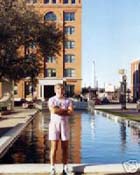
The photograph of Day with the plaque behind him is in Matthew Smith's "JFK: The Second Plot" and several other books. The companies listed on the plaque are as follows:
Allyn & Bacon, Inc.
American Book Co.
Gregg Publishing Division
Lyons and Carnahan
McGraw Hill Book Co.
The MacMillan Co.
Scott, Foresman & Co. [employer of Vickie Adams, Girl on the Stairs]
Southwestern Publishing Co.
I think those are the only book and publishing companies which rente premises in the building. Employees from thoswe lodger companies did not all appear on the infamous list of absentees. For example, Warren Caster was the Regional Manager of Southwestern Publishing Company but his name was not on the list despite him being away in Denton all day. They didn't seem to bother about all the employees of the above companies.
 If you get around to the Dal-Tex Building, the following companies had premises inside the building:
M & B Manufacturing Co, Inc.
Eddie Mister, Inc.
Adaptables, Unc.
Marilyn Belt Manufacturing
Dallas Uranium & Oil (aka DUO)
Edward Barry Inc.
Miller Cupaioli, Inc.
Stanlea of Dallas
McKells Sportswear, Inc.
Edwill Fashions
Cupaioli/Leeds Ltd.
Jennifer Juniors, Inc.
Hope this helps.
IAN
We have already identified some of the above companies in previous blog posts. Jennifer Juniors, Inc. was Abraham Zapruder's company, and Morty Freedman operated M & B, Marilyn Belt, and Mr. Eddie's. We can learn more about the other companies, listed in boldface above, in various news media in the 1950's. Mildred Whiteacre, fashion editor for San Antonio's  Express and News boasted in a March 1955 item:
Whoops! I'm headed Northeast again—this time to Dallas and three style-packed days as guest ot the Dallas Fashion Center. More than 30 newspaper fashion editors will be on hand for a preview of the summer collections of 23 Dallas clothing and accessory manufacturers, all members of the Fashion Center. Texas is gaining more and more prominence in the ready-to-wear manufacturing picture each season, and fashion editors on hand for this current showing will represent cities throughout the country....
A preview of three Dallas manufactured ensembles to be presented during the Dallas Fashion Center's press week beginning Monday. Left, a subtly curved, soft suit of cotton and silk with printed silk collar and cuffs by Miller-Cupaioli.
M.C. Feldman was said to be president, and Clyda Johnson the director, of the Dallas Fashion Center.

Another news article (press release?) datelined Dallas 1958 that appeared in the Tucson Daily Citizen:
Boxy blouson jackets, ribbon trim and decorative use of white buttons marked the summer collection of Miller-Cupaioli Inc. and Edward Barry, Inc. This company, which manufactures under two labels—the Miller Cupaioli and Edward Barry, Inc., specializes, in high fashion silk ensembles—with emphasis on fabrics. They are the largest users of Italian silks in America.
When we search the phrase "Dallas Fashion Center," one of the hits discusses research of both Russ Baker (Family of Secrets) and Bruce Adamson in his self-published manuscripts about George de Mohrenschildt's many relationships. Adamson, who is not a writer, did a phenomenal amount of research. Unfortunately for him, research is not something that is subject to copyright laws; only the published words writing up that research can by protected under the federal law. Baker did give Adamson credit for discovering some priceless information and paid him for Adamson's self-published "books," but for some reason Adamson still felt miffed, as we detect here:
Bruce Adamson
Many people have watch [sic] author Russ Baker being interviewed on TV and Radio about his book Family Secrets. People who have studied the JFK assassination have said to me that he has stolen my work. Without making a judgment I can only point out that Russ Baker purchased my 14 volumes and made a threat he was going to use the material that I spent 19 years working on with or without my help.

One needs to only look at my radio shows since 1992 and my books to see that Baker has used in four of his chapters are identical material. Yet, different words. One can not copyright facts. If you have to read Family Secret's [sic] I recommend checking it out of the library.
As any literate person can see from this example, reading Adamson's work is nerve shattering for anyone with even a smattering of grammar and syntax, not to mention the ability to spell. Later in his diatribe, he writes: 
Baker p. 78-79; In 1953 Jeanne and Robert LeGon moved to Dallas. Her first job there was as a designer with Nardis Sportswear, which was owned by Bernard L. "Benny" Gold a tough-talking Russian-born Jew who had started out as Brooklyn cabdriver and ended up as a titan of the Dallas fashion scene. The store shipped goods out on planes via Slick Airways, owned by the oilman and renowned explorer Tom Slick, a Dresser Industries board member and good friend of Prescott Bush. Benny Gold knew everyone he was president of the Dallas Fashion Center and the huge parties. When Jeanne first arrived in town, Benny Gold put her up in his mansion. Gold joined all the anti-Communist groups as well as Neil Mallon's Dallas Council of World Affairs. He employed... Jeanne designed clothing, her coworker Abraham Zapruder cut the patterns and material. A decade later Zapruder, by then the owner of his own company would become world famous for his breathtaking home-movie footage of the Kennedy Assassination. Adamson vol. 1 p. 77-78. Adamson's discovery on Bernard Gold was published in the Dallas Morning News twice he ran ad to locate 4 people to confirm at a cost of $1,000 dollars for a month. [my emphasis added]
Russ Baker had contacted me some weeks before he even heard of Bruce Adamson. I know because I was the one who told him about the research Adamson had done, apologizing profusely for Adamson's inability to convey his ideas articulately. Baker looked at the information and together we verified everything before it was used in the book. He insisted on purchasing the work because he found it valuable, and he offered to work with Adamson further, but was refused. Yet Adamson still complains--whines--because he doesn't like the fact that he can't write. It's like a gold miner wanting credit for a gold ring a jeweler creates.

Adamson is his own worst enemy. The information, as I say, is priceless, but if he was willing to pay $1,000 a month to run an ad, he should have forked over an equal amount to pay someone to write the data up into a well-worded narrative about what happened.

For anyone who wants to know about George Bush's possible links to the Kennedy assassination, I highly recommend Baker's book, whose limited subject was about George W. Bush and how he was molded into the man he was by his father. This is not an assassination book per se, however. For anyone who considers himself/herself to be a researcher who can wade through redundant facts stated in a way that makes you want to cringe, I also recommend Adamson's work as a resource for further research, even though many of the conclusions he drew from the facts were somewhat laughable. I cannot praise his research skills enough!

The facts and data that researchers find, by whatever means and expense it takes to get there, are the truth. Truth cannot be copyrighted. Anyone can tell a story that is true in his own words without violating anyone's copyright. When Adamson published his research by furnishing copies of it and selling the copies, he more or less provided the work to anyone else to use without additional payment for the research. All he has left are sour grapes, but that's the law.

But that's enough carping. Onward and upward!

Further investigation into the history of the Dallas Fashion Center reveals in a 1965 Marketing masters thesis written by Edward Kay Fisher, that the Center began in 1942:
The Dallas market realized its potentialities in June, 1942, when the Dallas Fashion & Sportswear Center (later the Dallas Fashion Center, and eventually Texas Fashion Creators), was bom. Later, during the war years, traveling was difficult and the Office of War Transportation issued a directive canceling all conventions and trade shows....A growing problem in 1946 was the shortage of hotel rooms for buyers wishing to attend the market, A housing committee was established to assist in finding rooms in private residences where buyers could stay during Market Week, After the war, business was booming as more goods became available and the association grew rapidly.
The Dallas Fashion Center discussed in the above thesis was referred to as one "marketing group" utilized by textile manufacturers. In March of 1951 readers of the Ogden Standard-Examiner were told: "This week's style shows, designed to place the Lone Star state firmly on the world's fashion map, are sponsored by the Dallas Fashion Center, an organization of some 40 of the city's 80 apparel manufacturers, who do a total business of $150 million a year." Dallas directories show the center to have been located in the Chamber of Commerce building in Dallas at 1101 E. Commerce St.

Texas Fashion Creators began to evolve in 1961 out of the Dallas Fashion Manufacturers Association, already rated second to New York in the number of manufacturers of clothing in the United States. The Texas State Historical Association handbook tells us:
During the 1930s such Dallas companies as Nardis, Donovan, Marcy Lee and Justin McCarty capitalized on the marketability of the low-cost cotton house dress and produced new distinctive lines of sportswear, especially ladies' slacks, for national consumption. Texas had 73 clothing factories in 1917, 102 in 1929, and 103 in 1933. The receipt of federal contracts to manufacture large quantities of military uniforms during World War II enabled Texas firms to modernize plant machinery and expand national sales contacts. In 1942 manufacturers formed the Dallas Fashion and Sportswear Center, now the Southwest Apparel Manufacturers Association. This aggressive trade organization used advertisements in national fashion magazines, sponsored elaborate style shows, expanded the size and number of apparel markets held in Dallas, and published its own magazine, Dallas Fashion and Sportswear (later Texas Fashions) from 1942 to 1972....A catalyst to the continued growth of the Texas industry was the opening of the $15 million Apparel Mart building in Dallas in 1964. By 1984 it was the nation's largest wholesale fashion market under one roof, having 2.3 million square feet of space in seven stories with 2,000 separate showrooms. The Apparel Mart attracted approximately 80,000 buyers annually.
Time Magazine also did a close-up in 1950 on the man it called Benny Gold:

Tough-talking Benny Gold often sounds like a New York cab driver, and used to be one. Born in Russia, he started a taxicab company in Brooklyn soon after World War I, went broke when he tried to buck the cab drivers during a taxi strike in 1938. Confesses Benny: "They run me out."
Corduroy Man. Benny ran all the way to Texas, where his brother Irving was part owner of Nardis, a near-bankrupt dress firm which he wanted Benny to pull out of the red. To the horror of other Dallas garment-makers, who are still only 20% unionized, Benny called on the International Ladies' Garment Workers' Union for help. I.L.G.W.U. engineers taught him an assembly-line method of making dresses. Benny not only signed a union contract but became the first Dallas manufacturer to employ Negroes....
As president of the Dallas Fashion Center, formed three years ago by 40 of the biggest manufacturers, he whooped it up with a welcoming party at Pappy's Showland nightclub, got up early to greet buyers at his own shop.
Texans in the late 1940's must have really freaked out when Gold brought in the union, which David Dubinsky led, and hired blacks to work alongside white workers.

Irving Gold in 1939 was involved in incorporating the Texas Novelty Jewelry Co., Inc., Dallas; manufacturing; capital stock. $10,000. Incorporators: Irving Gold, Fred Levy, and Martin Rosenbaum. Fred Levy was listed in a Dallas 1944-46 directory at the address 912 Commerce St., and Martin Rosenbaum (novelties) at 906 Commerce. There was no listing under the manufacturers agents for Irving Gold, but the name of Irving and Celia Gold did show up in a regular listing as a venetian blind maker at 216 N. Marsalis in Oak Cliff, while Fred S. Levy and his wife Hermine lived at 6113 Vincient (possibly Vincent Ave).


Saturday, June 11, 2011

Other Uranium Explorers in Texas in the 1950's

According to J. Evetts Haley's account, Morris D. Jaffe had help from LBJ's connections in Washington to get his alleged uranium field certified as "rich" by the AEC. As the grandson of real estate investors, he was then able to buy up options to purchase adjoining lands in which he optioned off prior to the uranium crash, apparently to Climax Molybdenum Company (see article below). Whether or not Karnes County mines contained an abundance of uranium or not, they were actively worked for a time by strip mining, which brought molybdenum to the surface which ranchers claimed in 1977 had poisoned their cattle.

What Haley failed to mention in his long diatribe against Jaffe was the plethora of others engaged in searching for uranium during the same time. The same producer who operated the mines in Karnes County was also engaged in production in Colorado according to Time Magazine
  •  here: ("Climax Molybdenum Co., one of the nation's biggest uranium producers, bought Whitehill") and
  • here: ("With a string of uranium mines and one mill already operating at capacity in Colorado's plateau country, Climax announced that it was moving its uranium subsidiary headquarters from New York to Grand Junction, Colo., to be closer to actual operations, making it easier to expand into uranium. Though the company netted only $428,248 (4.4% of total profits) from uranium in fiscal 1953, it is prospecting for more lodes, will build new ore-processing plants wherever needed. Said Climax President Arthur H. Bunker: 'Our plan is to be very active in uranium. The acquisition of property is continual.' ")

Using Haley as his source, this is what John DeLane Williams wrote:

From The Dealey Plaza Echo (2003). 7,2,30-39.

...Jaffe also found South Texas uranium deposits, which, fortunately for him, were appraised as being quite rich in uranium by the Atomic Energy Commission. Jaffe picked up options on a large amount of acreage, inducing the government to finance a giant processing plant. He then sold his leases and options at top dollar, shortly before the industry went bust. It is as if he were in training to take over Billie Sol's holdings. (14)
References
13. Haley, p.151.
14. Ibid pp. 151-152.

 Three years earlier than the above editorial, this item appeared on the Associated Press wire, citing the Dallas Times Herald:
DALLAS. June 28. (AP)—The Byrd Oil Corp. of Dallas is seeking from the Securities and Exchange Commission the registration of 380,000 shares of its common stock with a par value of 25 cents, the Times Herald learned today. Of the 180,000 shares of stock offered, 100,000 would be sold by the company and 80,000 by D. Harold Byrd, president of the company, and his wife, Mrs. Martha C. Byrd. After the sale of the shares offered by the selling stock-holders, Byrd and his wife would own in equal proportions 311,810 shares or 62.36 percent of the total outstanding shares, according to a prospectus from the company. Proceeds from the sale of the new stock would he added to the working capital of the company and would be devoted mainly to the payment of drilling expenses. (Corpus Christi Caller-Times - June 29, 1952)
By mid 1953 it was reported that Byrd Oil Corp. had purchased two other Dallas corporations--McConnell Drilling and Anco Gas--the former engaged in exploration in the Rocky Mountains, and at about that time he had admitted publicly that he planned to do extensive development work during the summer in the Uintah Basin of Utah. He was quoted as saying the Clear Creek field was a "major discovery" being produced by Three States Natural Gas Co., which had recently merged with his former company, Byrd-Frost, Inc. Utah and El Paso Natural Gas Companies had requested permits in Utah to build a pipeline from that field to Salt Lake City. Jerrell Dean Palmer writes: "In 1952 the entrepreneur [Byrd] began to phase out Byrd-Frost and organized the Three States Natural Gas Company, which was purchased by Delhi-Taylor Oil Corporation in 1961."

A University of Texas geology newsletter from 1956 stated: "Col. D. Harold Byrd is one of the most energetic and enterprising U.T. geology exes and one of the most active supporters of the University, which owes much of the Longhorn Band's appearance and activity to his assistance. He is president of the following four corporations in Dallas: Byrd Oil Corporation, Byrd Uranium Corporation, McConnell Drilling Corporation, and Colorado Carbonics, Inc. The fabulous role which Harold Byrd and Jack Frost played in discovering and developing the great East Texas Field is well known to most of the oil industry."
After incorporation, the next step was to re-incorporate in Delaware and  take the corporation public on the American Stock Exchange. The United Press reported in mid-March of 1955: "Byrd Uranium Corp. had a new charter from Delaware Thursday making it a wholly-owned subsidiary of Byrd Oil Corp., President D. Harold Byrd said. The new company, authorized to operate in Colorado, Utah, New Mexico and Texas, will examine uranium prospects on the oil company's extensive holdings in the Rocky Mountain region." 

It would have been during this period of time that George De Mohrenschildt's resume reflects he worked for Three States Natural Gas in the Rocky Mountain area and in the Uintah basin.

Byrd sold his own stock in the parent corporation, controlling interest in the uranium company, to A.M. Abernethy of Toronto, Canada, and James Crisona of New York.

 And that was the last we heard of that project touted by a right-wing member of the Dallas establishment. However, Williams' article mentions yet another uranium company in Dallas listed in directories, sharing a telephone number with companies owned by Morty Freedman. What he doesn't say is that D. Harold Byrd owned the 411 Elm Building, to which the Texas School Book Depository company moved in April 1963 from just across the street at 501 Elm, often called the Dal-Tex Building.
Mort Freedman, Sam Bloom's brother in Law

Mort Freedman was a brother-in-law to Sam Bloom (30) and the owner operator of Morty Freedman Inc. at 2135 Lamar in Dallas. More importantly, he shared the telephone number with the Dallas Uranium and Oil Company on the third floor of the Dal-Tex Building (RI2-8063), with a perfect view of Dealey Plaza, unobstructed by trees. This number was also shared by Marilyn Belt Manufacturing, also in the Dal-Tex Building. (31) Freedman was apparently well connected with the powers that be in Dallas. He was friends with all members of the Dallas Crime Commission. Livingstone was told, "Concentrate on the Crime Commission... if you want to get some leads on who killed John Kennedy." (32) Freedman died in 1978 in Miami. (33)
NOTES:
30. Cole's Criss Cross Directory. (1963). Cited in Goodman, p. 243.
31. Goodman, p. 176, p. 243.
32. Livingstone, H.E. (1993). Killing the Truth: Deceit and Deception in the JFK Case. New York: Carroll & Graf, p. 477.
33. Social Security Records.
~~~~~~~~~~~~
 Morty Freedman began his career in Dallas as a manufacturer of women's belts (Marilyn Belt Mfg.) at 702-704 Main and 205 N. Record in Dallas (according to 1945 and 1948 directories of Dallas) as a dress designer (Mr. Eddie's dresses), and manufacturer of sportswear through his M&B Mfg. Company in Denton. He later owned a shoe factory in Denton named Den-Tex. He also had numerous oil properties in the Abilene area, possibly purchased from the Byrd Oil Corp., since in 1955 he was president of Dallas Uranium and Oil Corp. in Denton.
In 1958 the address of this uranium company was the 17th floor at 1309 Main Street (the Davis Building) in Dallas, TX, which had been the headquarters of the Republic National Bank for many years until 1954. For some reason, John DeLane Williams has indicated that Freedman's companies were located in the Dal-Tex Building (501 Elm St.), some 4 or 5 blocks west of the Davis Building.

It could also be mentioned here that Abraham Zapruder, who filmed the head shot of the assassination operated a business out of the Dal-Tex Building, according to a chronology compiled by Ira David Wood III:
In Dallas this year (1949), Abraham Zapruder goes into business for himself, creating “Jennifer Juniors, Inc., of Dallas,” which manufactures and markets a line of women’s and young ladies’ clothing. By 1963, Zapruder’s company will occupy the fourth and fifth floor of the brick Dal-Tex Building in Dallas, located at 501 Elm St. on the northeast corner of Elm and Houston Streets. (POTP)
Zapruder's dress making business leased the fourth and fifth floors of that building. From a google search we find this contribution, which must be verified for accuracy, but is worth exploring, even though quite over-reaching and vague:
On the issue of who ran the Dal-Tex Building and could have provided the snipers with positions, Zapruder was not the only interesting person connected to the Dal-Tex Building:
  • The co-owner of the Dal-Tex Building was David Weisblat, a major financier of the Anti-Defamation League, which has ties to Israeli Intelligence and is a key part of the Israeli lobby. The Israeli lobby hated Kennedy for going after it's [sic] nuclear arms program. The Israeli intelligence agency, Mossad, has close ties to the CIA.
  • A number of firms in the Dal-Tex Building used the phone number of one Morty Freedman, who was active in the Zionist community and who was behind the Dallas Uranium & Oil Company, which was possibly helping Israel manufacture weapons. Freedman had other suspicious connections.
Zapruder was a Zionist and a high-degree Freemason, as well as a member of two CIA front organizations and the business partner of [Jeanne de Mohrenschildt] the wife of Oswald's best friend in Dallas (Who was also CIA). He was a friend of the mother of Lyndon Johnson's secretary [Olga Fehmer, who spent many years working at Nardis in Dallas] and he was, through his CIA front groups, linked to the owner of the Book Depository [D. Harold Byrd?], Oswald's Russian CIA friend [George de M?], the woman who swore in Lyndon Johnson [Judge Sarah T. Hughes], the host of the 11/21 "Perp Party" where Lyndon Johnson promised to kill the Kennedys [Clint Murchison Jr], the likely supervisor of the Anti-Castro Cubans operation [?] and the shooting, an oil baron with a massive amount of connections to the assassination [?], Bush's mentor [?], and other suspicious people [?].
A researcher named Richard Gilbride posted the following excerpt (which must also be verifed as to accuracy and sources) at the JFK Lancer forum:
Bravo! And isn't it more than strange, that after 47 years, hardly anything is known about the Dallas Textile Mercantile Building? As the assassination investigation played out, it worked out great to have a grassy knoll diversion to take the focus off of the Dal-Tex.

Info I've culled from a few sources is that: the 1963 owners were Morris J. Russ and David R. Weisblat.

The 3rd floor was occupied by garment manufacturers Edward-Barry and Miller-Cupaioli. LBJ crony Morris Jaffe was a board member in both companies. He had made his fortune selling the South Texas uranium deposits to the Atomic Energy Commission during the 50's.

The 4th & 5th floors were occupied by Abraham Zapruder's dress-making company, Jennifer Juniors.

The 6th floor was shared by Marilyn Belt Manufacturing, lawyer Morty Freedman, and a front company named Dallas Uranium & Oil. All three shared the same telephone.

The 2nd floor was apparently unoccupied in November 1963.

The 1st floor had been used by the Texas School Book Depository company until sometime over the winter of '62-63

The 1930 census shows that David R. Weisblat, born in Ohio in 1909 to Russian Jewish immigrants (Abraham and Frances Weisblat from Sapochow, Poland), was single and working as a salesman in Los Angeles for a dry-goods manufacturing plant and lived at the El Aro "bachelor apartments" near MacArthur Park. Death records indicate this same man died in Dallas, Texas in 1974.

The Dallas Textile Mills were purchased by the Miller family--first operated by Clarence R. Miller (of 5112 Swiss Avenue), a bond broker in Dallas in 1930, and later by his son Giles E. Miller and Bryan C. Miller. Son Connell was killed in a car accident in 1954, two years after the two brothers had created a financial syndicate to purchase a football team called the New York Yanks, changed to the Dallas Texans (later sold to the Baltimore Colts). The Miller sons had both attended SMU around 1920.

Giles Miller ran and lost a race for Congress as a Republican in 1962 and then, following the Supreme Court ruling in Reynolds v. Sims, he filed suit in Dallas County for redistricting and ran again in a special election when Rep. Robert Hughes announced his resignation.

Here's what Williams tells us about the building called the Dal-Tex (Dallas Textile):
The Dal-Tex Building as a Possible Assassination Shooting Site

The Dal-Tex building has been identified by several authors as a possible site for one of the Kennedy-Connally shooters (34) Groden (35) identifies shot #1 at Zapruder-153, or Z-153) as a miss from the Dal-Tex Building, #4 as either from the Sixth Floor of the School Book Depository or the Dal-Tex Building, at Z-224, and another probable shot from the Dal-Tex Building. Wood (36) reports that the shot that missed and hit the concrete near James Tague likely came from the Dal-Tex Building (perhaps the second floor). Curiously, the work reported in Posner (37) indirectly supports the possibility of one or more shots emanating from the Dal-Tex Building. Cones of possible places a shot may have come from are drawn on page 477 in Posner's book. In that drawing, the Dal-Tex Building is conspicuously missing. Were the Dal-Tex Building included and the cones extended, much of the western end of the Dal-Tex building would be included in the cones.

Roberts (38) said that George Bocognini and Sauveur Pironti, members of the Corsican Mafia, were shooting, one from the fire escape on the Dal-Tex Building, and the other from the roof of the Dallas County Records building; each was accompanied by a control agent with a radio. In another scenario, Braden was identified as the control agent with Bocognini, shooting from the Dal-Tex Building. Bocognini may have fired the shot that hit Kennedy in the shoulder. (39) Jim Braden is the only person known to be at both the assassination of John F. Kennedy and near the Ambassador Hotel, June 6, 1968 at the time of the assassination of Robert Kennedy. Braden claimed that at the time of the JFK assassination, he was trying to find a phone on the third floor of the Dal-Tex Building. Braden said he was in Dallas on oil business, seeing H.L. Hunt. (40) Braden was later identified as a mob connected person then on probation in California, whose actual name was Eugene Hale Brading. Braden became his legal name on September 10, 1963. (41) Much of the early legwork on Braden's underworld connections was done by Noyes (42). The only business in the Dal-Tex Building related to oil was the Dallas Uranium and Oil Company. This business was owned by Morris D. Jaffe. (43)

References:
34. For example, Benson, M.(1993).Who’s Who in the JFK Assassination: An A- to Z Encyclopedia. New York: Citadel Press; Benson, M. (2002). Encyclopedia of The JFK Assassination. New York: Checkmark Books; Goodman, 1993; Livingstone, H.E. & Groden, R.J. (1998). High Treason: The Assassination of JFK and the Case for Conspiracy. 35th Anniv. Ed. New York: Carroll & Graf.
35. Groden, pp. 20-46.
Murder in Dealey Plaza: What We Know Now that We Didn't Know Then
Jim Fetzer
36. Wood, I.D. (2000). 22 November, 1963: A Chronology. In Fetzer, J.H. (Ed.) (2000). Murder in Dealey Plaza: What We Know now that We didn't Know then about the Death of JFK. (pp. 17- 118).Chicago: Catfeet Press.
37. Posner, G. (1993).Case Closed. New York: Random House, p. 477.
38. Roberts, C. (1994). Kill Zone- A Sniper looks at Dealey Plaza. Tulsa, OK: Consolidated Press p. 52 & p. 55.
Kill Zone: A Sniper Looks at Dealey Plaza

The Elite Serial Killers of Lincoln, JFK, RFK & MLK39. Ross, R.G. (2001). The Elite Serial Killers of Lincoln, JFK, RFK, & MLK. Spicewood, TX: RIE. Ross's account is at least confusing. On p. 105, Ross reports that Braden may have been the shooter that hit Kennedy in the shoulder; Braden was said to be with a man with a walkie-talkie. On p. 117, Bocognini is the shooter accompanied by Braden. On pp. 265- 266, both Braden and Bocognini are identified as shooters. If both were shooters, was there another person with a walkie-talkie?
40. Benson, 1993: Blakely, G.R. & Billings, R.N. (1981). The Plot to Kill the President. New York: New York Times Books; Marrs, J. (1989). Crossfire: The Plot that Killed Kennedy. New York: Carroll & Graf; Russell, 1992.
41. North, M. (1991). Act of Treason: The Role of J. Edgar Hoover in the Assassination of President Kennedy. New York: Carroll & Graf; p. 308.
Legacy of Doubt: Did the Mafia Kill JFK?42. Noyes, P. (1973). Legacy of Doubt. New York: Pinnacle Books. Noyes was the person who first broke into the public media the sordid life of Jim Braden, one Eugene Hale Brading. (pp. 24-30). He discovered that Braden/Brading was present in the cities where the assassinations took place at the time of the assassinations of both JFK and RFK. (p. 30)
43. Goodman, p. 87. [Goodman was cited by Williams earlier in his article at footnote 25, which I have relocated in my own blog: "Goodman, B. (1993). Triangle of Fire. San Jose, CA: Liquerian Publishing Company"]
 We'll pick up with Sam R. Bloom in a later blog post and will also follow up on Ian Griggs information at JFK Lancer Forum about the firms doing business in the Dal-Tex Building.

Friday, June 10, 2011

Jaffes in Old San Antonio


Wolfe Jaffe
 John Delane Williams' statement, citing Madeleine Brown, that Sam R. Bloom was the father-in-law of Morris D. Jaffe of San Antonio, was erroneous. The proof is in a study of the Jaffe genealogy.

Jaffe's grandfather was a Russian Jew named Wolfe Jaffe who arrived in Galveston from Hamburg in 1883 and initially settled into a Mexican-Catholic neighborhood in downtown San Antonio one  block west of the river. He sold dry goods, and his store was listed in San Antonio's directory at 613 W. Commerce Street. In 1915 Wolfe's plan to construct an apartment building in San Antonio at 423 Oakland Street was announced with fanfare. A large fourplex on what was then called Oakland Street (now within the right of way of IH-35) near the intersection with McCullough Avenue would be built for himself and three tenants.

Only a few doors away from these apartments lived the wealthy Irish-born  attorney, Henry Patrick Drought, with a family of four sons and five servants. Mrs. Drought took pride in the heritage of her family, the Tunstalls, who claimed their first Tunstall forebears arrived in Virginia shortly after the death of Charles I. The old half-century old Tunstall homestead at 418 Oakland was sold in  1907 to be demolished and graves in its adjoining family burial ground moved to the city cemetery. When Mrs. Drought's mother died in 1911, the obituary reflected about her life that:
Mrs. Tunstall was born in Lexington, Ky., and was the daughter of Rev. Nathan Hall, pastor of the Presbyterian church there. She remembered with great distinctness the great men of that day, knowing Andrew Jackson, who was a friend of her father's and who attended his church in Lexington when he made his periodical visits to Kentucky looking after his democratic fences in the whig stronghold of Henry Clay. She early married Warrick Tunstall, a distinguished lawyer of St. Louis, one of the founders of the St. Louis Law society and library, who died some years ago. Mrs. Tunstall taught probably the first Presbyterian Sunday school in San Antonio, having among her pupils then many who have since become the leading men and women of San Antonio. She took a great interest in politics and, in fact, in all current issues. She was extremely charitable and her heart and hand were always open to the afflicted or needy. In the early days in San Antonio her house was a center of gayety where hospitality was generously dispensed.
Despite her mother's pride in her Presbyterianism, Mrs. Drought converted to Catholicism upon her marriage to the Irishman, and she took her role as a socialite very seriously, as revealed by her own obituary in 1943:


Apparently the rent from the other units was profitable, and by 1917 Wolfe Jaffe began construction of another apartment complex at 223 4th Street for $35,000, a tidy sum in those days. He sold it in 1920, only a year before his death. His widow, however, continued managing other rental properties until her own death in 1949.


Wolfe and his Polish wife, Anna Jaffe, had two sons, Louis and Morris, and four daughters. When their son Morris died in 1958, his funeral was held in St. Mary's Catholic Church. He had married  a Catholic woman named Irene, and their son, Morris D. Jaffe, was not born until 1922, several months after Wolfe Jaffe's death. He attended St. Mary's, a Catholic university in San Antonio, at about the same time as Mrs. Roger Zeller's brother, Edwin F. Dietzel, Jr., and entered the Army air corps at about the same time as well. A notice in the local paper in 1918 indicates Morris and Irene lived at 525 E. Elmira, one street west of Oakland, that year and that he ran a loan company that helped finance his father's real estate business, further confirmed by WWI draft registration papers.
1918 notice in San Antonio newspaper

The real estate market in San Antonio had begun to take off, and the Jaffe family benefited by being involved in both the construction and loan industries. Northerners had discovered the climate in the south to be favorable and were relocating to the warmer state. One of those transplanted northerners was Clara Augusta "Gussie" Ayres, born in Ohio shortly after the end of the civil war.

Miss Ayres married James Mills Young, son of a medical doctor, Dr. Charles Glidden Young, in San Antonio in 1890, the same year his brother, Vinkler Howard Young, had died in Palestine, Texas. Dr. Young, originally from New Hampshire, had come south prior to the war that erupted between the states to build short line railroads connecting cities in Mississippi, Louisiana and Texas.

One family researcher has shown that James was born in 1864 in Chappell Hill, just outside of Brenham, Texas, shortly after his father (who had married Henrietta Maria Louisa Chamberlain in Cincinnati, Ohio, in 1842) finished his railroad work in Louisiana and moved on to eastern Texas.

In 1910 James M. and Gussie Ayres Young lived in San Antonio (within the present bounds of Fort Sam Houston) with their three daughters and Gussie's father, Nathan Tandy Ayres. More will be said about these families later. Suffice to say that it was this area on the outskirts of the military reservation where the Jaffe land development projects were focused.


Morris D. Jaffe
When Morris married Jeanette Elaine Herrmann, a former student at the Catholic Incarnate Word college, in April 1947, he was described as having been "a captain in the air corps." He had trained at Blackland Field in Waco and was assigned to duty posts in Utah, El Paso and Kansas. His best man was Paul Herder, son of trucking line owner, Charlie J. Herder, from Weimar, Texas, located in San Antonio at 1311 S. Flores.

His new wife's family were established in San Antonio, and their names appeared often in trivial society blips such as this one in 1932:
Mrs. Albert Hermann entertained with a party Sunday afternoon in her home in West Mulberry Avenue, complimenting her small daughter, Jeanette Elaine, on her fifth birthday anniversary.
On the occasion of the fifth birthday of Jeanette's brother, Don Albert Herrmann II two years later, the guests at his birthday party included young Ann and Travis McCrory "Mac" Moursund (frequently spelled Moursand), son of Travis and Marion Moursund, who lived on E. Mistletoe a block or two from the Herrmanns. Ann McCrory Moursund would be crowned queen of the Victory Black and White ball in 1945, long after her parents' divorce, and in 1944 Mac began his studies in New York at West Point.

Their father, Travis B. Moursund, was the son of Anton N. Moursund, an attorney who practiced for a time in Mason County, not far from Blanco and Johnson City, Texas, where his brother Albert Wadel Moursund practiced law. Their father was known as "Judge Moursund," an attorney from Norway who had settled in the Texas Hill Country near Lyndon Johnson's birthplace. Travis entertained a brief fling with politics--elected in 1926 as a state representative from San Antonio--where he served only one term. He lost his primary bid for the Texas state senate race in 1928 and was thereafter content to spend his spare time acting in local "little theater" productions and serving as local bar association president. In August 1932 he married Norma Basse of San Antonio in Nueva Laredo, Mexico. The Moursund children's mother was the former Marion McCrory, daughter of criminal judge W.W. McCrory, who later married Charles Murphy, city license and dues collector, who then ran for tax commissioner.

Sunday, June 5, 2011

Morris D. Jaffe and his role in Fed-Mart


Madeleine Brown told John Delane Williams, in his 2001 interview with her that in none of her previous interviews had she been asked about Morris Jaffe.Williams found Jaffe interesting, he says in an article appearing in the Dealey Plaza Echo, for the following reasons:
Morris Douglas Jaffe, to begin with, backed Johnson for the Democratic nomination for President in 1960. Jaffe was in Los Angeles "... to lay his money on the line. An old time San Antonio newspaperman came home admitting that Jaffe not only seemed to be the "money" man but the brains and trouble-shooter and smart beyond imagination, the most effective man behind Lyndon B. Johnson." (2). Jaffe was the person who bought all of the holdings of Billie Sol Estes when Estes declared bankruptcy, although Jaffe did not get Estes' holdings immediately. J.C. Williamson moved at once after Estes' bankruptcy to regain Estes' property, which was blocked by the bankruptcy judge, Ewing Thomason, who incidentally, was a good friend of Lyndon Johnson. (3) In June, 1963, Jaffe paid Williamson only the outstanding amount on Williamson's loan, $418,000, to acquire Williamson's holdings, who by that time had been converted to the political conservative cause. (4). Jaffe was said to have offered $7 million for Estes's vast holdings. Actually, Jaffe, who preferred not to risk a single red cent, agreed to pay perhaps as little as $100,000. (5). "The conclusion is inescapable that the Johnson-controlled political machine in Texas designedly set the stage for Jaffe's takeover, as the cleanup was without financial risk and potentially very good." (6).
Notes:
2.  J. Evetts Haley, A Texan Looks at Lyndon.: A Study in Illegitimate Power (Canyon, TX: Palo Duro Press, 1964), p. 156.
3. Ibid, p. 148.
4. Madeleine Duncan Brown, Texas in the Morning: The Love Story of Madeleine Brown and Lyndon Baines Johnson. (Baltimore, MD: The Conservatory Press, 1997), pp. 149-150.
5. Haley, p. 148.
6. Ibid, p. 150.
~~~~~~~~~~~~~
Williams speculates a great deal in his article, using the words "seems," "may," "likely," "presumably," and similar such phrases that indicate mere guesswork on his part. In addition, citing Madeleine Brown as a source, without corroboration, is a dangerous habit because much of what Brown said is inaccurate. For example, Williams quotes Brown's statement that Morris Jaffe was the son-in-law of Sam Bloom of Dallas, when in fact, Jaffe was married to Jeanette Herrmann, daughter of a German family in San Antonio. Perhaps Madeleine was speaking of a different Morris Jaffe, an attorney in Dallas. It's an easy mistake to make, but one which needs to be corrected.

With that caveat in hand, we can pick our way through Williams' work (posted at his blog) to see what more we can learn about Jaffe. The following was derived mostly from J. Evetts Haley:
Jaffe was born in San Antonio of Jewish-Hispanic heritage and became an aircraft engineering officer during World War II. Jaffe and a friend, David P. Martin, began a construction company (Jaffe and Martin Builders). They built barracks at Lackland Air Force Base in San Antonio. It was determined that Jaffe had wined and dined the civil engineer named McLain, who was hired by the government to insure the job was done to specifications. An inquiry was begun to investigate shoddy workmanship, but the investigation ended when McLain was transferred.
A friend of Jaffe's, Lieutenant Colonel Roger Zeller, was allowed to jump over several hundred full colonels to the rank of Brigadier General, and get a plum transfer to the Pentagon. With influence in the Pentagon and with Senate Majority Leader Lyndon Johnson, "...Jaffe really hit his stride." (13) Continuing on at Lackland, Jaffe built a skating rink, which he could not own, because it was on government ground, costing $260,000, but he was given a ten year period to "recoup" his costs. Jaffe used his influence to require that each airman in basic training skate at least one hour a week. The director of basic training, Colonel James A. Smyrl, was brought under fire because he refused to go along. It took some time for Smyrl to save his military career; other Lackland officials would eventually suffer either resignation or reassignment. And Jaffe? He would sell his interest to a Sam Katz in January, 1959 and walk away unscathed, at a good profit.
Brig Gen. Roger Zeller
That Army colonel was Roger L. Zeller, who died in San Antonio in 1997 at the age of 80. According to his obituary, Zeller in 1952 "founded Columbia 300 Industries in San Antonio....Columbia began sponsoring PBA events in 1972. PBA Commissioner Mark Gerberich called Zeller a bowling industry giant....Zeller, who was a college basketball player, was a member of the first investors group that brought the Spurs to San Antonio." (Galveston Daily News, August 11, 1997)

In March 1963 Brunswick Corp. sued Columbia Industries in federal court at Spokane, Washington, for patent violation on its manufacture of its "300" plastic bowling balls, then produced at Ephrata, Washington, near the Columbia River. After acquiring that company, Zeller moved it to San Antonio, and on December 3, 1963 announced an expansion, indicating that "the San Antonio firm is the originator of the high-impact plastic bowling ball which has revolutionized bowling ball sales throughout the nation." It added to its existing 2011 Sable Lane plant, southeast of the current airport, by purchasing 40,000 square feet at 5005  West Avenue in San Antonio, southwest of the airport. In the fall of 1965 Zeller announced the promotion of Mitchell Webb to be a vice-president--a man who was "company commander in Europe during World War II and earned the Bronze Star in action at the Remagen Bridge on the Rhine."  Zeller thus maintained the military connection.

In 1943 Zeller, said to be a San Antonio First Lieutenant, was listed as missing in action in North Africa. A World War II pilot, he had married the former Miss Laura Dietzel, daughter of Mr. and Mrs. Edwin Frank Dietzel, of 1606 W. Woodlawn ave. in San Antonio while stationed in that city. Laura was called "Cherry" and had a brother who was killed in the war. He was announced missing in action a year or two after Zeller was missing:

 Cherry's paternal grandfather was Alfred Dietzel, proprietor of a bakery and retail grocery at San Pedro and Woodlawn, and her mother was the former Stella Favella:
Mrs. Dietzel was a descendant of one of the original 14 families from the Canary Islands who founded San Antonio. She was a native of San Antonio and had lived here all her life. Her son, Lt. Edwin F. Dietzel, was killed in action over Japan in World War II. Survivors are her  husband, Edwin F. Dietzel; daughter, Mrs. Roger L. Zeller, San Antonio; and six sisters, Mrs.Mary Favella and Mrs. J. W. Cook Coker, both of San Antonio; Mrs. Adele Peschke, Mrs. Hortense McLean, Mrs. Annie Montel and Mrs. Josephine Whitt, all of San Diego, Calif. (San Antonio Express, March 5, 1951)
The old Dietzel home at 714 West Laurel was located within the historic community of Five Points, just north of downtown San Antonio, one of the oldest communities in the city, and it was Fermin Favella's address as early as 1895 when his name was listed in the news as having become an American citizen. Fermin died in 1919, and his widow conveyed the residence to Edwin Dietzel in 1926, whose family operated the market at 1902 San Pedro not far away. Fort Sam Houston was situated a short distance to the east. Stella Favella Dietzel's mother, Zulema (Emma) Rodriguez de Favella died in San Antonio in 1930, survived by one son, Joe Favella, who was affiliated with the San Antonio Express publishing company, and seven daughters.

On January 23, 1944, the following notice appeared in the San Antonio Express:
This has been a regular home week for several members of the armed force just back from overseas duty. CAPT. AND MRS. ROGER ZELLER have returned from Miami and are awaiting orders for a new station. She is the former LAURA "CHERRY" DIETZEL. Roger has many decorations, and should have been awarded one to show that he escaped from a GERMAN PRISON CAMP. Cherry's brother, ED, is back after serving with the Army Air Corps in Trinidad. Making it a "flying threesome" is CAPT. JULIUS "RED" TAYLOR, formerly of NORTH AFRICA, now of BROOKS FIELD.
Zeller's heroics during the war were told in an article that appeared in Del Rio, Texas in April 1944:
Captain Zeller was on a mission over enemy territory when his ship was badly shot up. When fire broke cut in the cockpit at 10,000 feet he ordered the men to bail out and stayed with the ship until it reached an altitude of only 1,000 feet. He bailed out and was taken captive by a sheep herder and was taken to a concentration camp in Rome. After three months in Italy,
he escaped and in 24 days found his way back to the British lines.
In May 1950 Cherry's husband, Lt. Col. Roger Zeller, was named commanding officer of the 9817th Volunteer Air Reserve Training Unit at Brooks Air Force Base, replacing the retiring Lt.Col. Ernest F. Kusener, and in 1953 he was involved in Reserve Officers Association--accompanying 1948 Dixiecrat presidential candidate, Col. Strom Thurmond, on speeches to military bases. He was installed as president of the group on June 23, 1956 at New Orleans.

Roger and his wife Cherry had built a bowling alley in San Antonio called Woodlawn Alleys and were avid bowlers with their scores listed often in the local news. They also played tennis in mixed doubles tournaments during the 1950's.

Their names also appeared in a local column called "Bexar Facts," written by Morris Willson, who reported local society news gleaned from such groups as the St. Anthony Club, which the Zellers and Jaffes frequented. He announced the following news in December 1960:
Names of note: Atty. Park Street revealed as ardent dancer (he danced almost every set during a recent outing in the St. Anthony club) * * * Things to come: Look for insuranceman Roger Zeller to be promoted to brigadier general next month in the air force reserve.
An excerpt of the column from July 1961 stated:
Verdant vernacular: Cherry Zeller's description of a dog fish * *  ...  * *  Didja hear about
Morris Jaffe's size-7 feet in Roger Zeller's size-13 shoes?
A month later the following tidbit appeared in that column:
The city at night: Cherry Zeller, the general's wife, has a little joke with her husband about his forgetting dance step countdowns. * * * ... Pattern for parents: The Morris Jaffes refuse to ride on the same airplane.
In November was this one:
Some of the great facial contortionists of movie and television fame could take lessons from Cherry Zeller, wife of the brigadier general; Cherry's cleverest new routine is a realistic, if somewhat exaggerated, demonstration of tuning a color TV set . . . 
The columnist gave another clue to how he kept up with the Zellers in a February 1962 item:
At the St. Anthony Club Saturday night prime topics of conversation included ... an original tune called "Coconut Island," its words and music written by Cherry Zeller . . .
In January 1958 Roger Zeller was spokesman for the Loma Corp. in El Paso, Texas at a town hall meeting of protesters to a zoning change in the community who wanted information about the company which would be operating a commercial business there. Zeller told the group:

"Loma Corp. is a retail department store. We sell everything, all nationally advertised merchandise." A wave of surprise passed through the audience when Zeller added, "All that our operations will include is the department store and a gas station."
A Fed-Mart was eventually built in El Paso in 1959, located at 6600 Montana Avenue, owned by the North Loop Plaza, Inc., a corporation filed in Texas in August 19, 1957.

In 1961 there were Fed-Mart stores located in Long Beach, Anaheim, San Diego, Phoenix, Houston, San Antonio (at 2514 S.W. Military Drive), El Paso and Dallas. At that time shoppers had to be members, paying $2 to join and $1 per year to renew their membership. A 9th Circuit court opinion involving a dispute over income tax stated:
Fed-Mart is a California corporation engaged in the business of discount retailing. On March 3, 1967, Fed-Mart made an exchange offer to the holders of its common stock... The primary purpose for the exchange offer was to effect the withdrawal of Morris Jaffe from corporate ownership and management in a manner agreeable to him. At the time of the offer, Jaffe was the holder of the largest single block of Fed-Mart's common stock. Disagreements between Jaffe and Sol Price, Chairman of the Board and President of Fed-Mart, had created problems in the operation and management of the taxpayer and had contributed to a decline in earnings in the three years preceding March, 1967.
Jaffe's connection to Sol Price leads one to wonder whether there may have been a CIA connection. In Price's obituary in the Washington Post, it was stated:
"Sol Price -- his family said it was never Solomon -- was born Jan. 23, 1916, in New York City, the son of Samuel and Bella Price, who came to the United States from Russia during the wave of Jewish immigration in the first years of the 20th century. Mr. Price said his father had worked with organizer David Dubinsky in the creation of the International Ladies Garment Workers Union and later founded his own clothing factory in Lower Manhattan. His father, who became ill with tuberculosis, relocated the family to San Diego in the late 1920s."
Long-time Central Intelligence Agency operative Jay Lovestone, a former Communist,
...worked [his] way into the good graces of ILGWU President David Dubinsky, who had been [his] fiercest enemy before [his] expulsion....In 1944, Dubinsky arranged to place Lovestone in the AFL's Free Trade Union Committee, where he worked out of the ILGWU's headquarters. Along with Irving Brown he led the activities of the American Institute for Free Labor Development, an organization sponsored by the AFL which worked internationally, organizing free labor unions in Europe and Latin America which were not Communist-controlled.
In connection with that work he cooperated closely with the CIA, feeding information about Communist labor-union activities to James Jesus Angleton, the CIA's counterintelligence chief, in order to undermine Communist influence in the international union movement and provide intelligence to the US government. He remained there until 1963 when he became director of the AFL-CIO's International Affairs Department (IAD), which quietly sent millions of dollars from the CIA to aid anti-communist activities internationally, particularly in Latin America.
In 1973, AFL-CIO president George Meany discovered that Lovestone was still in contact with James Angelton of the CIA, who was conducting illegal domestic spying activities, despite being told seven years earlier to terminate this relationship.
Samuel Price, Sol's father, moved to San Diego in 1929, the same year Dubinsky was undergoing upheavals within the union and the same time Lovestone began to gain influence. San Diego was the location of military intelligence giant General Ralph Van Deman, who retired there in September 1929 and died in mid-1950's.

By 1959, Sol Price had become influential enough in California politics to be appointed to Governor Pat G. Brown's Business Advisory Council with the state's leading businessmen who supported the Democrat. It was during his tenure on that council that the first Fed Mart stores were built in California. The ground-breaking ceremony was announced in Long Beach on April 2, 1961 by the company that developed the site for the stores. It was the same corporation Roger Zeller had represented in the El Paso meeting a few years earlier, Loma Corp. The spokesman in California told the Independent Press-Telegram the building to be built would be:
a one-story building to house a giant market for the Fed-Mart Corp., a membership discount firm for federal and civil service employes. Loma Properties, the development corporation, with offices in San Diego, said William Schmidt of theleases are being negotiated on some other stores to be erected in the center.
 That confirms the link between Zeller, who was working in 1959 to get Fed-Mart into El Paso on behalf of Loma Corp. and Jaffe who by the time he sold his stock in Fed-Mart was its largest shareholder.

Saturday, May 21, 2011

McCloy and the Rockefellers

Rockefeller Land, Bill Zeckendorf and John J. McCloy


William Zeckendorf was acting in 1946 as real estate adviser for John D. Rockefeller, Jr. and a few years later by his sons--Nelson, David, Winthrop and Aldrich.  Behind all these transactions was the attorney John J. McCloy, High Commissioner for Germany following World War II, followed by presidency and chairmanship of the Chase Manhattan Bank of New York.


FLUSHING, N. Y., (UP). — The United Nations general assembly plans to put its final stamp of approval today on the choice of New York City for permanent U. N. headquarters. The assembly had before it an
overwhelming recommendation of the U. N. headquarters committee in favor of building a skyscraper world capital in midtown Manhattan. Thirty-three nations voted to accept the offer of John D. Rockefeller, Jr., of land worth $8,500,000 along the East river. Seven nations — all of them Moslem nations except Australia — opposed the site.


Leonard Lyons column - DECEMBER 22, 1949
The Rockefeller family has retained William Zeckendorf, head of Webb & Knapp, as their real estate advisor for Radio City, the largest single privately-held parcel in the world. Nelson Rockefeller, consummated the deal with Zeckendorf, who was also responsible for selling to the Rockefellers the site on which the new U.N. buildings are being erected.


January 14, 1955
Biggest Bank Merger
Okayed By Directors
NEW YORK (AP)—The biggest bank merger in history has been approved by directors of Chase National Bank and the Bank of the Manhattan Co. If the plan is approved by stockholders and the New York superintendent of banking , Chase would be merged into Bank of the Manhattan Co. to produce the nation's second largest bank.

Bank of America in California is the largest bank with total resources of around 94 billion dollars. The Chase Manhattan Bank, as it would be called, would have resources of about 7 billion. Chase Manhattan would become the largest bank in New York—a position now held by National City Bank of New York.
On Dec. 31, Chase had deposits of $5,379,000,000 and Bank of the Manhattan Co. deposits totaled $1,479,000,000. The two thus would have deposits of $6,858,000,000 compared with Bank of America's $8,270,000,000 and National City's $5,639,000,000.
 
John J. McCloy, Chase chairman, would be chairman of the new bank and J. Stewart Baker, Manhattan's chairman, would become president and chairman of the executive committee. Percy J, Ebbott, president of
Chase, would have the post of vice chairman, the two banks announced.


 We can't leave here without connecting one more dot: how Zeckendorf became involved in Texas with the Wynne family in Dallas. That, too, began with our friend Jack McCloy. Author/historian Kai Bird tells us at p. 409 in The Chairman: John J. McCloy, The Making of the American Establishment (1992):
"Only three days after Eisenhower issued his 'clarification,' McCloy came to the White House for one of the president's intimate stag dinners. He was one  in The Chairof fourteen tuxedoed guests that evening. Others included such old friends as Bernard Baruch, Milton Eisenhower, Arthur Hays Sulzberger, and Dr. Henry Wriston, the president of Brown University. Seated across from him at dinner was Sid Richardson, a Texas oil man who was then one of America's wealthiest individuals. Richardson had met Ike aboard a train traveling from Texas to Washington, D.C., in December 1941. The two men had kept in close touch since the end of the war, and Ike now counted the oil magnate as one of his closest friends. For years, Richardson had kept the Eisenhowers' freezer stocked with hundred of pounds of Texas beef, sausage, and hams. As president, Eisenhower consulted Richardson on oil and economic matters and used the Texan to influence the newly elected Senate minority leader, Senator Lyndon B. Johnson.
"That evening, Richardson took an instant liking to McCloy and invited him to visit his farm in Texas. In a very short time, their friendship would also include some business dealings. But on this occasion, the dinner talk was all politics."

The Texans, Sid Richardson and Clint W. Murchison, have been shown many times to have been parts of an intricate network of businessmen in Texas tied up with all sorts of "deep political" intrigue. The first researcher to make the connection was Peter Dale Scott, whose work led this writer to engage in many other research projects following up on this fascinating connection. Those links can be seen in this blog at various tags and also in another website called Minor Musings. Search key words here.