Saturday, April 16, 2011

Part 8 of Land and Loot

Tracing the Roots of General Homes in Houston


Eden Corporation was one of the names under which General Homes Consolidated Companies, Inc. did business after the public stock issue, even though the first land transaction involving Eden Corporation had occurred on June 29, 1976 when Eden bought a 127-acre tract near the present Barker-Cypress Reservoir from Candace Mossler, only a few months before her death the following November. Candace and her son, Norman Johnson, had offices just west of the Astrodome, at 2525 Murworth, Suite 200 (known as the International Trade Center building), on the same floor as Douglas Welker of Eden Corporation.
Accused murderers, Candy and Mel

Candace Mossler was not just anybody. She was notorious, and her sensational story had been splashed from coast to coast from the date of the murder of her husband, Jacques, in 1964 until her trial in 1966, with that of her nephew/lover, Melvin Lane Powers

As we learn from the New York Times, "Mr. Mossler was killed on June 30, 1964, stabbed 39 times and bludgeoned on the head. His wife found his body wrapped in an orange blanket when she returned from a hospital where prosecutors said she had gone to establish an alibi."


Mossler conveyed an adjoining tract of land to First Management Corporation, another subsidiary of First Mortgage Co., which was a partner with Eden Corporation in a joint venture in Stafford (southwest of Houston) called Keegans Wood. She first acquired the land in 1968 from Percy Selden and the J.T. Rather, Jr. Estate [C822661].

John Thomas (Tom) Rather, Jr. had been born in Copperas Cove adjacent to what is now Fort Hood in Bell and Coryell Counties, and but he had moved to Houston to work for the Houston Post at the time World War I began. Fort Hood was built up during the next world war as the tank battalion training area on land that surrounded Oveta Culp Hobby's stomping grounds in Bell County.

J. T. Rather and the Monteiths from Belton

Oveta worked for quite a few years as the parliamentarian in the Texas Legislature, having been trained by her father, Rep. I.W. Culp of Killeen, who also was acquainted with Edgar Monteith and his elder brother Walter E. Monteith; their family had created Monteith Abstract Co. in Belton.

After graduating from Belton High School in 1904, Edgar Monteith would move to Houston to work as an attorney for Herman Brown's corporate empire. Both Herman and his younger brother George were also born in Belton, but grew up in nearby Temple (Belton is county seat of Bell County, where both Temple and Killeen are also located). Walter Monteith--an 1894 Belton High graduate--would be appointed judge in Houston's 61st district in 1919 by Governor Hobby, and he was elected mayor of that city in 1928.

Edgar's one attempt at electoral politics was a disaster when he ran in 1916 for the Democratic nomination for District Attorney in a three-county district and polled last in his own county in a four-man competition. Thereafter, he would content himself for pulling strings for Lyndon Johnson, while hiding behind the Brown & Root curtain. Edgar married Grace Wilson from the same graduating class as Tom Rather, no doubt giving him an entrée into his future career as a architect for Houston's oilmen.


Oveta met and married Lt. Governor William P. Hobby, who replaced as governor the impeached Gov. James E. "Pa" Ferguson from Temple (in the same county she and her father were from). She also worked for the newspaper Hobby edited, the Houston Post, which also employed J. T. Rather, Jr. Oveta would later become the only woman member of the Suite 8F group that frequented Herman Brown's suite in Jesse Jones' Lamar Hotel. Years later it would be learned that Hobby's nominal ownership of the Post was merely a front for Jones' powerful control of the paper.

J.T. Rather's parents were living in the small town of Belton (county seat of Bell County, Texas), where both George and Herman Brown (founders of Brown & Root and Texas Eastern Transmission Co.) were born. Not only did the Rather siblings go to school in Belton with the Brown children before the Browns moved to Temple a few miles away, but also with the Monteith brothers mentioned previously.

The 1920 census reflects that the Rather family by then lived at 2610 Webster in Houston, where a brother, Nathaniel H. Rather, worked as an attorney; the senior Rather was a bookkeeper for an oil company; and daughter Vera, 28, an oil company clerk. J.T. (Tom) Jr. was also a member of the mostly adult household and listed his occupation as an architect. Herbert, the eldest at 31, was a teacher in public school. He married Mary Stokes in Lampasas in 1926.

J. T. Rather and W. H. Francis, Jr.

In 1953 the following announcement appeared in the news:
W.H. Francis [Jr.], a Houston attorney, and architect John Thomas Rather, have been appointed to four-year terms on the board of governors of Rice Institute. George R. Brown, chairman of the board, announced their appointments, succeeding Herbert Allen and Robert H. Ray. Both new governors are graduates of Rice.
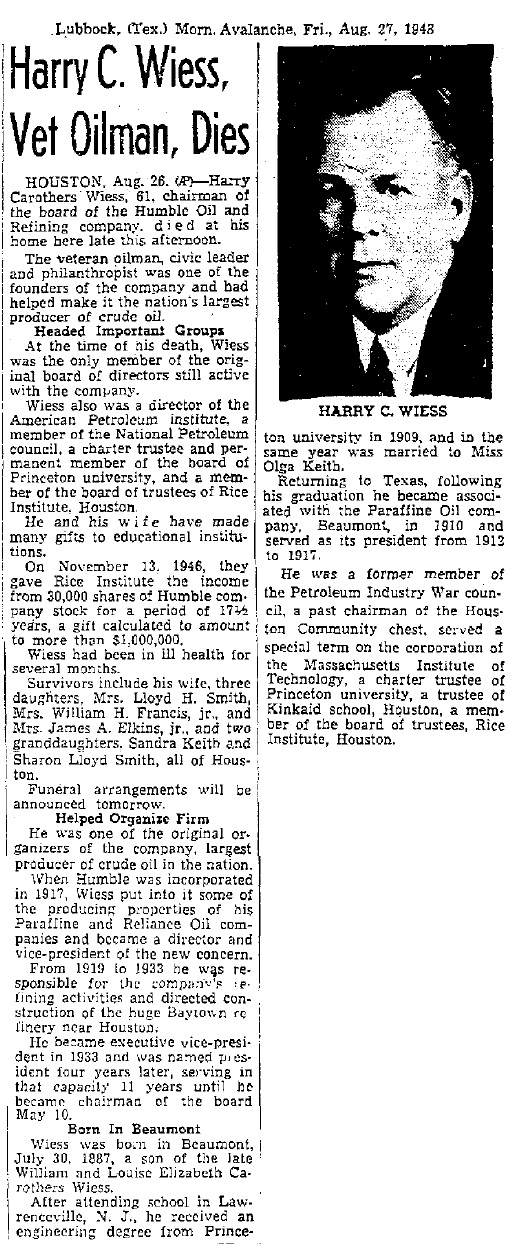
Chairman Wiess, Humble Oil
William Howard Francis, Jr. was married to Caroline Keith Wiess, one of the three daughters of Humble Oil chairman, Harry Wiess. His father lived in Highland Park in Dallas and, according to his 1946 death certificate, had served as general attorney for Magnolia Petroleum Co.

Rather's contacts helped to get him appointed to various state boards as well, and, working for the firm of noted architect John F. Staub, he designed several of the homes in the private enclave of Shadyside, a highly exclusive neighborhood between Rice University and the museum district where W.S. Farish, Kate Neuhaus, R.L. Blaffer (W.S. Farish’s first partner in a number of oil companies created during their Spindletop beginnings which they later merged into Humble Oil) and Irishman J.S. Cullinan, founder of the Texas Company (now Texaco), lived.

The book, Monster in River Oaks by Michael Phillips, tells the story of one of the heirs to the oil millions--Joan Blaffer Johnson, who lived on 2933 Del Monte in the River Oaks section of Houston.
"Despite her wealth, Joan [Blaffer], born in 1952, was no stranger to tragedy. Her younger brother committed suicide in 1990. She "married the irresponsible, alcoholic Luke Johnson, Jr., and was sinking her money into his failing car dealership," according to the book....Johnson was found dead in 1995 at the family's second home at Morgan's Point. It was ruled a suicide by shooting, but a mystery remains involving a male prostitute Johnson had flown in. Johnson was HIV-positive. According to the book, it was in the devastating aftermath in 1996 that Joan Johnson met [Dinesh] Shah and his friend David Collie at a Bible study group at the River Oaks Boulevard mansion of Baron Ricky di Portanova [mentioned in George Crile's book and the subsequent movie, Charlie Wilson's War], who has since died. Johnson would become romantically interested in Collie, but it was Shah who, presenting himself as a financial wizard, would gain her trust and take over the role of father to her children, actually moving into her house."
Del Monte St. home of Joan Blaffer Johnson
Shadyside Addition was a gated enclave developed by the Texaco founder before 1930. The senior Cullinan that year resided at 2 Remington, while son Craig and his family were on Longfellow, one street away. Mayor Monteith had a residence on Sunset Boulevard, almost within shouting distance. In 1950,
55-year-old Craig Cullinan's pajama-clad body was discovered by his son Craig Jr. in a third-floor bedroom, dead from a gunshot wound to the heart, ruled to be suicide. His 1943 will, made shortly after his daughter, Barbara, divorced her husband J. H. Pittman, cut her from his estate and took custody of her only child. Barbara Cullinan Pittman Waller, by then a Baton Rouge waitress at the Black Lamp Lounge, sued the estate which was ably represented by Leon Jaworski, whose law partner John Crooker had also lived near the Cullinans. In 1964 the Black Lamp Lounge was called a gay bar and "rendezvous for minor police characters," which found a place in the Warren Report.

We can only wonder whether any neighbors heard the gunshot. W.S. and Libbie Farish lived a few doors away at 10 Remington, while Hugo and Kate Neuhaus lived at No. 9. The Blaffer and Wiess homes appear to have been side-by-side on Sunset Boulevard, but the numbers do not match today's street configuration.

Does it not seem strange that all these supposed competitors in the oil business would choose to isolate themselves together into such an exclusive residential area? Could it be that they were all--even then--mere fronts for secret investors who wanted to fool the public into believing that a monopoly did not exist? What a legacy they left to their children!
Of course Farish, Wiess, Blaffer and Cullinan became part of what we now call "Big Oil," but a similar situation existed for the "wildcatters" like H.L. Hunt, Hugh Cullen, R.E. Bob Smith, J.S. Abercrombie and Michel Halbouty, who called themselves "independent" oil men.

W.S. Farish's first partner, Robert L. Blaffer, was married to the daughter of Scotsman W.T. Campbell, who, ironically, was J. S. Cullinan's partner in the founding of the Texas Company, later changed to Texaco (now Chevron). The story was always told of Cullinan's flying of the pirates' flag atop his Petroleum Building in Houston (later called the Great Southwest Life Building) on St. Patrick's Day as a "warning to privilege and oppression, within or without the law--the latter including witch burners, fanatics, and the like, who fail to realize or ignore the fact that liberty is a right and not a privilege."[1] It was, more likely, symbolic of his membership in a secret society such as the Knights Templar, which was more accurately represented by the skull and bones. The truth will never be known.

Percy Selden

Selden was formerly known as Percy Straus, Jr., heir to his family’s interest in R.H. Macy’s Stores, founded by Nathan Straus in New York. In 1954 he set up a trust for his children—all named “Straus”. By 1968 the family members were using the name “Selden,” when he conveyed real estate to Mossler. At some point in between he had the name legally changed. All his children, some of whom were already married, also changed their names to “Selden.”

His wife was the former Lillian Marjorie Jester, daughter of Frank Godwin Jester, a real estate developer in Dallas (not the former governor of Texas Beauford Jester); they married at Highland Park Methodist Church in 1937 and had a reception at Brookhollow Country Club. Selden, an attorney, possessed a collection of armour and chivalric weaponry which he eventually donated to a Houston museum.

In 1978 Selden's name appears as grantor of 162 acres in Harris and Fort Bend Counties to Keegan’s Wood, a joint venture made up of Eden Corporation and First Management [Harris Co. File No. F531714]. Edgar Monteith of Monteith, Baring and Monteith (Brown & Root’s and Gibraltar Savings’ attorneys) were attorneys for Selden as well [C822663], possibly due to Monteith's knowing J. T. Rather back in Belton as children.
The founder of Eden Corporation, Douglas Welker, had worked for a number of years for El Paso Natural Gas Building Co. (a company affiliated with Clint Murchison), which had a Houston office in the Americana Building owned by Gulf Interstate, about which more will be said in other parts of the series. Welker was closely associated with Larry Johnson, who became Tom Masterson’s partner in Underwood Neuhaus investment bank in 1985. Masterson was also a limited partner in Wilcrest Apartments, Ltd. in 1975, in which Triangle Investment Co. (formerly Johnson-Loggins) was the general partner/ syndicator. Other limited partners were Philip R. Neuhaus (Hugo and Kate’s son) and Milton R. Underwood (a founding partner of Underwood, Neuhaus) [E642917]. Milton’s first wife was Catherine Fondren, whose father was one of the founders of Humble Oil.

Carroll Sterling, daughter of another Humble founder, Frank Sterling, was first married to Bert Winston (a relative of Ella Rice Winston’s husband) and later to Harris Masterson (a distant cousin of Tom). One of the unnamed partners of Underwood, Neuhaus was W.S. Farish III (stepson of Hugo O. Neuhaus, Jr.), who joined the firm in the 1960’s. Larry Johnson's office was, for a time, in the Exxon Building, constructed in 1972 in Houston a few blocks south of the original Humble Oil Building.

W.S. Farish III inherited half of his grandfather’s interest in Humble Oil in 1943 at the age of 4. His mother, the former Mary Wood, was from the Chicago family which owned much of Sears, Roebuck, her father being Robert E. Wood, a founder of America First. After her first husband died, Mary married Hugo V. Neuhaus, Jr., an architect, whose mother was Kate Rice Neuhaus--Libbie Rice Farish’s first cousin. They all lived in Shadyside Addition across from Rice University next to Texaco founder J.S. Cullinan.

And they say Arkansas natives are interbred?

Another family investment company was W.S. Farish & Co., founded by W.S. Sr., which was managed by J.O. Winston, Jr., husband of Ella Rice Winston, Libbie Farish’s sister. Ella, incidentally, had married another cousin, Howard Hughes, Jr. in 1924, a year after his father died, but divorced him in 1929. Howard’s mother’s sister, Annette Gano, married Dr. Fred Lummis, son of Frederick A. Rice’s daughter, Minnie Lummis, whose son, a partner at Andrews, Kurth, later became chairman of Summa Corporation after Howard, Jr. died. Lummis moved to Las Vegas where he supervised the operation of the Hughes companies, including the medical research foundation he had set up for his cousin before his withdrawal.

W.S. Farish Sr., one of the founders of Humble Oil in 1917, became a director of Jersey Standard (a secret owner of half of Humble Oil stock) in 1926, moved to New York in 1933, and became chairman in 1938. His office was at 30 Rockefeller Plaza, not surprisingly, since the Rockefellers had founded Standard Oil and were not allowed legally to invest in Texas oil companies. When W.S. died in 1942, followed by his son’s death the next year, his estate fell to his grandson, W.S. Farish III, who was then 4 years old. The guardian of the minor child’s estate was his uncle, Stephen Power Farish (married to his brother's wife's cousin, Lottie Rice), until 1960. The minor’s investments were managed by the investment banking firm, Underwood, Neuhaus.

According to a February 19, 1950 Houston newspaper article by George Fuermann, Steve Farish had formed a syndicate with an “accountant friend,” M.W. Mattison,[2] in 1925 to raise $800,000 to buy Reed Roller Bit Co. from stockholders J.H. Giesey and the Niels Esperson Estate. After Spindletop in 1901, Steve Farish worked at Humble Oil until he left to form Navarro Oil which was sold in 1945 to the Continental Oil Co. (later Conoco).[3]
 
One interesting fact concerning Farish is that he was apparently acquainted with George DeMohrenschildt, according to information put together from Jim Marrs and others.[4] Born in Russia in 1911, De Mohrenschildt was the son of a Czarist official who later became a wealthy landowner in Poland, and had an uncle, Ferdinand, who was secretary of the czarist embassy in Washington and was married to the daughter of William Gibbs McAdoo, Woodrow Wilson’s son-in-law and U.S. Secretary of the Treasury.[5]

DeMohrenschildt immigrated to the U.S. in 1938, having been involved in espionage with the OSS and probably with the Nazis.[6] He had a doctorate in commerce from the University of Liege, Belgium, when he came to the United States at age 27, where his brother Dmitry was a professor at Dartmouth, having degrees from Columbia and Yale.[7]

Margaret Clark Williams

Visiting his brother and American sister-in-law (who, coincidentally was the mother of George Bush's prep school roommate, Edward Hooker, at Andover), DeMohrenschildt spent time at Bellport, near East Hampton, on the ocean tip of Long Island. There he met many influential people, including stockbroker Jack and Janet Bouvier (Jackie Kennedy’s parents). He was also a friend of Margaret Clark Williams, whose family had vast land holdings in Louisiana. She gave him a letter of introduction to Humble Oil.[8]

Jim Marrs said that DeMohrenschildt came to Texas by bus “where he got a job with Humble Oil Company in Houston, thanks to family connections,” and that “[d]espite being friends with the chairman of the board of Humble,” George worked as a roughneck in the Louisiana oil fields.[9]

George was married four times: first to Dorothy Pierson of Palm Beach, Florida in 1943 for seven months; then in the late 1940s to Phyllis Washington, “the daughter of a high State Department official”; then in 1951 to a Chestnut Hill socialite, Wynne (“Didi”) Sharples, a medical doctor from a wealthy Philadelphia family, with whom he had two children who died of cystic fibrosis. In 1959 he married Jeanne LeGon, whose Russian father had been director of the Far Eastern Railroad in China.[10] When his first marriage ended, George came to Texas in 1944 and got a master’s degree in petroleum geology at the University of Texas at Austin. For a time he worked overseas for the MurchisonsThree States Oil and Gas[11] and for Pantipec, an oil company owned by William F. Buckley, Jr.’s father.

Buckley Sr., a Texan, as an undergraduate lived in an upperclass dorm at the University of Texas at Austin which was also DeMohrenschildt's residence during his time at UT. The same dorm was also the home of brothers Rex G. Baker and Hines Baker (attorneys and top executives at Humble Oil with W.S. Farish, Sr.) and Jack R. Dougherty, who owned a ranch adjacent to the Farish ranch near Beeville.[12] In the 1960s, DeMohrenschildt was represented by attorney Morris Jaffe of San Antonio, who shared a mutual friend in John Mecom, Sr. of Houston.[13] Jaffe was in partnership with the Wynne family of Dallas, who were in investments with the Rockefellers, recipients of Teamster loans and members of the “Bobby Baker Set” in Washington.[14]

As we are often wont to say: "Small world!"
NOTES:

[1] Marguerite Johnston, Houston: The Unknown City, p. 279.

[2] Mattison's name appears a number of times in the Harris County property records as a signatory on behalf of the Scottish Rite Masonic Lodge in Houston.


[3] Steve Farish was born in Mayersville, Miss. but went to prep school and later to the University of the South in Sewanee, Tennessee, an Episcopal college.

[4] Jim Marrs, Crossfire: The Plot That Killed Kennedy (Carroll and Graf Publishers, Inc.: New York, 1989), p. 279.

[5] Priscilla Johnson McMillan, Marina and Lee (Harper and Row, 1976), p. 215. Does this mean he was Wilson's grandson-in-law? McAdoo was also Wilson's Treasury Secretary. In 1918 he founded McAdoo, Cotton and Franklin, a law firm located at 80 Pine--later called Cahill Gordon--which represented TWA against Howard Hughes. [Hoffman, p. 23]

[6] Marrs, Crossfire, p. 278-9. Gaeton Fonzi, The Last Investigation (New York: Thunder Mouth Press, 1993), p. 190.

[7] Priscilla Johnson McMillan, Marina and Lee (Harper and Row, 1976), p. 216.

[8] Ibid., p. 219.

[9] Ibid. The quoted passage does not identify which of the Humble Oil founders was DeMohrenschildt's friend, but it does state that he was also friendly with H. L. Hunt, Clint Murchison, John Mecom, Robert Kerr and Jean De Menil, and, according to Jim Marrs' interviews with Jeanne DeMohrenschildt after her husband's death, George was making regular trips to Houston from Dallas during 1962-63 on oil business with Mecom and De Menil. George's Russian friends in the Tolstoy Foundation told Marrs that he was going to Houston to see George and Herman Brown (p. 282.)

[10] Fonzi, The Last Investigation, p. 191.

[11] Peter Dale Scott, Crime and Cover-up, op. cit., p. 34

[12] Richard Bartholomew, Possible Discovery of an Automobile Used in the JFK Conspiracy (the Nash Rambler)--unpublished manuscript, pp. 63, 88-89. Also in the Dougherty family is J. Chrys Dougherty, a 1940 Harvard law graduate who also studied at the Inter-American Academy for International and Comparative Law in Havana, Cuba, in 1948. He was also a counter-intelligence officer in World War II and later a special assistant to the Texas Attorney General in charge of defending the State's interest in offshore oil. Committee on History and Tradition of the State Bar of Texas, Centennial History of the Texas Bar: 1882-1982, p. 140. Compare this information with the discussion of Phil Graham's residence while he was living in Washington, D.C. following his student years at Harvard. The atmosphere was reminiscent of that of the Cliveden Set and Astor Round Table, which had control of the Rhodes and Beit Trusts.

[13] Priscilla Johnson McMillan, Marina and Lee (Harper and Row, 1976), p. 216. Brewton, p. 317. See also Jonathan Kwitney's book, The Mullendore Murder Case, about the murder of the Mecoms' son-in-law in Oklahoma, and the connection with Northwestern Mutual Life Insurance and the Jaffe law firm.

[14] Peter Dale Scott, Crime and Cover-up.

Tuesday, April 5, 2011

Part 7 of Land and Loot

Lehman Brothers' Role in General Homes

General Homes - Connections with Canada

One way to research General Homes is to begin in 1983, when it really began to sell homes at a fast pace. It was that year that certain investment banks, primarily Lehman Brothers, began issuing mortgage-backed securities. The General Homes initial public offering (IPO) was completed that year, bringing in money for new stock issues that was pumped into real estate purchases in Harris County. Possibly this new-found cash was a means of paying off some of the other companies which had already bought land in that area, or perhaps it was to continue the growth in that area with an updated legal vehicle the attorneys and legislators had pushed through.

But as we will clearly see, the moving force behind the move into residential development and construction in Harris County was a group of Canadians who had formed a partnership to build the new commercial retail and office center in downtown Houston on land owned and acquired by an arm of the Texas Eastern Transmission Co. The Canadian group was called Cadillac Fairview, and the Bronfman family members who owned its stock were also heavily invested in banking and other industries as well. Leo Kolber explained that fact in his book, Leo: A Life
 
In 1978 Cadillac Fairview first acquired an interest in General Homes, a Texas corporation, which formed General Homes Consolidated Companies, Inc. Almost two years following the IPO, the stock was owned as follows: 
  • General Homes Management Co. owned 97%; 
  • General Homes Investment Co. (partnership of the Texans from whom the company was purchased in 1978) owned 1.5%; and 
  • ASLA of Florida owned 1.5%.  
 
The address of General Homes Management Co. was 17801 N.W. 2nd Avenue in Miami, which was the address of Morris N. Broad and ASLA (formerly American Savings & Loan Association). However, Broad and his father in December 1982 had signed a voting trust agreement relative to control of ASLA with Marvin Leon Warner, a Cincinnati businessman, to allow Warner to purchase $13 million of ASLA stock.

In 1963 the Bronfmans had acquired Texas Pacific Oil and Coal, which they held until 1981, using their $2 billion profit to take over Conoco (formerly the Continental Oil Co) by purchasing a block of stock from DuPont. According to Kolber's book, the Bronfmans would sell off Cadillac Fairview in 1987 to buy into the Music Corporation of America (MCA), which is not part of our story. Our focus is on the time they were in control--and while Edgar Bronfman, Jr., who controlled the corporate interests, was married to Ann Loeb, daughter of John L. Loeb and granddaughter of Carl M. Loeb.

In December 1983 General Homes acquired 86 acres in Old Town Spring, an unincorporated city north of Houston. The seller was a joint venture called North Spring Joint Venture--a partnership composed of Walter Mischer’s TMC Funding and United Financial Corp., in which Charles Hurwitz (a customer of Michael Milken) began buying a year before.[1]  

Development around Spring, located in northernmost Harris County, had taken off five years earlier by Canadian-connected corporations, such as Genstar Homes of Canada, which in 1977 had acquired all of Lexington Woods Section 5, purchased from Spring Village Development Co., an entity set up by H. Arthur Littell and Don McGregor, Jr. [Harris Co. File No. F404069].[2] The local executive vice-president for Genstar was an engineer named Bernard Johnson of Houston, who would become one of County judge Jon Lindsay’s biggest contributors. His engineering office on Westheimer was situated between the Galleria shopping center mall and  Post Oak Bank--next door to the original office building of an oilman named Michel T. Halbouty.

Genstar was established in Canada in 1951 as Sogemines Ltd. by Societe Generale de Belgique de Brussels. It was closely linked to the Royal Bank of Canada, and its chairman in 1955 was Angus MacNaughton.  When Genstar opened an office in the U.S., its headquarters was in San Francisco in a Rockefeller building called Embarcadero Center. In 1986, however, the Genstar corporation was bought by Imasco, based in Montreal, a company set up to handle investments for Imperial Tobacco, Canada Trust and Shoppers Drug Mart. In 2000 those corporations were sold off to British-American Tobacco and Toronto-Dominion Bank.  

Genstar bought property in Houston primarily from companies controlled by McGregor, Littell and Marvin Leggett, who were involved with Canadians in Lexington Development and in Markborough Properties, a subsidiary of Hudson’s Bay Co., Canada’s largest retailer, which acquired Markborough in 1973 and spun it off in 1990 “to shareholders in the form of a dividend. HB offered one Marborough share for every HB share held. Kenneth Thomson, chairman of Thomson Corp, and his family, holders of” the majority of shares:

Hudson's Bay Company acquired Markborough Properties, a real estate company, in 1973; Zellers, a chain of discount department stores, in 1978; and Simpsons, a group of Toronto-area department stores, the following year. Kenneth R. Thomson, representing the family of the late Lord Thomson of Fleet, acquired a 75 percent controlling interest in the company in 1979…. In a strong attempt to survive, Thomson shook up top management, eventually appointing George Kosich, a career merchandiser, president. Thomson revamped retail operations. The combined market share of the three department store chains rose to 33 percent from 29 percent in two years…. Hudson's Bay Company reversed a formidable debt picture in 1987 by shedding nonstrategic assets such as its wholesale division and getting out of the oil and gas business. In 1990 it spun off its real estate subsidiary, Markborough Properties, as a separate public company. Shareholders received one share of Markborough for each share they held of Hudson's Bay, with the Thomson family retaining a majority interest in Markborough. Also in 1990, the company bought 51 Towers Department Stores and merged them with Zellers. 

By 1981 Hudson's Bay--the merchandizer corporation, which was successor to the Canadian fur trading company chartered by the Crown--whose stock eventually came into the hands of London investment banks in 1886--would be owned by Conoco (which was taken over by the Bronfmans). But it was through a series of intricate and confusing maneuvers and manipulations which led to that outcome. To understand the relationships, we have to begin with the individuals named in Genstar documents. Genstar was busy buying land from Don McGregor, H. Arthur Littell and Marvin E. Leggett.

Who were these men?
The Great Texas Banking Crash: An Insider's Account 
Leggett and Littell, who owned Texas Bank and Trust,  were both directors also of Colonial Savings, an institution chartered in 1961, in which Littell was chairman and William H. Doyle, Jr, was president in 1977. S.N.Goldman (the Oklahoma grocery tycoon, owner of Standard Food Markets and Humply Dumpty, who in 1937 invented grocery shopping carts ), with whom the two were involved with investments in Oklahoma mineral interests, was also a director. The headquarters was 6161 Savoy in Sharpstown. Other directors were Jack D. Mulvihill,  J. Curtiss Brown, a long-time official of the Texas State Bar before his appointment as chief justice of the Texas Court of Civil Appeals for the 14th District; Edward R. Godwin, senior vice president of Mortgage Trust Inc. of Houston; and Houston City Councilman Johnny Goyen.

They worked on the development of Regency Square in Sharpstown, an area in which Frank Sharp had spearheaded a huge Texas scandal referred to as the Rent-a-Bank Scandal. Sharp had begun his 25,000-home development in the heart of Houston with great fanfare during the Cold War days of 1955 by announcing he was considering including bomb shelters as part of the construction. Seven years later, shortly after Houston had been selected as the location of NASA headquarters, Sharp began announcing that astronauts would be given free homes in Sharpstown. The acreage for Sharpstown had been acquired at a cost of $6 million in the mid-50's. Sharp had to be quite confident of success to spend that kind of money, or he must have been acquainted with some very convincing salesmen. .


In 1930 Sharp, young and single, was living in the Savoy Apartments at 1600 Main Street in downtown Houston. He transitioned from oil sales to home building in a few short years. He arrived in Houston from Crockett, Texas, where his father was a carpenter and farmer, rearing a great many children there. Within a few short years Sharp had become secretary to the Houston Lions Club and was friends with the newly elected Congressman in Houston, Albert Langston Thomas, accompanying him and his wife on out of town trips; Sharp, too, had married by 1937.

In the 1970's Littell had become associated with South Coast Investment Co., which would be located in Houston at 806 Main, a building once referred to as "Carter's Folly," home of S.J. Carter’s Second National Bank building. It later sold to a subsidiary of American National Insurance before Howard Pulver, a strange New Yorker who spent some time in Corpus Christi before relocating to Houston, began using it for apartment syndications. He and his associates were described in detail by Pete Brewton in his book, The Mafia, CIA and George Bush. An important player in that insurance company was Dee S. Osborne, who applied for a state bank charter in Sharpstown early in 1971, naming proposed directors of the Community Bank of Houston as Corbin J. Robertson Jr., Meredith J. Long, William N. Finnegan III, R. E. "Bob" Smith, Vivan Smith, Marvin K. Collie (famed attorney at Vinson and Elkins law firm in Houston), Morgan J. Davis (petroleum geologist who spent his career at Humble Oil and Refining Company (now Exxon Company, U.S.A.); and Gaston E. Heffington, all of Houston. Some of those same men were drawn into a scandal in 1983 involving the Hermann Estate, which set up the Medical Center with a gift from George Hermann:


The South Coast Investment Company was a vehicle of South Coast Life Insurance, whose directors included independent oilmen Grover Joseph Geiselman (with an office at Suite 849 of the Houston Club Building, where both W.S. Farish III and George Bush were located during the late 1950's), Floyd Louis Karsten of Fort Worth, Jack S. Blanton of Eddy Refining Company, and E.C. Scurlock (among several other oil men), attorney Newton Gresham, a partner in Leon Jaworski's firm, Charles G. Heyne, and Vernon F. Neuhaus of Mission, Texas. Most of these individuals have in some way been connected with the Neuhaus Education Center in some manner since its founding by W. Oscar Neuhaus in 1978.

Geiselman's son was married to a daughter of Everette deGolyer, and Neuhaus, who was related to the family of W.S. Farish through marriage, also served on the board of Texas College of Arts and Industries (Texas A&I in the Valley) with numerous illustrious Texans, including John F. Lynch of Corpus Christi and later Houston (senior vice president of the Texas Eastern Transmission Company) and Mrs. Richard M. Kleberg Jr. of Kingsville, whose husband was the Congressman for whom Lyndon Johnson first worked in Congress. Charles Heyne was the uncle of Marcia Heyne Modesett, granddaughter of Fred J. Heyne, Jesse Jones’ right-hand man for many years, who remained in control of the Jones family companies and foundation until his own death in 1966. More will be said about this group later.


NFL Dallas Cowboys Plastic Parking SignIn 1973 Neuhaus was one of the honorees who received awards from emcee John Connally from the Ex-Students Association of the University of Texas, along with George R. Brown of Brown & Root and Texas Eastern Transmission Co., and Tom Landry, coach of the Dallas Cowboys.

The long and short of it is that, even though not well-known, Littell was "close to wealth and power" in Texas at the time. It is a type of power that has never been adequately explored or understood. Exploration of the network that gave it life and power is the goal of this project.

Littell was also in partnership with S.N. Goldman of Oklahoma City in a number of syndications that, by all appearances, could have involved the laundering of money through overseas banks, and he was connected with some of the biggest banks in the U.S. who provided financing for his buyers.
Leggett and Littell also developed lands surrounding the Sam Houston Racetrack, that had been held by Lexington for many years before a horse-racing license was finally approved in Texas. The land surrounding the racetrack was developed by Leggett--for commercial purposes--and by General Homes--for residential. The State Highway Commission, chaired by Bob Lanier, agreed to complete Beltway 8 through the property, and Harris County Flood Control District paid for the drainage outfall. But that's another story. 


NOTES:

[1] The history of United Savings began with Houston First Savings, founded by Humble Oil executive and attorney, Rex G. Baker, Jr., which was changed to Southwestern Savings before again changing its name to United.
[2] McGregor's father had owned an office next door to Lomas & Nettleton at 201 Main in Houston and had bought land in Nassau Bay with financing from Carl M. Loeb, Rhoades & Co. In 1966 Don McGregor, Jr. had an office on the 12th floor of the First City National Bank Bldg. and was involved in a number of general partnerships with Solomon Goldman of Oklahoma City [Harris Co. File No. C414892].

The Wynne-ers' Circle

 The Power of the Wynne Family


Excerpt from Peter Dale Scott, Deep Politics and the Death of JFK, pp. 285-86:

Toddie Lee Wynne, Sr., the founder of the Wynne family fortunes, had begun in the 1930s as attorney for Clint Murchison, Sr. [10]  Bedford Wynne, the senior partner in the family law firm of Wynne, Jaffe, and Tinsley, was a Washington troubleshooter for the powerful Murchison oil and construction interests in Texas; we have already seen that in 1963 his questionable lobbying activities were beginning to attract the attention of the federal government.

*****

TSHA
Bedford Wynne
Most accounts of the efforts to bring an NFL team to Dallas treated Murchison and [Bedford] Wynne as partners and Wynne clearly served as the spokesman of this partnership. Wynne was the one who announced the hiring of Tex Schramm as general manager of the proposed team in November 1959. Wynne was also present at the meeting in Miami in 1960 when NFL owners officially approved the Dallas club as a franchise.
The picture above [see photo inset to right] shows Wynne and Murchison left along with Redskins owner George Preston Marshall and Tex Schramm. Marshall had been one of the more vocal opponents of expansion especially to the Southwest.
Wynne’s story is actually quite fascinating. Born July 14, 1923 he attended high school in Longview before graduating from the New Mexico Military Institute. He spent three and a half years in the Army and then attended the University of Texas. After graduating from UT he moved on to SMU Law School and was later admitted to practice in Texas.
He came from a prominent family in East Texas. His father [Angus Gilchrist Wynne, Sr.] was a lawyer [from tiny Van Zandt County] and active on the political scene. His brother [Angus Gilchrist Wynne, Jr.] was a successful real estate developer and his uncle [Toddie Lee Wynne] was a famous oilman. Wynne joined his family’s law firm and became a partner.
His interests were diverse. He was a director with such companies and organizations as Reliance Life Insurance Company the Sweetwater Development Center Junior Achievement Children’s Development Center the Cotton Bowl Athletic Association University of Texas Ex-Students Association Highland Park United Methodist Church and the nonprofit Garrett Foundation. He was also co-owner of Wynne & Black an oil business as well as the Garrett-Wynne Angus Ranch of Longmont Colorado.
In 1959 he earned media attention when he bought a share of a famed Black Angus bull named Prince 105 which reportedly carried a hefty price tag of $230,000. During the same year Wynne was actively involved with an effort to bring top professional bowlers to the Dallas area. At that time he was an official with Great Southwest Lanes of Arlington.
When Dallas millionaire Lamar Hunt and others announced the formation of the American Football League during the summer of 1959 the NFL moved quickly to announce that the older league would expand as early as 1961. The first two cities named as possible locations were Dallas and Houston and Murchison and Wynne appeared in the newspapers constantly during negotiations. These negotiations ultimately succeeded and Dallas received a franchise a year earlier than originally announced.
Because Wynne appeared in the newspaper so often many thought he was an equal co-owner. However Clint Murchsion owned 95% of the team with his brother John while Wynne was only a minority owner along with Toddie Lee Wynne and W.R. “Fritz” Hawn. Bedford Wynne held the position of director and secretary of the Cowboys.
In 1967 Wynne decided to sell his shares in the Cowboys to help organize the expansion New Orleans Saints. He also left his law practice in 1967 and began to focus on other business ventures.
After 1967 Wynne’s name surfaced less and less. In one interesting story he won a camper at the Byron Nelson Classic in Fort Worth when he hit a tee shot closer to the mark than opponent Mickey Mantle.
He was chairman of a group that operated and managed Teen America Associates which produced a teen beauty pageant for several years and he later became president of Family Recovery Inc. a family counseling service.
Wynne died at the age of 65 on December 30 1989 of a heart attack. He was survived by three daughters and a son along with six grandchildren.
[Source: Viewed at  Sports Comet  [http://www.sportscomet.com/sports_thread/view/id-10802] no longer extant.]
~~~~~~~~~~~~~~
Continuation of Peter Dale Scott excerpt:

In August 1963 Bedford Wynne was the subject of a highly critical army audit of his "salary" from a firm with federal-government contracts (Sweetwater Development), which had been set up by the Murchisons' Tecon Corporation through the law firm of Wynne, Jaffe, and Tinsley. [11] To Wynne this must have seemed like gross political ingratitude. As recently as January 1963, Bedford Wynne had raised a half-million dollars for the depleted treasury of President Kennedy's Democratic party, after which Clint Murchison's son John was granted a mutually satisfactory interview with President Kennedy about preserving the oil depletion allowance. [12]

But it was unlikely that Wynne could escape being noticed in the mounting publicity about the scandalous activities of Lyndon Johnson's Senate protege, Bobby Baker. As noted earlier, it was in the Life issue of November 22, 1963 (p. 92A), that Bedford Wynne was first named as a member of the "Bobby Baker set" at Washington's Q Club. Subsequent Treasury and congressional investigation of Bedford Wynne and Clint Murchison established that their Sweetwater company had made payments (which looked very much like political kickbacks) to the legal firms of Bobby Baker and of Democratic Congressman Emmanuel Celler.[13]  Dallas Republican leader Robert H. Stewart III, a director of Great Southwest, had also arranged for questionable loans to Bobby Baker, via the same two Murchison employees (Robert Thompson and Thomas Webb) who figured in the Baker payoffs from Bedford Wynne.[14]

*****
The Great Southwest Corporation's Project in Texas


When Charles Hurwitz began acquiring a company called McCulloch Oil in 1978, the chairman of the
company was Charles Wood, Jr.--the man who had designed and engineered the construction of
Disneyland in 1955. McCulloch Oil had been founded by Robert McCulloch, a close business associate
of Wood. In 1960 McCulloch and Wood began to develop Lake Havasu City near Scottsdale, Arizona
around a man-made geyser and the London Bridge, which had been transported across the Atlantic and
reassembled. After Disneyland, Wood had gone on to build Freedomland in the Bronx, New York and to
work with Toddie Lee and Angus Wynne of the Great Southwest Corporation in building Six Flags in
Texas. The Great Southwest Corp., in conjunction with Webb and Knapp had gone into great debt in the
early 1960s pursuing these projects and tried to recover by selling the corporate stock to the Penn Central
Railroad owned by the Pennsylvania Company, which, at the same time, bought Macco Realty and
Arvida.

What is intriguing about this is that McCulloch Oil, the Great Southwest, Macco and Arvida were very
rich in land. This fact was no doubt known by David Murdock, who in 1964 had moved to Los Angeles
from Phoenix where he had been involved in home construction. Although he was allegedly insolvent
when he arrived in California, he founded a company that made tile to be used in construction and later
became a land developer and then a corporate tycoon. We do not know at this point whether Murdock,
whose background before that time is extremely sketchy, may have been involved with the Bonanno family which had been involved in real estate development in Arizona.


In 1956-57 the area between Westwood and Los Angeles proper, now called Century City, was owned by Twentieth Century Fox (headed by Spyros Skouras); it was the Tom Mix ranch and the backlot. But the studio needed cash and decided to sell off this 260 acres of real estate. The studio contacted William Zeckendorf--who headed Webb & Knapp--was a Rockefeller-connected developer in New York (he had hired Disney's engineer, Charles Wood, to build Freedomland park in the Bronx and who was a partner with Toddie Lee and Angus Wynne in developing the Great Southwest project in Texas). He agreed to buy the land and lease back a portion to the studio for one and a half million dollars a year.

Zeckendorf eventually sold out his interest to the Mellon family's Alcoa. He states in his autobiography that he became great friends with "General Richard Mellon," whose family has long been connected to O.S.S. and C.I.A. activities, as well as with Gulf Oil (at the time the Mellons were largest shareholders), which was an investor brought into the Zapata Corporation by the Liedtke brothers.(5) By the time Victor Palmieri went to work for Janss Investment, the Janss brothers had sold a half interest in the commercial properties, in 1955, to Arnold S. Kirkeby of Chicago, owner of a chain of hotels including the Beverly Wilshire at Wilshire and Rodeo Drive. Kirkeby changed the design of the village by bringing in highways and high-rises.

The Arizona Project, a journalistic investigation into mob activities in Arizona, which found strong financial links between Arizona real estate development and construction of Las Vegas casinos, also noted:
For [Del] Webb, the Flamingo experience (6) led to a series of deals with other developers who had their own ties to the Mob-dominated Chicago political machine, including Henry Crown and Arnold S. Kirkeby of Los Angeles,

Part 6 of Land and Loot

Lamar Hotel in Houston, since demolished
In 1978 Houston was in the center of a real estate boom. At the same time that the corporation created by a consortium of Suite 8F Crowd interests and Dillon Read investors (TexasEastern Transmission Corp. which in 1947 had bought the government-constructed pipelines carrying natural gas from Texas to the northeast) was making plans with Canadians to build a commercial real estate project in downtown Houston, called the Houston Center, the stock of a local construction company, General Homes, was sold under a purchase agreement to CFGH-Texas, Inc., a wholly owned Texas subsidiary of a Delaware corporation, Cadillac Fairview U.S., Inc., whose ultimate parent was Cadillac Fairview Corp., Limited, an Ontario, Canada corporation.   

On January 7, 1981 the new General Homes, now a public corporation, executed a loan agreement to secure $50 million of financing from Bank of Nova Scotia and Toronto-Dominion Bank, both Canadian chartered banks, and Capital Bank, N.A. of Houston (later called MBank, then BankOne, before it became insolvent) [Harris County File No. J615338].[1]   

As part of the IPO that occurred, various transactions took place. On December 17, 1982 the Canadian banks transferred their rights in the notes and liens to American Savings and Loan Assn. of Florida [Harris County File No. J645338].[2]  In January 1983 the purchase agreement with Cadillac Fairview was cancelled by means of the following transactions described in the Notes to Consolidated Financial Statements contained in General Homes’ SEC filing:

In January 1983, GHMC [General Homes Management Corporation] acquired 545,104 shares of the Company’s redeemable Preferred Stock and all of its outstanding Common Stock for $5,000,000 from CFUS [Cadillac Fairview U.S.].  GHMC contributed the redeemable Preferred Stock to the Company, and it was retired.  The Company repaid loans due CFUS in the amount of $15,000,000 plus accrued interest of $5,078,000 and redeemed 714,646 shares of its redeemable Preferred Stock for $6,431,000, $1 per share less than its par value.  Also the Company’s $15,132,000 current tax liability to CFUS was forgiven.  The Company and GHMC agreed to indemnify CFUS and its parent for any liabilities arising from agreements consummated while it was a stockholder.

In 1979-80 General Homes sold $25 million in mortgage loans, payable to its subsidiary, FGMC, Inc. [abbreviation for “First General Mortgage Corp.”], to American Savings & Loan Assn. of Florida (“ASLA”) and retained a 20% participation interest.  These notes were transferred by FGMC, Inc. to American Southern Mortgage and then to ASLA.  In January 1983 General Homes entered into a revolving credit agreement with Bankers Trust Co. of New York for a $24.5 million line of credit with payment due by January 1988, said debt secured by $28 million in U.S. Treasury notes pledged by American Savings & Loan Association.  General Homes gave ASLA a security interest in life insurance policies and a 75% participation interest in the Bankers Trust line of credit.  With this new credit arrangement, General Homes stock was reissued, with all stock owned by Cadillac Fairview being transferred to General Homes and ASLA.  Cadillac Fairview, in return, on January 5, 1983, executed a release of lien on a $4 million note retained in a July 25, 1979 sale of land to General Homes [H796081],[3] and by corporate resolution attached thereto, Cadillac agreed to use other proceeds from the stock sale to “repay indebtedness of General Homes to The First National Bank of Chicago pursuant to that certain Loan Agreement dated as of August 31, 1978.”[4]

Shearson Lehman was the managing underwriter of the public offerings of stock and also purchased secured notes from General Homes which were used in some form of derivative securities backed by mortgages.[5]  Until 1983 ASLA was controlled by Shepard Broad and his son, Morris Broad, in Miami, but in December 1982 the Broads signed a voting trust agreement relative to control of ASLA with Marvin Leon Warner, a Cincinnati businessman, allowing Warner to purchase $13 million of the stock.  Warner's Warner-Kanter Construction Co in Cincinnati had been investigated by the FBI in 1954 for suspicious FHA loan transactions in Canterbury Gardens in suburban University City outside St. Louis.

Warner had been a large donor and fun-raiser for Jimmy Carter in his presidential campaign in 1976 and was appointed in January of 1977 as Ambassador to Switzerland. After serving two years in that post, he resigned and returned to Ohio in May 1979 to marry a well-known beauty, the former wife of Barry Goldwater, Jr.  According to other news items, however, it appears they were married no more than a year.


The Crimes of Patriots: A True Tale of Dope, Dirty Money, and the CIA One month later, ASLA acquired 43% of General Homes stock.  In January 1984 Warner took over as chairman of the board and CEO of ASLA.[6]  Jeffrey Payson, whose Houston construction company had just been taken public, served on ASLA’s board, and Morris Broad joined GH’s board.

Ohioan Marvin Warner’s history reveals a fascinating connection between his banks and the laundering of drug profits, according to certain evidence brought out in Pete Brewton’s book, The Mafia, CIA and George Bush, as well as Jonathan Kwitny’s book, The Crimes of Patriots.   

 ~~~~~~~~~~~
December 14, 1982  The New Mexican, Santa Fe, NM and also appeared in THE STARS AND STRIPES, December 16, 1982
MIAMI (AP) - A bank accused of laundering more than $97 million in drug profits
transferred funds by wire as far as Switzerland and disguised cashier's checks as nonexistent loans, a federal indictment charges More than 400 transactions to  launder proceeds from Colombian narcotics, in amounts ranging from $18,000 to
$837,530. were made by the Great American  Bank of Dade County over a 14-month period, according to the indictments revealed Monday. The defendants include the bank, former head teller Carlos Nunez; his former assistant, Elaine Kemp;
and a former vice president, Lionel Paytuvi of Hialeah. who is already in jail awaiting trial on unrelated federal charges of distributing methaqualone and filing false statements to the Internal Revenue Service. If convicted on all 21 counts of currency violations, the bank could be fined more than $7 million. 

Officials said it is the first time a south Florida bank has been charged with participating in a money-laundering operation in the billion-dollar drug market. Great American attorney Michael J Madigan said the bank was "extremely disappointed" by what he called an unwarranted  indictment, and said the Institution would demand "an immediate trial" to establish its innocence. "The truth of the matter is that the bank was a victim of what the government apparently alleges was a money-laundering scheme which occurred almost three years ago," Madigan said. But Assistant Treasury Secretary John Walker told a Washington press conference that money laundering "was, in effect, a bank practice .... not an isolated employee." The indictment alleges the deals took place in the 14 months before February 1981. The grand jury, working with information from an investigation called Operation Greenback, also indicted five Miami residents described as Colombian nationals, who worked with bank officers and allegedly sent $5.4 million through the institution to disguise its source. They were identified as Isaac Kattan, Jaime Escovar Balayar. Victor Tesone Kassin. Luis Viera and Jaime Diaz. Kattan is already serving in federal prison on a drug trafficking conviction. Kattan and other currency exchangers, including Interfil Inc. and Latina Export and Import Inc. acted as middlemen
between Colombian drug dealers and the bank, the indictment alleges.
~~~~~~~~~~~

Convicted Medellin cartel associate, Fernando Birbragher, a Russian Jew from Colombia, pled guilty to laundering money in 1980-81 through Warner’s Great American Bank in Miami

In addition to banking, Warner had made investments in race horses and sports teams in the late 1950s.  Shortly after Warner returned from Switzerland, the Great American Bank was hit by a money-laundering scandal.  Warner sold the bank to Barnett Banks just prior to December 1982, when Birbragher was indicted, the same month Warner and the Broads signed the voting trust agreement for General Homes.  Warner was himself convicted in 1987 in Ohio for fraud involving Home State Savings and E.S.M. Securities.[7]

While Warner was in Switzerland, he was replaced at Great American Bank by Donald E. Beazley, who had previously worked for Guillermo Hernandez-Cartaya, a banker who started at Citizens & Southern in Atlanta before organizing the Republic National Corporation (incorporated by CIA lawyer Walter Sterling Surrey), which later became World Finance Corp.   

According to an AP article carried December 16,1977 in various news outlets:
The Miami News reported in August that Hernandez-Cartaya's financial empire was threatened with collapse after the tiny Arab state of Ajman, a member of the United Arab Emirates, closed the Ajman Arab Bank, of which WFC owns 22 percent. Hernandez-Cartaya's tangled finances, according to the Times, affect dozens of banks in the United States and abroad as well as various foreign governments. The newspaper said his affairs also are under investigation by banking offiicials in Panama, Colombia and the United Arab Emirates.
The Times said the investigation was triggered in May when two Dade County policemen uncovered evidence while sifting through garbage of a suspected large-scale narcotics trafficker. The Times said the evidence reportedly showed financial transactions involving hundreds of thousands of dollars connected with WFC [WFC Group, Inc., a private holding company] corporate accounts.
During Beazley’s tenure at the Miami bank, he negotiated a deal with an individual from Nugan Hand Bank of Australia to sell a Great American subsidiary, Second National Bank, which had connections to Paul Helliwell. 

When Beazley left Great American after Warner’s return, he became CEO at Nugan Hand.  Warner’s undoing came about as a result of fraud involving his son-in-law, Stephen W. Arky, who had been a lawyer in the SEC under Stanley Sporkin, later general counsel for the CIA, who characterized Arky as “one of my finest young men.”[8]


Bitter Fruit: The Story of the American Coup in Guatemala, Revised and Expanded (David Rockefeller Center Series on Latin American Studies)Birbragher described how he engaged in drug smuggling and how Warner’s bank aided him in laundering his profits.  He set up a shell corporation called International Finance Company,[9] which had an account at the bank.  His partner in Colombia furnished him drugs, which were flown to Miami by pilots, Jack DeVoe, William Sundback and Warren Bullock, and delivered to Birbragher, who then sold them.  The cash was deposited directly into the bank.  DeVoe, who was convicted of cocaine smuggling, has stated that he flew into the Ocean Reef Club’s landing strip and Opa-Locka Airport (used as the CIA’s center of operations during the 1954 Guatemalan coup). The Ocean Reef Club is a subsidiary of Carl Lindner’s American Financial Corp., which also owns the banana company formerly called United Fruit, which served as a cover for the coup.  DeVoe is the pilot who was laundering his money through Lawrence Freeman’s bank in the Isle of Jersey being used by the Mike Adkinson group.

DeVoe had two attorneys during his legal battles—both with IRS and for drug smuggling.  One was Theodore Klein,[10] who had also represented arms dealer Ron Martin, an alleged casino partner of Robert Corson.  Another was Harvey Silets of Chicago, who represented Burton Kanter, a former associate of Paul Helliwell.  Another lawyer to whom DeVoe was introduced was Lawrence Freeman, a member of Helliwell’s law firm in 1970, which he left to become in-house counsel for Castle Bank & Trust, the Bahamian bank set up by Helliwell and Kanter.

Even though Freeman left Castle Bank and then Helliwell’s firm, he kept in close touch with Kanter.  They and their associates were involved in at least 21 companies incorporated in Florida.  Almost all of them were registered in the late 1970s or early 1980s, and some are still active.  Kanter also had a law office next to Freeman’s in Miami for about a year, and when Florida state prosecutors and investigators raided Freeman’s office in November 1985, they found Kanter’s name on several documents.

One was a disbursement of $27,500 to Kanter from a $50,000 receipt from the Bank of New England.  Freeman got $10,000 of this, while his law firm received $6,000.  In a letter to me [Brewton] at the Houston Post, Kanter said the $27,500 was a “reportable fee and was, in fact, reported on my personal income tax return.”[11]

The Texas counsel for the Bank of New England was Trevor William Rees-Jones at Locke, Purnell in Dallas, who served as trustee for MONY in Mel Powers’ loans [E426559].  This firm included Eugene Locke, who ran for governor of Texas after he had managed John Connally’s gubernatorial campaigns.  Rees-Jones has served as trustee on deeds of trust for Mutual of New York (MONY), New England Mutual Life in Massachusetts and the Bank of New England.  The Bank of New England, incidentally, refinanced Enron Cogeneration’s loan with Morgan Guaranty in 1988.[12]  Further research needs to be done on the history of these institutions.  


NOTES:


Acid Dreams: The Complete Social History of LSD: The CIA, the Sixties, and Beyond[1]  According to Brewton (p. 137) Capital Bank merged with Paravicini Bank in 1969 to start a new Swiss bank, Bank for Investment and Credit Berne, which included among its investors, Seagrams [both Seagrams and Cadillac Fairview are owned by the Bronfmans].  William Stamps Farish III of Underwood Neuhaus and J. Hugh Liedtke of Zapata were directors.  Not long after the merger, the bank was involved in fraudulent stock transfers with Billy Mellon Hitchcock, heir to Gulf Oil [Liedtke's father had been general counsel to Gulf for many years] and was caught laundering $67 million of Hitchcock's money, which, according to a 1985 book by Martin A. Lee and Bruce Shlain, included proceeds from the manufacture and sale of LSD [Acid Dreams:  The CIA, LSD and the Sixties Rebellion (New York:  Grove Press, 1985)].  Hitchcock and his friend and attorney, Seymour Lazar, both owned shares in Resorts International, the successor to Mary Carter Paint, and had accounts in the Castle Bank & Trust in the Bahamas.   

Bernie Cornfeld StoryBecause Castle Bank was created by attorneys, like Paul Helliwell, who laundered money for the CIA, it is highly likely that Lazar's LSD activities were related to the CIA's MK-Ultra operations in California.  Lazar also knew Bernie Cornfeld, owner of IOS mutual funds.  Robert Vesco, who took over IOS from Cornfeld, is said to have created Global Holdings and Global Natural Resources in order to acquire Resorts International stock.  See Arthur Herzog, Vesco, p. 151.  Lazar's name also came up in 1977 as the bankroller of Harold Rhoden, "the shrewd Los Angeles lawyer" who attempted to probate the "Mormon will" which would have given Rice Institute 1/4 of 1/8 of the estate, 1/32 to "Ella Rice of Houston," 1/16 to William R. Lummis and which appointed Noah Dietrich as executor.

[2]  Both Canadian banks executed the documents in Atlanta, where they were operating in the First National Bank Tower (2 Peachtree Northwest) [G926576], although their Houston address was Two Houston Center.  Trotter, Bondurant, etc., the attorneys representing Citizens & Southern Realty Investors (later Southmark), was located in Peachtree Northwest [F660925].   Another address for the Toronto Dominion Bank in Atlanta is 225 Peachtree Street, N.W., #1600 Peachtree Center South.  This is shown on a Financing Statement Assignment of a lien from Albert Lum filed October 1990 by his attorneys, Schlanger, Cook, Cohn, Mills & Grossberg located in the same building with Charles Hurwitz, 5847 San Felipe.  This lien was assigned to Guaranty Properties (U.S.), Inc. in Toronto [M886850].  Another assignment was made from Toronto Dominion to Guaranty Properties of a lien from Raintree Village, Ltd. [M886849].  Raintree Village, Ltd. was located c/o Jim M. Reinders, Ronto Development Corp. at 277 N. Collier Blvd. in Marco Island, Florida.  Raintree was assigning the net proceeds it would receive under a contract with A. Jack Solomon and Harry L. Solomon [M886846].  The new address for Toronto-Dominion Bank on that assignment is Two Houston Center #1700.  Shell Oil, in 1968, had an address of 230 Peachtree, N.W. [C791165], and the law firm that represented Cadillac Fairview in the suit filed by Odom--Chamberlain, Hrdlicka, White, Williams & Martin--now has an Atlanta office at 233 Peachtree, N.W. (according to their letterhead).  [Peachtree Center Tower was owned 100% by Trizec in 1980, according to Susan Goldenberg, Men of Property:  The Canadian Developers Who Are Buying America (Personal Library Publishers:  Toronto, 1981, in Appendix B).]  Michael H. Trotter was also a named trustee of the C&S investment trust, the Houston attorneys of which were Baker & Botts.
[3] The release was signed by  Gerald Sheff in New York, who was one of Cadillac Fairview U.S., Inc.'s executive vice-presidents.
[4] General Homes 10-K filed with SEC 1980.
[5] according to a class-action lawsuit filed against General Homes in the Dallas Division of U.S. District Court in CA 3-88-2509-H.
[6] Brewton, p. 283.
[7] Brewton, p. 280.
[8] Brewton, p. 281.
[9] Strange how similar this is to the International Financial Society set up by the consortium of London investment bankers in 1886 set up to buy the bonds of the Canadian Pacific Railroad.
[10] Could this be a descendant of Julius Klein, who had been instrumental in the Zionist movement for the Rothschilds and for British Intelligence in the decades between the two world wars?
[11] Brewton, p. 296.
[12] According to Brewton, Robert Corson's mother, B.J. Garman, took two trips with Mel Powers in 1987 to Belize "to discuss a business deal with some New York insurance people.  At least one eyewitness, and officials who have seen Customs' records, state that Walter Mischer accompanied them." (p. 115)

Part 5 of Land and Loot

CONNECTION BETWEEN SCOTTISH MERCHANTS AND COLONIAL BANKING

The History of Warfare: Culloden 1746 - The Last Highland Charge

These questions and the other intriguing connections between George Smith, Northwestern Mutual and Aberdeen and Banff Scotland lead one to wonder about the history of Scottish emigration during the 18th century.  Many Scots came to America in a wave which began after the 1746 battle at Culloden, where the Stuart loyalists (called Jacobites from the French word for “James”) were crushed, resulting in the Disarming Act of 1746 by which Scots were forbidden to have weapons, render military service or wear their Highland plaid kilts.  Many of the estates of the clan chiefs were confiscated, breaking feudal ties and replacing it with a landlord/tenant relationship.  The first wave of emigrants from the Highlands were the clan chiefs and tacksmen—middlemen or brokers between the landlords and tenants.  They were relatively wealthy, often Catholic or Episcopal, with a tradition of Jacobitism.[1]

According to Duane Meyer,

... the British in the 18th century were remarkably successful in pacifying former enemies.  The two prime examples of this facility are their relations with the French Canadians and with the Scottish Highlanders. In 1755, at the outset of the French and Indian War, the British were so suspicious of the French settlers of Nova Scotia that thousands of Cajuns were abruptly scattered to other English colonies, thereby bringing great hardship on the people and also creating the historical background for Longfellow’s “Evangeline.”  Only twenty years later, the French Canadians were sufficiently loyal to the British government that they refused all invitations to join the American rebellion, even after France entered the conflict on the American side.  Not even the clever appeals of America’s best diplomat, French-speaking Ben Franklin, could persuade them to attack the forces of George III.  According to Canadian historians, the Quebec Act played a major role in pacifying the French Canadians.  By establishing the Catholic Church, the British government secured the friendship and support of the clergy....

Similarly, the British had effected a conciliation with the Scottish Highlanders during approximately the same period of time....

In Virginia, Loyalists were referred to as “the Scotch party.”...John Witherspoon of Princeton, who gave dedicated support to the revolutionary cause, included in a sermon of May, 1776, an appeal to Scottish-born Americans to support the rebellion.  He observed that so many Scottish people were faithful to the King that the word Scotch was becoming a term of reproach in America.[2]

In addition the Board of Trade in 1775 adopted a policy to encourage enlistment in the Royal Regiment of Highland Emigrants.  If the revolution were quelled, they would receive 200 acres of land for each family man plus an extra 50 acres for each additional family member—free, based on a contract with Duncan McArthur in Boston in December 1775.  This contract attracted recruits from New York and Nova Scotia.[3]

Most of the Scots in America arrived in the Carolinas, which was named after the Stuart King Charles, and became merchants and administrators such as colonial agents.  Others settled in Virginia, such as Neil Jamieson, a Lowlander from Glasgow, who:

... owned a network of stores and warehouses on the Virginia rivers, where he exchanged European goods for tobacco, crying on the trade in his own vessels.  In partnership with various Scottish merchants, he owned the ships which carried the tobacco of Virginia to Glasgow and the naval stores and foodstuffs of North Carolina to London and the West Indies.  Jamieson was independent only in the sense that he was the possessor of considerable real property in Virginia on his own account.  But in trade he was the fourth partner in the Glasgow firm of Glassford, Gordon, and Monteath....He also possessed a partner’s share in some warehouses at Richmond belonging to the Glasgow firm of Henderson, McCall, and Company.[4]

Other Glasgow firms mentioned by author Ian Graham are John Hamilton and Company, “one of the largest businesses in the Albemarle region of North Carolina, if not the entire South”; James Brown and Company; Jamieson, Johnstone and Company; and John Glassford, Shortridge and Gordon.  This region was a “commercial appendage” of Virginia where the Glasgow merchants also “succeeded in absorbing the cream of the profits.”  According to ads appearing in the Virginia Gazette in the five years before the revolution, approximately two dozen Glasgow firms operated more than 60 retail stores in Virginia alone.  There were 20 Glasgow-owned stores in Maryland and the Albermarle area. Photo Reprint The landing of his majesty's forces, under the command of the Rt. Honbl. ye Earl of Albermarle, on the
According to Graham:
The Scots, especially the Lowlanders, showed amazing energy and enthusiasm in taking advantage of that section of the Treaty of union which opened the colonies to their commercial enterprise.  In the first seventy years thereafter, they developed a trading empire stretching from the West Indies and Florida to Quebec and Nova Scotia.  Their shipping routes stretched out from Glasgow like the ribs of a fan....Trade and immigration went hand in hand.  The settlement of emigrants was in itself a commercial enterprise.

When the American Revolution began, few of these Scottish merchant class were considered to be patriots of the new nation.  Most either returned to Britain, emigrated to Canada (Nova Scotia, Montreal or Toronto primarily), or left the Carolinas where they were treated with great suspicion.  Many even fought for the Loyalist cause.  Those Scots who were patriots were primarily of the tenant class, usually called “Scotch-Irish” or “Ulster Scots.”  Nevertheless, because of the overwhelming association between the “greedy” Scottish merchants and their propensity for loyalty to the mother country, many other Scots were suspected of disloyalty if not treason.  For example, on December 18, 1776, the Virginia House of Delegates passed a resolution instructing Governor Patrick Henry to require “natives of Great Britain who were partners with, agents, storekeepers, assistant storekeepers, or clerks for any merchant in Great Britain” except those who could prove themselves loyal, to leave Virginia within 40 days.  Many of the Tories who left opened stores in New York or Pennsylvania, but they were unable to sell their property prior to departure.  Some tried to return several years later to collect debts or liquidate real estate interests.

When Scottish emigration resumed after the American Revolution, the destination switched from the Carolinas and New York to Canada, especially Ontario and Nova Scotia.  Prince Edward Island received the discharged Royal Highland Emigrants who had fought for the Crown against the Americans.  “The prewar Highland immigrants to Nova Scotia were intensely loyal to the Crown.”   

What impact, if any, did Scottish investment have in other parts of the United States, specifically in Houston, Texas?


[1] A good account can be found in Duane Meyer's book, The Highland Scots of North Carolina (Chapel Hill:  Univ. of North Carolina Press, 1961).
[2] Graham, Colonists, p. 150.
[3] Graham, Colonists, p. 153.
[4] Ian Charles Cargill Graham, Colonists from Scotland:  Emigration to North America, 1707-1783 (Ithaca, N.Y.: Cornell University Press, 1956), pp. 121-22.