Coolidge AFB was named for Hamilton Coolidge,
a great-great-great grandson of U.S. President Thomas Jefferson and the
best friend of Quentin Roosevelt, the youngest son of President
Theodore Roosevelt, who had been killed in WWI. Crichton and Starr may
have been part of the 25th Bombardment Group which spent "virtually its entire existence in the Antilles Islands." The 4th Reconnaissance
Squadron as part of the Antilles Air Command was also charged with "air
defense in the Caribbean area, 1941-1945." 
Uranium exploration and Byrd Oil Corp.
It has previously been shown at this blog
that a great deal of intrigue was witnessed during the 1950's (shortly
following upon the acceptance of the Jewish State of Israel in 1948)
within uranium mining fields. In all likelihood, this active search for
uranium is what led to the ability of Israel to quickly become one of
the few nations in possession of a nuclear bomb. The facts, however, are
not clear and lucid--strewn haphazardly as they are among the news of
the day--making them almost hidden within plain sight.
In 1952 Byrd Oil Corp. of Dallas
registered 380,000 new shares of common stock with the Securities and
Exchange Commission--Byrd and his wife owning 62.36 percent of the
total outstanding shares, according to a prospectus from the company.
Proceeds from the sale of new stock was added to the working capital of
the company, used mainly to the pay drilling expenses.
Byrd's Three States Sold to Murchison's Delhi-Taylor
 |
| Click image to enlarge. |
In 1953 Byrd acquired McConnell Drilling, which was engaged in
exploration in the Rocky Mountains. He said publicly that he planned
to do extensive development work during the summer in the Uintah Basin
of Utah and was also quoted as saying the Clear Creek field was a
"major discovery" being produced by Three States Natural Gas Co., which
had recently merged with his former company, Byrd-Frost, Inc. The previous year Byrd had started to phase out Byrd-Frost and began to focus on Three States Natural Gas Company. , and it was during the mid-1950s that Three States had employed George de
Mohrenschildt.
For some reason, however, in 1961 he sold Three States to the Murchisons' Delhi-Taylor Oil Corporation.
As I update this article [Jan. 12, 2026] I only recently
discovered evidence that John Alston (Jack) Crichton was in the middle
of these two companies.
Crichton was a passenger on a Douglas airplane N62574
registered to Delhi-Taylor Oil Co. owned by Clint W. Murchison on May
29, 1951. The two Delhi-Taylor pilots who flew for the Murchison company for many years were Don Rogers
Beeler, Sr. and J. Richard Duhe.
Both pilots had flown during
WWII, and
Beeler, from Kansas, had been based in the India-China theater before
being assigned to Love Field in Dallas. Duhe, who hailed from Louisiana,
had a disability
for which he was discharged after only two or three months of service.
Numerous flights were logged by Immigration at Brownsville during the
1950s and 60s for the two pilots, who flew members of the Murchison
family and their associates to the Murchisons' ranch near Tampico, Mexico.
We also discovered an even earlier flight for Jack Crichton listed on a May 23, 1944 manifest, indicating he was stationed at Coolidge AFB in Antigua,
along with a fellow passenger named Truman Starr. The two men had
boarded the Pan American aircraft, based in Miami, which apparently
began that day's flight at Camaguey, Cuba--with passengers embarking at
Brazil and Surinam, the British West Indies (St. Lucia) and at Coolidge
Air Force Base in Antigua--and final destination in Miami.
Panam
(PAA) was the first airline to fly to Antigua. The plane shown in the
inset flashes its N#, which is unfortunately not readable. This blogger,
Linda Minor, knows from researching George Doole with Daniel Hopsicker for his last book, Gangster Planet, that the men attached to PAA were civilians, even
though they assisted the military and the OSS during the war. That research appeared in a chapter we wrote for the book called "Spooks Don't Fly Southwest."
Jack Crichton's Ready Made Family
World
War II had ended before 1948, the year Crichton married a service widow
named Mary Earle Bailey, whose stepfather, Harry Lee Crichton, married
Mary's mother (Martha Fay McElya Haynes) on June 1, 1935, in Beaumont.
Shortly after Mary turned 16 in September, she married Louis Clinton
Bailey in Tyler, Texas. According to the 1940 census, Mary Haynes Bailey
was 20 years old and had a 3-year-old daughter, both living with Louis
Bailey in Calcasieu, Louisiana. They had married only four months after
her mother's remarriage, and Patty Jo was born 11 months later in
Beaumont, Texas. Louis was working for Sun Oil in Beaumont when he
registered for the draft on October 16, 1940.
According to an article
from the Jan 8, 1949 News-Press in Fort Myers, Florida, Louis Bailey
had been born in Florida in 1914 and grew up there but attended boys'
military high school and two-year college, known as Schreiner Institute in
Kerrville, Texas. The Schreiner family who founded the military school
in 1923 had a round-about connection with the vast King Ranch through Alice King Kleberg, and her grandsons, Belton Kleberg Johnson and Robert Shelton,
who were raised by Robert and Helenita Kleberg. Texas Monthly magazine
published many stories over the years about the Kleberg family's ranch
and the importance of the oil discovered there. One story by William
Broyles in October 1980, "The Last Empire," said:
To get the money the ranch went to Texas Commerce Bank in Houston [where Jesse Jones
had formerly been president and controlled much of the stock the rest
of his life]. Instead of borrowing only enough to buy B’s [B.K.
Johnson's] stock, the ranch made the amount a round $100 million, with
the extra money going to finance new drilling ventures with Shell,
Chevron, and other oil companies. The debt was transferred into
long-term loans with two insurance companies. Those loans had as
collateral a portion of the ranch’s oil royalties and also the ranch
itself. For the first time since 1933 the 825,000 acres of the ranch—its
windmills, stock pens, swimming pools, Kineños’ cottages, and even the
Big House—were mortgaged.
 |
| Schreiner of YO Ranch |
[
Side story:
I was working for the Federal Land Bank (FLB) in 1986 when Texas farms
and ranches began to be foreclosed right and left. One loan we managed
to save involved the Y.O. Ranch in Kerrville. I have vague memories of
attending a closing at Bobby Shelton's home on a hilltop in Kerrville.
Much of the chatter between the parties and the FLB vice president Gary
Vaughn (who had asked me to go to Kerrville only because I had examined
the abstract on the ranch) was how involved Charles Schreiner III
(called "Charlie III") had been in the loan's history.]
The
Broyles story cited above made several references both to the "Exxon
claim" and to the "Humble lease," an important detail in the King Ranch
story, since the Humble Oil founders--leading families in Houston--had
sold half the Humble Oil shares somewhat secretly to Standard Oil of New
Jersey, which eventually became Exxon.
Crichton Family Genealogy
Peter Crichton
immigrated from Cumnock, in Ayreshire, Scotland around 1842 and settled
his family first in Muscogee, Georgia, where he worked as a baker. John
Crichton was born there in 1843, and John's brother Adam Henry was born
ten years later in Minden, Louisiana, where Peter died in 1863 after
acquiring a large plantation which passed to his four sons.
Adam
had a large family with a commodious residence in Minden in 1894, when
it burned to the ground, unfortunately, shortly after he let his
insurance premium lapse. He then relocated to Webster in Caddo Parish,
Louisiana. After Adam died in 1906, two of his sons--Volney and Lloyd,
whose last name was sometimes spelled "Creighton"--moved to California,
each initially working as clerks or bellboys in different hotels. By the
time WWI was starting up, Volney had a job as an electrician at the
Richfield refinery in Bakersfield, and Lloyd went to work for Standard
Oil Co. of California (SOCAL). Harry, the in-between brother, also got a
job with Standard Oil in Louisiana at about the same time, and lived most of his life near Shreveport.
In
1934 Volney died in California after having been wounded during WWI
while in the Army Air Force, stationed at Kelly Field in San Antonio. He
had married Mary Baird Allison in El Paso, Texas in 1924. Two years
later Mary had an illness that required blood transfusions, for which
Volney made a public appeal in local newspapers in March 1926, but Mary
died soon after getting the needed blood. Volney's death occurred eight
years later in Los Angeles.
Harry, the middle brother, did not
marry until 1935. His marriage to a from Beaumont, Martha Fay McElyea
Haynes, brought him two grown children from her first marriage to Jeptha
P. Haynes. She and her family lived in Beaumont until about 1933, when
she left Haynes and went to Eldorado, Arkansas to stay with her sister
for two years. Six months after she married Harry Crichton, her daughter
Mary Earle Haynes married Louis Clinton Bailey.
While Mary Earle Bailey's husband was overseas in WWII, she and her two
daughters moved in with her mother and stepfather Harry in Shreveport.
That's apparently where she was living when she met Jack Crichton, whom she married in 1948, almost four
years after Louis Bailey's death in China around Christmas
of 1944, though his body wasn't returned home until 1949.
The
1947 Dallas city directory lists Jack and his ready-made family,
including her parents, living in Dallas at 3112 Hanover although their
wedding announcement stated the wedding took place at Harry's home in
Shreveport.
Jack was employed straight out of the military by the
famous firm of geologists, DeGolyer & MacNaughton in Dallas,
working alongside Robert J. Bradley, who later became his partner in
numerous oil ventures.
According to Harry Crichton's obituary he had been employed by Interstate Pipeline Company, a
Louisiana company which would later merged with Humble Oil's pipeline.
Humble's stock by
then was almost wholly owned by Standard Oil of New Jersey. Harry's
death certificate indicated he was a retired leasing agent from Standard
Oil
Co. Records reveal he was in a nursing home in Dallas in November 1950
before his death at age 66. His wife Fay Crichton was living with her
daughter and Jack Crichton at 3112 Hanover Street in the University Park
section of Dallas.
It can't have been long after Harry's death
that his widow moved back to Louisiana and at some point married a man
named Oscar McPherson, possibly someone she'd know back in Kountze,
Texas, where she was born. Her daughter, Mary Earle, also was divorced
from Crichton about the same time, though we found no evidence of that.
Only that when daughter Anna Bailey had an elaborate wedding in Beaumont
in 1962, her parents were Mr. and Mrs. Corbin Conn Kees of Jackson,
Mississippi.
Jack himself had married a younger woman, Marilyn
Berry, who hailed from Sedgwick, Kansas. They lived on Kenshire Drive in
Colleyville in Tarrant County, just west of where the Dallas-Fort Worth Airport
was about to be built. At the time it was known as Greater Fort Worth
International Airport (GFWIA), which during WWII was known as Amon
Carter Field. GFWIA opened with great fanfare in the spring of 1953 when
Secretary of the Air Force, Harold E. Talbott, arrived to dedicate the
newly named airport.
who
would be killed in action in China on December 22, 1944. A memorial
says Louis "flew out of India, over the Hump, supplying China in their
efforts to repel the invading Japanese." They had been married nine
years and had two daughters. By the time Louis Bailey's body was
returned to his former home of Florida, Mary Earle was married to Jack
Crichton, and they traveled to Florida to bring his remains back to
Shreveport.
was by then ended, but the Cold War had begun to heat up against the Soviet Union, our WWII ally.
When De Mohrenschildt testified
at the Warren Commission in 1964, he said the company he worked for was
"in Dallas." Albuquerque newspapers during the mid-1950's indicated,
however, that Three States Oil and Gas, along with Delhi Oil, were
unlisted New Mexico companies. Both companies may have been loosely
connected to the Southern Union Gas Corp., as the following item that
appeared in Lubbock, Texas in 1946, indicates with regard to Delhi:
CHICAGO, June 10, 1946 - (U.P.)—Southern Union Gas
company announced today that it will dispose of all oil properties and
will offer purchasing rights in the stock of the subsidiary Delhi Oil
corporation to stockholders of record June 20. Delhi, an oil-producing
subsidiary, took over Southern Union's Louisiana oil properties when
first formed and later acquired the company's wells and leases in New
Mexico.
In 1956 D. Harold Byrd was recognized as president of Byrd Oil Corporation, Byrd Uranium Corporation, McConnell Drilling Corporation, and Colorado Carbonics, Inc. Byrd Uranium Corp. went public in 1955 on the American Stock Exchange with its shares then wholly owned by Byrd Oil Corp.
Buyers of Byrd's uranium company
The
men involved in the group which would make Byrd even more wealthy were
primarily Canadian, with the exception of a state supreme court judge
named James J. Crisona, who lived in Queens, New York. In 1967 Judge
James Crisona was embarrassed when his brother, Frank Crisona,
former Queens Assistant District Attorney, was arrested with others in a
national swindle. Ten years later he was indicted again for offering
$1,000 bribe to IRS agent for approving $40,000 deduction on his 1965
income tax return. Frank Crisona's co-defendant in the swindle, Dominick
C. Lonardo, was, among other things, the president of Trans-American
Corp., a bail-bonding agency, and in 1960 he had filed a $3-plus-million
lawsuit against two competitors for libel. Lonardo, "reputed Cleveland underworld figure," would be tied into a nationwide mortgage fraud scheme in 1977 with Moe Dalitz, his father's buddy.
January 1967
Clevelander charged in swindle
NEW
YORK (AP) - A Cleveland restaurant owner and five other men were
indicted yesterday in an alleged coast-to-coast mortgage swindle U.S.
Atty. Robert M Morgenthau said they were accused of taking more than
$250,000 in advance payments from mortgage applicants for commitments
"in the millions of dollars" although, this money did not materialize.
Those indicted included Dominick C. Lonardo, 47, of University
Heights owner of the Highlander Restaurant in Cleveland, and Frank J.
Crisona, 46, a brother of New York Supreme Court Justice James J
Crisona. Morgenthau said the scheme was pulled off in several cities,
including Cleveland. The 30-count indictment said the men operated
through Columbia Resources, Ltd, New York,
pretended the firm had more than $17 million in assets, listed
fictitious officers and directors and induced Dun and Bradstreet to give
Colombia credit ratings based on the false information. The defendants
were released on bond. A hearing was scheduled for next Tuesday in
Federal Court.
"According to
Plain Dealer columnist Brent Larkin,
the Highlander Restaurant and Lounge, 'is remembered as a gathering
place' for people like Salvatore 'Sam' Vecchio and other members of the
Cleveland Mafia. Like Jackie Presser’s Mayfield Heights, Ohio
restaurant, The Forge and the Pettibone Club in Bainbridge, Ohio. Along
with the Theatrical Restaurant on Short Vincent Avenue in Cleveland,
Ohio. The Highlander became a watering hole for local organized crime
figures and celebrities. Mafia and Mafia wanabees rubbed shoulders and
traded stories there." --
By Amy A. Kisil
Associates of Buyers Abernethy and Crisona
1943
March 13, 1943 - THE LETHBRIDGE HERALD (Alberta, Canada)
EDMONTON, March 12, 1943.—(AP)— Charges of monopolistic control of the Vermilion oilfield, made by Elmer E. Roper
(C.C.F., Edmonton) in a recent address in the legislature, was denied
in a telegram received by minister of lands and mines N. E. Tanner from Bryan W. Newkirk,
Toronto, member of a group operating the field. The wire, made public
Thursday by Mr. Tanner, said from Mr. Newkirk's knowledge "there is no
monopolistic control of the Vermilion field, and disclosed that the
Canadian National Railways should have their new oil cleaning plant in
operation at the Vermilion field next month. [In a speech in the
legislature Mr. Roper charged monopolistic control in the Vermilion
field and criticized the government for not taking over the oil cleaning
plant when it was closed down by its operators.]
1951
NEW YORK, Feb. 7, 1951 (JTA) –Mr. Arie Ben-Tovim
arrived in New York today to assume the position of Consul at the
Consulate General of Israel. He has served in a similar capacity in
Montreal since May, 1949. Born in Jerusalem 43 years ago, Mr.Ben-Tovim
is a third Israeli generation. He was educated in the Hebrew College of Jerusalem and is a graduate of the Universities of Strasbourg and Paris.
NEW YORK, Mar. 6, 1951 (JTA) – Hanan Aynor, who served with the Western European Division in Israel's Ministry for Foreign Affairs, has arrived in Montreal, Canada, to assume his new duties as Vice Consul in the Israel Consulate, He replaces Mr. Arie Ben-Tovim who was recently transferred to New York as Consul.
1952
WINNIPEG FREE PRESS- APRIL 14, 1952
EDMONTON,
April 14 (CP) —Hon. N. E. Tanner, mines minister, has announced the
first entry of Quebec mining interests into the Alberta oil picture.
Quebec mining interests are financing Marigold Oils limited, which has
an interest in 10,612 acres of oil rights in the Barrhead area, about 60
miles northwest of Edmonton. The group financing Marigold includes
- East Sullivan Mines limited,
- Louvicourt Goldfields corporation,
- Bibis Yukon Mines limited,
- Eric Cradock and
- Bryan W. Newkirk.
1953
THE LETHBRIDGE HERALD (Alberta, Canada) May 9, 1953
Arie Ben-Tovim
returned recently to Toronto from the State of Israel where he secured
licenses for oil prospecting and development for a Canadian group of oil
men. This group comprises
- Bryan W. Newkirk, representing Marigold Oils Limited and Barclay Oil Company, Limited,
- T. R. Harrison, representing Trans-Era Oils Limited and Wilrich Petroleums Limited, and
- A. M. Abernethy, of Minerva Mining Corporation Limited.
- Mr. Ben-Tovim is a chemical engineer by profession, and after the establishment of the State of Israel he was appointed consul of Israel in Canada where
he served in 1949-50, and then as consul in New York during 1951-52.
Mr. Ben-Tovim then asked to be relieved of this position so that he
could return to his professional and private occupation and to engage in
this oil project.
1960
FLORENCE MORNING NEWS, FLORENCE, S.C. - APRIL 6, 1960 -
DUCK
KEY, Fla., — This is a sunny blob of coral and money 95 miles from
Miami down the Overseas Highway toward Key West. The coral was here when
Blackbeard sailed the Spanish Main; the money was trucked in by Bryan W. Newkirk, the wolf of Canada's penny stock market, who had a hand in developing Coral Gables, has one foot in Canadian gold mines and another in uranium.
With his remaining hand he directs the Florida-Southern Land Corp.,
which has transformed this pelican roost into a flowering hideout for
the over-privileged, complete with yatch harbor, fresh and salt water
swimming pools, a nine-hole long-iron golf course, and a spang new hotel
of simple elegance.
From the 1952 article
that appeared in Canadian press, along with others, we learn that one of
the men who bought out D.H. Byrd's interest in the oil company he
created, which owned all his stock in a uranium company, was a Canadian
named A.M. Abernethy of Toronto, Canada, partner of James Crisona of New
York.
Abernethy's financial connections indicates he was one of several Canadian oil men with ties to
Arie Ben-Tovim, a Canadian who served as Israeli consul in Canada and then in New York. [See Zachary Kay,
Diplomacy of Prudence: Canada and Israel, 1948-1958.]
Another
of the group was a Toronto stock broker, Eric Cradock, better known as
the owner of Canadian sports teams. Still another was Bryan W. Newkirk,
who developed Coral Gables and the small island in the Florida Keys,
known as Duck Key. Roy Cohn, a member of the committee staff of Senator
McCarthy at the same time as Robert F. Kennedy (later Attorney General),
was one of the first residents of the island developed by Newkirk.
Roy Marcus Cohn's Connection to JFK Hit?
Cohn was a flamboyant homosexual within the J. Edgar Hoover
orbit of friends, as well as within the Clay Shaw, David Ferrie circle
which intersected with business interests in Permindex, a Swiss
corporation whose name was short for "permanent industrial
exhibitions"--a wet dream first announced by Mussolini in 1942: "Then
came the war. The great olympiad of culture was forgotten while the
world bled. Only a few curious German and then Allied soldiers ever
wandered out to the weed-grown site to stare at the abandoned massive
statue heads and slabs of marble, great foundations and debris. Italy
had no time to think of the place in the difficult days after the war.
But in 1952 a plan was elaborated to finish the work and turn the
quarter into a permanent world exposition center, museums, government
offices, and restful gardens." (Source: United Press International,
April 20, 1959)

The above connections all seem to lead us to the network surrounding Bobby Kennedy

's nemesis, Roy Cohn, a Jewish corporate attorney in league with Canadian businessmen and investors, including many named in the
Torbitt Document
.
For anyone who is not up on the financiers for the JFK assassination named in the
Torbitt Document, you can read it by clicking on the link and downloading the pdf file.
Excerpts from website about Duck Key:
THIS PAGE CREATED BY DUCK KEY ONLINE
COPYRIGHTED MATERIAL
An
old news article reveals that Roy Cohn of Army-McCarthy hearing fame
built one of the first homes on Duck Key. He may have built 1104 Indies
Drive South, the home now owned by Tom and Graham Davis....
The
first homes to be constructed on the residential islands of Duck Key
are located at 1104 Indies Drive South (Davis residence and and
associated with Roy Cohn), 1100 Indies Drive South, 158 Indies Drive
North (Copeland residence), 146 Bimini Drive (Smithwich residence), and #
Schooner Drive which is owned by the Kellogg, Brown and Root....
Developer
Newkirk and his wife stayed in living quarters in the Administration
Building during his early visits to Duck Key. Other buildings
constructed early on were given names: Villas St. Pierre, Villa Jamaica,
and Villa Trinidad. Villa Trinidad became the Newkirk residence and has
changed hands a number of times over the years. It is now owned by
Kellogg, Brown and Root, also known as KBR Engineering &
Construction and serves as a corporate retreat....
Another
image in a scrapbook in possession of Hawk's Cay shows Roy Cohn in the
same lounge chair but from a different angle. A small plane is visible
and no doubt had landed on the small airstrip that developer John
Newkirk built on Center Island. See Elizabeth Newkirk's recollections on
the Duck Key Mecca web page.
In addition to being a director of Florida Southern Land Corp. and
developing the resort area on Duck Key, Cohn who was only thirty-three
at the time of the 1960 article indicated that he headed a group of
investors associated with Lionel Corp.,
makers of toy electric trains and after being elected Chairman made the
corporation profitable again. He was also reported to be a director of Feature Sports, Inc.
which at that time was promoting boxing rematch between Ingemar
Johansson and Floyd Patterson. Johansson considered Duck Key as a
possibility for a training camp for the Patterson fight. He chose Miami.
["The Government brought an action against Johansson to collect the
taxes
assessed and against Feature Sports, Inc., Thomas Bolan, Roy Cohn, and
Humbert Fugazy to foreclose tax liens against funds held by them for
Johansson's benefit. The District Court for the Southern District of
Florida entered judgment against Johansson for the full amount of the
taxes claimed by the Government, plus interest.... In the year and a
half between the date Johansson claims to have moved
to Switzerland and March 13, 1961, the record shows that he spent only
79 days in that country as compared with 120 days in Sweden and 218 days
in the United States. Except for his activities in the United States
during this period, his social and economic ties remained predominantly
with Sweden. Indeed, the summary of Johansson's ties with Switzerland
presented in his brief to this Court cites only his maintenance of an
apartment and bank account there, his self-declaration of residence, and
two acts by the Swiss government that may well have been predicated
entirely upon his self-declaration of residence.... A contract of
employment was entered into by Johansson in December 1959
with Scanart, S.A., a Swiss corporation formed that very month....
answer filed by Feature Sports alleges "as and for an offset" that it
made certain payments to Scanart for Johansson free and clear of any
valid assessment or lien. (R. 62-63). That these pleadings were
considered as raising the issues to be tried in the case was expressly
acknowledged in the parties' pre-trial stipulation. (R., p. 98.) That
stipulation also specifically referred to a number of exhibits which
bear on no other issue in the case except that of setoff. (Govt. exhs.
5, 15, 17, 18 and 133-E.) All these exhibits were admitted without
objection. Moreover, testimony relevant to the setoff issue was elicited
from appellants Cohn, Bolan, and Johansson and from William Fugazy, a
member of the board of appellant Feature Sports.... To allow a setoff
for that part of the $37,750.60 attributable to the
second fight would be in violation of the agreement made by all the
parties to this suit and the Franklin National Bank in 1960. Under that
agreement, all funds received by appellants in connection with the
second fight, with certain exceptions not material here, were to be
deposited in the bank to secure the full collection of the taxes due on
Johansson's 1960 United States income.... court refused to allow a setoff in the amount of $250,000 which was
transferred to Johansson following the third Patterson fight by the Bank
Germann in Basel, Switzerland. On the present state of the record, we
are unable to affirm this part of the judgment. The $250,000 was
transferred to the Bank Germann by Feature Sports in three installments,
all prior to the date the Government's tax lien attached, and was
intended as an advance on the compensation which Johansson was to
receive from the third fight. Appellants contend that the transfers were
in escrow and that the funds were therefore not property of the
taxpayer in their possession to which the Government's lien could
attach. The Government, on the other hand, contends that a valid escrow
arrangement was not perfected. The findings of the district court on
this issue are ambiguous. Although the court's conclusions of law and
judgment clearly favor the Government, in its findings of fact it twice
denominated the Bank Germann as Feature Sports' 'escrow agent.' " Ingemar Johansson et al., Appellants, v. United States of America, Appellee, 336 F.2d 809 (5th Cir. 1964)]
Cohn's
mother's family controlled the Lionel Corporation which made it
possible for him to acquire control of the venerable toy train maker
company. Cohn borrowed over $900,000 from banks in New York, Panama, and
Hong Kong to facilitate the deal. Cohn moved Lionel into the area of
modern electronics. Cohn lost control of Lionel in 1962 with Lionel
recording losses of more than $4 million a year.
Several books give accounts of Cohn owning a home on Duck Key.
Jacob
M. Alkow in his 1985 book, "In Many Worlds" wrote of meeting Roy Cohn
and Bryan Newkirk on Duck Key, His recollection of marble bridges and
the death of Bryan Newkirk's son are a bit off, but for the most part
his narrative agrees with news accounts of that period. Alkow died as a
citizen of Israel in 1999 at age 96. He was a Chinese art expert, a
movie developer in Hollywood during World War II, a Wall Street
financier, and was part of the American Zionist movement and an active
participant in in the struggle for Israel's creation. Of his experience
on Wall Street he wrote:
"While
in Los Angeles. I received a call. . . that a Mr. Brian [Bryan] Newkirk
phoned from Florida. He wanted to know if I would meet him on my next
visit to our office in Hollywood, Florida. He had a proposition that
'sounded very interesting.' . . . I had heard of Newkirk in Wall Street.
He was a Canadian multi-millionaire, who made his fortune in uranium
mines in Canada."southern point of the United States.
"Newkirk and his wife, Lucille, had an only son, who had died from an
incurable disease, leaving them two grandchildren. To memorialize the
life of his son, Newkirk bought the island of Duck Key and began to
convert it into a replica of Venice. [Actually the son was involved in
the development of Duck Key and his death brought building to a halt for
a time. The Newkirks decided to honor their son's death by continuing
the development.] Newwkirk "cut through the island with canals and
spanned them with decorated marble [concrete] bridges high enough for
small craft to pass underneath. Newkirk asked me to be his guest for
three days on Duck Island. I would see the beauty of the site and its
potentialities. My association with Wall Street wa now leading me to new
ventures."
Alkow
wrote that he thought Duck Key to be even " . . . more beautiful than
Newkirk's description of it. With its canals, curved marble bridges, and
wide, two-story houses built in the exquisite architectural style of
the West Indies, there was nothing like it on the North American
continent". Alkow recalled that there were " about twenty other permanent residents on the island and about eight guests from all over the world, most of whom were listed in Who's Who."
"Surrounded
by a view of the blue waters, I could not have wished for better
accommodations. There were fifteen people at dinner and a trio played
South American music. One of the guests was Roy Cohn. Like many
Americans. I could not forget the important role that Roy Cohn played as
the chief counsel for McCarthy's Un-American Activities Committee
during one of America's darkest hours. Roy Cohn was one of Newkirk's lawyers,
and he occupied a beautiful cottage. Newkirk himself was politically a
reactionary, but his cool attitude toward Cohn helped to mitigate my
uneasiness in getting involved with him and his associates. Newkirk
alone, I thought, was bad enough for me, but with Cohn as his lawyer, it
was a little too much to take. After a few days some of my fears and
suspicions were allayed by Lucille Newkirk."
Of Lucille Newkirk,
Alkow observed that Lucille "was as different from her husband as any
wife could be different from the man she lives with". She had withdrawn
herself from her husband and his opulent way of life. The bottles of
Canadian rye standing on the tables of the house helped her retain her
inner equilibrium."
Alkow wrote that Lucille took consolation in
her life by reading books. Alkow recorded that Lucille "did not like
her husband, . . . her daughter-in-law, and . . . did not like Roy
Cohn." Lucille liked "honesty, humility, and intelligence. She avoided
all the pleasures and pastimes of her husband". I waited for every
available chance to sit and talk with her and listened to her
expressions of faith with reverence.
Alkow comments further that
he liked spending time with Lucille Newkirk. He observed that she was a
"remarkable woman, old beyond her years. As time went on, my respect
for Brian Newkirk increased because of the admiration he had for his
unhappy wife."
Alkow recounts a fishing trip that he, Roy Cohn,
Newkirk and his daughter-in-law took. At the end of the busy day
catching fish, he writes" . . . my relations with my three companions
with whom I had spent a full day were very friendly and cordial. Even
Roy Cohn appeared in a better light. He was bright and interesting as a
conversationalist. He avoided all controversial subjects including
anything Jewish with which I tried to test him. Ironically, Newkirk. who
said that he never thought of me as a Jew always thought of Roy Cohn as
a Jew. When I told him angrily. 'What you call Roy Cohn a Jew?' he was
embarrassed".
Newkirk tells Alkow of his plan to build a large
luxurious hotel on Duck Key. He explains that he has used up "a great
deal of money in the development of the island and laying the foundation
for the hotel" and was in need of private and public financing to
complete the project. Alkow agrees to present financing plans to his
firm when he returns to Wall Street.
"On my return. I consulted
with underwriters of new enterprises and they agreed to join our firm in
raising the funds needed for the building of the hotel. I called
Newkirk and he was delighted."
On Alkow's second visit to Duck Key he attends an elaborate party after concluding business.
"International Was the Word for Newkirk Party," read one Miami
newspaper. "Alkow writes, "After the party which was hilarious, I told
Lucille that while I enjoyed it very much. I was not overly impressed
with the big name celebrities. She smiled and promised not to tell her
husband. Quite unintentionally I derived some profit from Newkirk's
reference to my association with him as his "able Wall Street financial
advisor."
Alkow went through with the underwriting later in
1959. The SEC Digest in April of 1959 reported a proposed
Florida-Southern Land Offering.

Florida-Southern Land Corp., Tom's Harbor, Monore [ sic. Monroe]
County. Fla., filed a registration statement (File 2-14918) with the SEC
on April 13, 1959, seeking registration of 2,000,000 shares. The stock
is to be offered for public sale at $2 per share. The offering is to be
made on a best efforts basis by Alkow & Co., Inc., for which it will
receive a 36 cents per share selling commission. The underwriter also
will receive an expense allowance of $50,000, payable at the rate of 5¢
per share on each of the first 1,000,000 shares sold; and it will be
entitled to purchase, at one mill each, 200,000 four-year warrants to
purchase a like number of common shares at prices ranging from $2 to $3
per share.
The issuer was organized in 1956 to engage in the
business of buying, selling, developing and operating real properties.
Its present business consists of the ownership and development of a
300-acre tract known as Duck Key, located on the Atlantic Ocean in the
Florida Keys. It proposes to develop Duck Key as a luxury-type, island
resort community. The Duck Key properties were acquired in 1956 from
Florida corporations controlled by Bryan W. Newkirk, president of the
issuer. In consideration thereof, the company issued 2,150,000 common
shares to Newkirk Realty Corp. Newkirk Realty, which is said to have
expended $1,131,362 on the properties, has been liquidated; and of the
2,750.000 shares. 2,529,000 were distributed to Lorita Trading Corp., a
Liberian company owned by Mr. Newkirk and 138,000 shares to Newkirk
personally. The company now has outstanding 2,801,655 common shares, of
which 220,888 shares owned by Newkirk are to be donated back to the
company.
The company first proposes to expend some $770,000 for
the construction of 50 motel units and other facilities on Indies
Island, one of its island properties, plus $153,000 for furnishings and
equipment. $400,000 will be reserved for working capital, $125,093 will
be used to repay advances by Newkirk, and $1,136,901 added to general
funds to be used for either the construction of lease accommodations on
Duck Key or the acquisition of additional land sites in other areas.
Florida-Southern
Land Corp. underwent a name change to Florida Southern Corp. in 1961.
This new entity was adjudged insolvent in August of 1963.
Thomas Bruce Morgan wrote in 1965 in "Self-creations: 13 impersonalities"
"I
would do anything Roy Cohn told me to do," said the client, "because he
is the most wonderful lawyer in the world. ... Over the desk was a
six-foot sailfish which Cohn had caught near his vacation home at Duck
Key, Florida, in 1959."
The same snippet of information appeared in a 1960 edition of Esquire,
". . . Cohn awoke before eight in the morning. ... Over the desk was a
six-foot sailfish which Cohn had caught near his vacation home at Duck
Key, Florida, in 1959. ..."
COHN, THE F.B.I. AND DUCK KEY
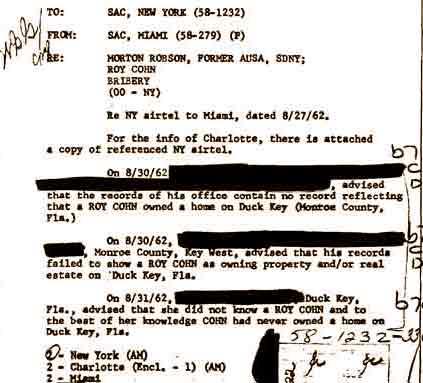
Although
the image above shows Roy Cohn relaxing on Duck Key, F.B.I records do
not substantiate that Cohn ever owned a home on the island. How is it
that the Federal Bureau of Investigation showed an interest in Cohn and
Duck Key?
Cohn
was accused of tampering with a 1959 grand jury probe in order to save
four stock swindlers from indictment. Investigators thought possibly
money change hands in Las Vegas or during Cohn's visit to Florida in
1960 and that possibly Duck Key might have been the location for this
exchange of bribe money.
 |
| Allegation |
|
|
|
The
case against Cohn alleged that $50,000 was paid to Cohn; two thirds of
the bribe money was supposed to have been paid to an Assistant United
States Attorney named Morton Robson with Cohn retaining the remaining
third. The investigation tried to ascertain where the money exchange
took place. Handwritten references to the side of the typed pages (b 7
c, etc.) indicate reasons for redacted parts of the communications.
 |
| FBI investigation of Cohn on Duck Key |
The
communication above shows that in 1962 the F.B.I. conducted an
investigation at Duck Key to establish if Cohn owned a vacation home on
the island.The record below shows that an interview was conducted with a
female to try an establish if Cohn had been on Duck Key as well as an
effort to inspect Indies House ( now Hawks Cay) guest records.
 |
| Interview and effort to see Indies House records |
The
record below dated 8/27/1962 reports that several parties likely
including County Officials reported no record of Roy Cohn owning a home
on Duck Key.

Did
Cohn own a home on Duck Key as the original May 1960 UPI news article
stated? The picture of Cohn reclining in a lounge is evidence that Cohn
visited Duck Key. A review of old property records might shed some light
on this mystery.
COHN ACQUITTED IN 1964
News
reports of 1964 indicate that Roy Cohn was acquitted by a federal jury
on charges of perjury and obstructing justice. If found guilty on all
counts Cohn could have been sentenced to 35 years.
He is quoted
as telling newsmen "Above all I thank God for the United States of
America, where no matter who in high places moves against you, there is
recourse to a jury of 12 Americans." Who in "high places" was Cohn
referring to? Cohn had previously contended that "a few people" in the
Justice Department were out to get him. Robert F. Kennedy was U.S.
Attorney General and headed the Department of Justice at this time. The
animosity between Kennedy and Cohn began in 1953 during the
Army-McCarthy hearings. Cohn was made Chief Counsel to the McCarthy
Committee and Kennedy was Assistant Counsel. Their differences actually
led to fist fight in the outer chamber of Congress and according Donald
Ritchie, the U.S. Senate historian. "they became enemies for the rest of
their lives."
THIS PAGE CREATED BY DUCK KEY ONLINE
COPYRIGHTED MATERIAL
http://www.duckkeyonline.com site map
email@duckkeyonline.com


, founder of the World Jewish Congress and its president in 1963, after taking counsel from influential friends of Israel.
ng individuals:
training Haganah soldiers during the Arab Revolt in the 1930s; resided in Montreal
sily see Goldmann, speaking not only for himself, but as President of the World Jewish Congress that year, prophesing that President Kennedy should die for the nation of Israel. And his death would not only be for that nation, but for all friends of Israel scattered abroad. From that day forth they plotted to kill him. Louis Bloomfield was directed to manage the assassination. And he did so with the full knowledge and support of Lyndon Baines Johnson and J. Edgar Hoover.
 Marseilles, France." He cites as his source a statement made by Christian David to "Steve Rivele that the assassins were flown from Dallas to Montreal about ten days after the assassination (reference The Men Who Killed Kennedy). [See DVD version]. Second, it has been established by Garrison and others that Ferrie provided pilot services on an as needed basis for members of the 'cabal.' Garrison specifically pointed out that Ferrie had flown Shaw to Montreal on numerous occasions. (Reference On the Trail of the Assassins, pp. 136-137.)"
 : The Life and Times of Seagram’s Mr. Sam (1991, p. 112) as the source for the following statement:


 family at $15 a share, some $5 over the market value at the time. 'We didn't want a proxy fight,' he emphasized....The group is keeping many officials of the old management in the top operating posts. A president for the company has not yet been selected. 'We are considering several candidates and will make a decision shortly. He probably will be an outsider.' Cohn. 32, was a graduate lawyer at 20. His father was the late Justice Albert M. Cohn of the New York State Supreme Court's Appellate Division."
 and
became the largest produce of collapsible tubes in the country;
producing Tin-base, Lead base and Aluminum tubes for the pharmaceutical,
dental and general trades."
and
became the largest produce of collapsible tubes in the country;
producing Tin-base, Lead base and Aluminum tubes for the pharmaceutical,
dental and general trades." 

 Robson's name also appeared in FBI files--with an identification number following it (58-1232), which in other FBI files is simply designated "New York"--connected to New York Bureau information sent to J. Edgar Hoover in Washington, D.C. It appears to indicate that a copy of such investigative information was also sent to the U.S. Attorney's Office in the Southern District of New York, where Morton Robson and Roy Cohn had been employed as attorneys by U.S. Attorney Frank Hogan before Morgenthau's appointment in 1961 by Kennedy.
 fieldstone showplace in fashionable New Hope, Pa., where he once kept a shiny, vintage fire engine, and reportedly entertained such celebrities as his friend the master swindler