Of Pilgrims
 |
| Death of Joseph Beakey, 1858 |
Initially setting out to explore the family of the woman who became the wife of David Davis Walker, I happened upon a genealogical study published in 1903 by two women, each of whom was a society editor of a different St. Louis newspaper. When looking deeper into the background of these editors, it became apparent that each had her own connection to members of St. Louis' elite society, whom they dubbed "Americans of Gentle Birth." One of those families was D.D. and Martha Walker. Mrs. D.D. (Martha Beakey) Walker's ancestors were traced in that book to Pilgrim forefathers through her mother, Mary Ann Bangs Beakey, who became David Davis Walker's mother-in-law in 1862, four years after her husband died on the Minnehaha riverboat explosion.
Mary Ann's father, according to his brother, Methodist minister Nathan Bangs, D.D., had been born in Stratford, Connecticut in 1781, descended from Edward Bangs, a Pilgrim, who arrived in Plymouth colony in 1623 on the third ship to arrive there. Their father Lemuel Bangs was a schoolteacher and land surveyor who grew up near in Cape Cod, Massachusetts, married Rebecca Keeler of Connecticut and with her raised nine children. Lemuel moved his family to Fairfield, Connecticut, around 1782, and from there, in 1791, to what would later be known as Stamford, Delaware County, New York, before moving farther north to New Brunswick, Canada.
 |
| Nathan Bangs, uncle |
Elijah's marriage to Esther Stackhouse in 1807 ended with her death in Philadelphia in 1819, leaving several minor children, including Mary Ann Bangs, who was only two years old when her mother died. The eldest child, Henry, born in France in 1808, would have been only eleven at that time. Rev. Nathan Bangs, who saw Elijah in 1811, wrote in his journal that his brother had been detained by French under Napoleon's 1807 Milan decree, for trading wines from Bordeaux with the British, thus earning imprisonment for two years in Dunkirk, in northern France, for himself and his wife who gave birth to Henry there. Following their release from the French prison, Elijah was again captured while engaging in the same trade, but this time by the British, in 1811.[1]
Historical records compiled by genealogists confirm that Captain Bangs continued going away to sea, traveling as far afield as Amsterdam, where his ship was wrecked in 1820. A year later he was in Puerto Rico and in Brazil in 1826. Esther had returned after from her French imprisonment to Philadelphia, where she died in 1819. Nathan Bangs' writings intimate that he kept in contact with Elijah, though Nathan did not reveal what became of the young children "left motherless" upon Esther's death. Who took care of Mary Ann and her siblings? With whom was Mary Ann living when she met Joseph Beakey shortly before their marriage in Philadelphia in 1840?
In Part III, we concluded there may have been a close connection with Esther's brother, Powell Stackhouse, who manufactured metal stoves, since Joseph had left his home in Emmitsburg, Maryland, in order to learn that same trade. The couple were possibly introduced to each other there. Although the Stackhouse family had long been Quakers, even tracing their immigration to America back to the days when William Penn arrived, Mary Ann, whose mother had been a Quaker who married outside her family's faith, had no strong attachment to any church, and she married Joseph Ambrose Beakey, a German Catholic, in the St. Augustine Catholic Church in Philadelphia. They returned to live in Emmitsburg for the next eight years before relocating to St. Louis.
Mary Ann's elder sister, Rebecca, in 1830 had married Anson Steel in Philadelphia, rearing possibly as many as sixteen children! But she still had room to take her father in to live with her until his death. The 1850 census indicates the Steels (with 9 children from ages 5-19 still at home) lived in Camden, N.J., that year, with Elijah Bangs, then 72 years old, making his home with them. Mary Ann Bangs Beakey had by then moved west with her new family to St. Louis.
Of Papists
 There was, however, a much greater influence on
Martha's life from her father's German Catholic roots, shown in Part
III, than from the Pilgrim ancestors from which she
stemmed.
There was, however, a much greater influence on
Martha's life from her father's German Catholic roots, shown in Part
III, than from the Pilgrim ancestors from which she
stemmed.Martha's father had brought his family to St. Louis from Emmitsburg in 1848 when she was seven. David Davis Walker arrived in town in 1857, met Martha, and married her in 1862. Both Catholics, they most likely met at a church gathering. The couple began raising their own family in St. Louis in the midst of the civil war, while D.D., as he was always known, "won his way, grade by grade, to a junior partnership" at Crow, McCreery dry goods company.[2]
Jesuit Training of the Walker Boys
Their firstborn, a son named Joseph Sidney (or Sydney) Walker, was born in 1863, followed closely by another son, named for one of D. D.'s partners in the dry goods business, William Hargadine Walker, who as a child was called Willy. In 1876, when Sidney was 13 and Willy 12, they were listed under their full names as students at Saint Louis University, a private Jesuit college founded by the same priests who had set up the Jesuit school in Emmittsburg, Maryland, which their grandfathers, George E. Walker and Joseph Beakey, had attended.[3] The third son, David D. Walker, Jr., born in 1870, was enrolled there during the 1882-83 term. D.D. Walker, Sr. was a member of the university's board of trustees for many years.
Sidney's name appeared in the Catalogue numerous times for accolades, often on the same page as another St. Louis lad born in 1865, Edward Reilly Stettinius, a junior student during the same year as J. Sydney Walker. Both boys were distinguished in Greek, Latin and English, while "Sydney" also excelled in math and history as well. Stettinius would later become president of the notorious Diamond Match Company, a director of the Morgan banking company, and in 1918 assistant secretary of war. He died in Locust Valley, NY, in 1925, ten years after the state's census showed William H. Walker living in that same area of Long Island. E. R. Stettinius Jr. was destined to become Secretary of State in the Franklin Roosevelt and Truman administrations while his sister, Betty, in 1928 married Juan T. Trippe (Yale 1922) of Pan American Airways. This couple would become very close to the Prescott Bush family in Greenwich, Connecticut, where Edward Jr. died at the age of 49, but that investigation is for another post.
Walker Children and Their Marriages
1. J. Sidney Walker.
 |
| Gibson Man |
Kate's father, Dr. Henry Hodgen Mudd (see page 1581) was not only a surgeon but, as a nephew of one of St. Louis' most eminent medical practitioners, he was employed as a professor at Washington University's medical school. Kate's brother, John Hodgen Mudd, was the same age as Sidney's younger brother, Bert, and like him studied law at Washington University in St. Louis. Although Bert would enter business and finance after graduation, John practiced law. Kate's sister, Edith Mudd, married Isaac Cook, Jr., a Harvard graduate who drowned at their summer home Linkside, in Biddeford Pool, Maine in 1926.
Sidney was also considered a great horseman, having played on the first polo team established after the St. Louis Country Club was organized in 1892. John F. Shepley (Yale 1880) and A.L. Shapleigh played on that team with him. There was even a horse with his name which ran at the St. Louis Fair Grounds track. Sidney died in St. Louis in 1912 at the age of 49. According to the December 8, 1912 St. Louis Post-Dispatch:
A cold, caught by exposure after a tennis match, proved fatal yesterday to J. Sidney Walker, secretary of the Ely & Walker Dry Goods Co. and a director of the Mercantile Trust Co. He died at his home at Hortense place, from the bursting of a blood vessel in his lungs, caused by violent coughing. The funeral will be held from the residence at 1 p. m. tomorrow, and will be conducted by the Rev. Father O'Connor of the New Cathedral Chapel. Walker, who was 49 years old, was an adept at tennis. Wednesday afternoon he played in a hard-contested match at the Country Club, and while perspiring from his exertion, neglected the customary rubdown and change of clothing, and sat in the clubhouse in his tennis flannels. Exposure then, or during his ride back to the city. caused a cold. Dr. W.E. Fischel visited the Walker home Thursday and Friday, and made another visit yesterday morning. He believed at that time that the danger of pneumonia had passed. A short time after the physician's departure, Mrs. Walker heard her husband coughing violently, and entering the room, saw him fall back on the pillow, dead. Walker was the eldest of five sons of D. D. Walker, founder of the Ely & Walker firm. His brother Theodore (Ted) Walker was accidentally killed a few years ago by the explosion of a gasoline engine on his country place near Clarksville, Mo. The surviving brothers are G. Herbert Walker, broker; D. D. Walker Jr., first vice-president of Ely & Walker, and William H. Walker. Missouri's national committeeman of the Progressive party. Mrs Walker was Miss Katherine Mudd before their marriage in 1898. Walker was a member of the St. Louis. Noonday, Country and Racquet clubs.2. William Hargadine Walker.
 In 1891 William H. married Elise Papin, a descendant of
both the Laclede and Chouteu families who had founded St. Louis in about 1762.[4] He entered Ely & Walker Dry Goods, becoming its president in 1902 upon his father's retirement.
In 1891 William H. married Elise Papin, a descendant of
both the Laclede and Chouteu families who had founded St. Louis in about 1762.[4] He entered Ely & Walker Dry Goods, becoming its president in 1902 upon his father's retirement. Between 1910 and 1915 William also retired from Ely & Walker and moved with Elise to a large home on Feeks Lane at Locust Valley, Long Island, New York, next to "Birchwood," one of several homes owned by Anson Wood Burchard, president of General Electric.[5]
One of William and Elise's two daughters, Marie Adelaide, after marrying Daniel Casey Nugent (Harvard 1911), son of a St. Louis retail dry goods merchant, moved to the Upper East Side in Manhattan, as did her mother, Elise Walker (separated from her husband by 1924 and divorced by 1930), while William moved to Santa Barbara, California. He later married Gladys and died in Montecito near Santa Barbara in 1935.
3. Rose Marion Walker Pittman.
The third Walker child, born 1867, was a daughter, Rose Marion, dubbed Maysie (though often spelled as either Mazie, Maizie or Maisie), who married Asa Pittman, son of Mrs. H. D. Pittman, the society reporter for the St. Louis Post-Dispatch mentioned in footnote 1.
The third Walker child, born 1867, was a daughter, Rose Marion, dubbed Maysie (though often spelled as either Mazie, Maizie or Maisie), who married Asa Pittman, son of Mrs. H. D. Pittman, the society reporter for the St. Louis Post-Dispatch mentioned in footnote 1.
 |
| Maysie's daughter, Martha Pittman |
Maysie died in 1896, followed three years later by Asa, leaving their minor daughter, Martha (named for her grandmother), an orphan at the age of seven, to be reared by her maternal grandparents, who sent her to a Catholic convent in Paris for a time. She returned for holidays to Kennebunkport, Maine, as shown in a 1910 news item (inset right) written when Martha was 18 years old. Point Vesuvius, mentioned in the news clip, was the peninsula formerly called Damon Park renamed Walker's Point. Before acquiring the land in 1902, the Walkers had a cottage no later than 1884. We will discuss more about that Maine location below.
4. David Davis Walker, Jr.
When Maysie was almost three years old, her third brother, David Davis, Jr., was born in
1870. Like his two older brothers, David also attended what we now call
middle school at Saint Louis University. Prior to that time,
however, it appears that their father was working long hours building up
his name in the dry goods business. James Cox wrote in Old and New St. Louis: A Concise History of the Metropolis of the West and Southwest (1894):
his ambition to succeed had impelled him to try his powers beyond their limits and because of this he was compelled, by 1878, to withdraw from the partnership. Then for the next two years he gave himself up to rest and the recovery of his health, returning to St. Louis in 1880.
 |
| 53 Vandeventer Place - Walker home |
David D. Jr., born in 1870, also like his two older brothers, became an executive at the dry goods company. Single until the age of 30, he lived with his parents at at 53 Vandeventer Place, near the western end of the Catholic campus. Today the site of their home is part of the grounds of Saint Louis University, but when first developed, Vandeventer Avenue's "mansions were built on a scale never before seen in St. Louis, and it took the private place concept many steps beyond Lucas and Benton [Places]."[6]
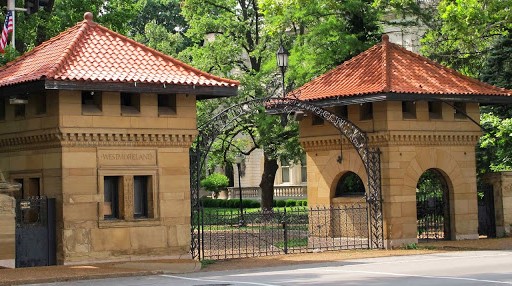 By 1900, however, Vandeventer was already bustling and noisy, and St. Louis' upper-class families had begun relocating to Westmoreland and Portland Places, closing off the private streets behind massive gates and walls. Late
in 1900 David married a girl named Louise Filley, a member of one of St.
Louis' oldest families, to be more fully described in a blog post to follow this one.
By 1900, however, Vandeventer was already bustling and noisy, and St. Louis' upper-class families had begun relocating to Westmoreland and Portland Places, closing off the private streets behind massive gates and walls. Late
in 1900 David married a girl named Louise Filley, a member of one of St.
Louis' oldest families, to be more fully described in a blog post to follow this one. 5. G. Herbert "Bert" Walker.
 |
| Stonyhurst College in England |
When the fourth son, George Herbert
"Bert" Walker, reached the age of seventeen in 1892, instead of taking him into the dry goods business, the Walkers sent him
to England for further education. Legend goes that young Bert sailed with his own valet in
1892 to attend Stonyhurst, another Jesuit institution
with strong ties to the same Archbishop John Carroll who looms so significantly
in the education of previous generations of the Walker-Beakey family.[7]
Further research into what has previously been reported makes it clear that Bert was not the first son to attend Stonyhurst. His older brother David also was sent there in 1887, and his younger brother, Ted, would follow Bert there. (See Part V to come).
Further research into what has previously been reported makes it clear that Bert was not the first son to attend Stonyhurst. His older brother David also was sent there in 1887, and his younger brother, Ted, would follow Bert there. (See Part V to come).
 In 1894, we have been told, Bert left
Stonyhurst, but, at that point discrepancies about what
followed emerge. One version written by
In 1894, we have been told, Bert left
Stonyhurst, but, at that point discrepancies about what
followed emerge. One version written by Dave Shedloski and published at the USGA website has it that he enrolled at the University of Edinburgh as a pre-med student for one year, and then returned to St. Louis. Bert's New York Times obituary recited the same version of his education which appeared in his listing in Who's Who, merely that he had an L.L.B. from Washington University Law School in 1897.
Thus, Bert's graduation from law school occurred only a few months after the Ely & Walker warehouse located at the southwest corner of Washington Avenue and N. 8th Street burned in March 1897, in a blaze that killed two firemen and did more than one million dollars in damage. According to newspapers, John R. Lionberger had constructed the 7-story building at 800 Washington Avenue (today the site of the Renaissance Grand Hotel) in 1889, five years before his death.[8].
 |
| 12 Hortense Place |
Bert was a very active clubman. He was a member in 1913 of the exclusive Log Cabin Club with Breckinridge Jones, Augustus Busch, Missouri governor David R. Francis and only a few others (only 20 members listed in the directory). A much larger group was the Noonday Club. He was was president of the Racquet Club, whose members included his three older brothers, as well as Adolphus Busch III, D. R. Francis, Jr. and Sr., John H. Holliday, Ludwig and Max Kotany, five members of the Lambert family, three McKittrick family members, W. C. Nixon, Arthur and Joseph Wear, and Thomas H. West.
G. H. Walker was vice president of the Sunset Hill Country Club, to which the Anheuser and Bush beer-brewing families belonged, along with a number of other eminent and not-so-eminent St. Louis families, including the Lamberts, Kotanys, Mudds, Papins--names from which the Walker men and women would select spouses. Not content with one country club, the Walkers also joined the St. Louis Country Club, which included other elites such as the Samuel F. Pryor family as well as Clarkson Potter, numerous Simmons family members, names like Fordyce, Francis and Jones. Max Kotany was a member, as were the Lambert brothers, Gerard, Albert Bond, and Marion. A. C. Church's name appeared on the rolls of the club, as did Dr. M. B. Clopton. James H. Wear was club secretary.
Another club to which they belonged was the St. Louis Club.

D.D. and Martha finally were able to retire from business and to leave St. Louis by 1902, the year they bought property in Maine, although there is evidence that suggests they had begun spending summer vacations at Kennebunkport as early as 1899, the same year Bert was married to Loulie Wear. That evidence is the application for a passport dated 1899, signed by Ted's father, D.D. Walker, Sr. at Kennebunkport, Maine.
Gil Troy wrote in his book, Morning in America: How Ronald Reagan Invented the 1980's (p. 301) that the Walker family had vacationed "on this coastal gem [Kennebunkport] since the 1880s," and that they purchased the land for $20,000 in 1902. It appears that D.D. and Martha moved into an existing structure, while Bert began building his own vacation houses on the adjacent land.
 The "big house" was profiled in 1905 in American Homes and Gardens magazine as "Rock Ledge, the summer home of George H. Walker, Esq." In the summer of 1908 the St. Louis Post-Dispatch reported Mr. and Mrs. G. Herbert (Lucretia Wear), were spending the summer at "Surf Ledge," Kennebunkport, Maine, along with Mr. and Mrs. Sidney (Katherine Mudd) Walker. In 1980 the G.H. Walker home was sold to the Bush family, possibly in anticipation of his election to the Presidency, which did not occur, however, until 1988.
 |
| Old Mission Santa Barbara |
Citing Walker family gossip in his 2008 book, Jacob Weisberg reported that the reason for Martha's insistence upon Bert's attending Stonyhurst was her desire to escape the "ill-bred German immigrants" who dominated St. Louis' Catholic education. Part III shows the irony of that statement, if indeed it was factual, given the fact her own grandfather, Joseph Beakey, had been a German Catholic immigrant, as had her mother's parents, the Schreiners. Weisberg also wrote that Bert "broke with his parents" in every way other than moving from St. Louis, by "rejecting his father's Republican politics and his Catholic faith," while D.D. and Martha not only "boycotted the wedding," but also later bequeathed Bert's share of their estate to the Catholic Church.
 Our research has revealed, however, that by 1888, D.D. and his partners had been already begun supporting Democrats, such as David R. Francis, in local elections. Other men whose names appeared in the endorsement of Francis included D.D.'s partner Hargadine and Bert's future father-in-law, J.H. Wear and his partner, Murray Carleton (more on the Wear family in a subsequent post).
The legend about the rift and boycott seems to be supported only by interviews with family members, since, when Martha died in 1917, her will, probated in Missouri, clearly did not leave her property to the church. Instead, she bequeathed all her jewelry to Maysie's daughter, Martha Pittman, to whom she also left her interest in Walker's Point Maine. The Santa Barbara estate initially was devised to the only son of their youngest son, Ted who died in 1906.
 Before D.D. Sr. died in late 1918, he was living in Santa Barbara after his wife's death when it was announced that he had been sued by his sons, alleging that he was mentally incompetent, which he fought until his his death.
Granddaughter Martha Pittman
When Martha Pittman, in 1919, obtained a passport to travel to Japan and China, she stated it was her first time to obtain one, although she had lived in Paris and Italy during 1904-1906, most likely sent away to boarding school. A note attached to her application was dated in December 1919 and signed by Alfred L. Marilley, referring vaguely to work Martha would do for him during her travel. As counsel to the Army, Navy and Civilian Board of Boxing Control, incorporated in early 1919 to legalize boxing under certain closely supervised conditions, Marilley answered to Major A. J. Drexel Biddle, the first president of that new organization. Biddle did not resign his commission from the Marine Corps until the summer of 1920. One of the boxing board's first lines of inquiry was whether Jack Dempsey, winner of the first big fight after the sport was legalized, had evaded his wartime obligations, as alleged by his former wife.
 Boxing had long been of interest to residents of
Hortense Place in St. Louis. Not only was Bert Walker named amateur boxing champion at
some point, but his neighbor, Marion J. Lambert (Ted's brother-in-law), was such an ardent fan in
1912, he brought Brooklyn
Tommy Sullivan to his "fashionable Hortense Place"
home. Thus, it was no surprise to readers to learn that Lambert's wife divorced Lambert a year and married Adolphus Busch III. In 1917 Bert Walker was
appointed chief of the American Protective League, the main function of which
was to investigate men who failed to serve in the military during WWI--"slackers," as they were called. It seems likely that in that role Bert may have recruited Martha Pittman to travel the world on behalf of the attorney for the
boxing board, which had set up its first fight for former champion Jack
Dempsey, later accused of being a slacker during the war.
Boxing had long been of interest to residents of
Hortense Place in St. Louis. Not only was Bert Walker named amateur boxing champion at
some point, but his neighbor, Marion J. Lambert (Ted's brother-in-law), was such an ardent fan in
1912, he brought Brooklyn
Tommy Sullivan to his "fashionable Hortense Place"
home. Thus, it was no surprise to readers to learn that Lambert's wife divorced Lambert a year and married Adolphus Busch III. In 1917 Bert Walker was
appointed chief of the American Protective League, the main function of which
was to investigate men who failed to serve in the military during WWI--"slackers," as they were called. It seems likely that in that role Bert may have recruited Martha Pittman to travel the world on behalf of the attorney for the
boxing board, which had set up its first fight for former champion Jack
Dempsey, later accused of being a slacker during the war.In 1922 Martha Pittman sought a new passport to travel extensively in South America, and at other times she traveled the continent of Europe and in Great Britain. During her journey from Japan to Vancouver in May 1920, Martha listed her address as 12 Hortense Place in St. Louis, once the home of her mother's younger brother, Bert Walker, but in the 1920 census she was listed at the home of her father's brother, W. D. Pittman.
In 1925 Martha married J. Mortimer Duval, who worked for the Guaranty Trust in New York. Her married name sometimes appeared in society clips relating time spent at Walker's Point in Maine. She acquired her interest in the property from her grandmother, Martha Beakey Walker, who left a half interest in the Walker's Point (formerly Damon's Point) land and buildings at Kennebunkport in trust to her granddaughter, subject to a life estate for D.D. Sr., with a contingent remainder to a grandson named James Theodore Walker, Jr. This contingent gift was, however, annulled in a codicil dated a month later, and Ted's only son was actually completely cut from her will at that time, with all the residue of her estate to be divided equally among the children of her three surviving sons, Willy, Bert and David Jr. at that time. Sidney, Maysie, and Ted, Sr. had all died by 1912. The grandson, J. Theodore, would not die until 1927. More on him later.
The birth of the fifth son, James Theodore "Ted" Walker, occurred in 1877, when Bert was two years old. This would have been a year prior to D.D. Walker's collapse from exhaustion which began a two-year respite from business life in St. Louis. Possibly during that rest period he returned to Bloomington to visit his siblings, John Mercer Walker, George, and two sisters, all of whom had remained in Illinois.
We know that in 1879 the family were in Minnesota when they were involved in a boiler explosion aboard a steamboat. Young Bert, age four, landed in the lake and had to be rescued. Sidney would have been 16, Willy 15, Maysie 12 and David 9 by then, but were not mentioned. Neither was the baby, Ted, who was a toddler.
 |
| Bert's dad's first cousin, Justice David Davis |
Colonel William Pelton, urged a Democratic-Greenback coalition in the Illinois state legislature to elect Davis to the U.S. Senate. Instead of remaining on the commission, grateful to the Democrats, Davis resigned since he would soon no longer be a Supreme Court justice, but a senator. He was replaced on the commission by Justice Joseph P. Bradley, a Republican who cast all his votes for Hayes.
Unlike the three eldest sons, Ted entered Yale's Sheffield Scientific School and graduated in the class of 1899, being named as a sophomore to Delta Psi semi-secret society (also known as St. Anthony Hall). Upon graduation in 1899, he traveled to Tokyo, as part of his worldwide tour.
Ted's Classmates. In the same class at Yale was Robert Sterling Clark, a man this blogger connected to the 1933 plot to overthrow FDR. Another classmate and brother in Delta Psi, John Cameron Greenleaf, became brother-in-law to Thatcher Magoun Adams, a partner in the Brown Brothers investment bank, which a few years later Bert would assist in merging with the Harrimans. Greenleaf also became a brother-in-law of their fellow classmate, Hamilton Fish Benjamin, when the two Delta Psi men married daughters of William B. Bacon from Boston. Following Yale, Greenleaf moved to Manhattan and, in 1903, formed an investment firm at 49 Wall Street at the corner or William Street, only one block up from Brown Brothers offices at 59 Wall at Hanover. Other members of "the Sheff" class of 1899 included Smith Academy, St. Louis, classmates such as:
- Leslie Helfenstein Thompson, who lived at 48 Portland Place (and whose wife, Violet, was a daughter of John W. Kauffmann). Leslie's mother was a Helfenstein, many of whose men were Yale graduates. The Helfensteins were also related to the family of Edward C. Simmons by his mother, Louise Helfenstein Simmons, and were important members of Skull and Bones.
- William Windus Knight, whose father, Milton Knight, vice president of the Wabash Railroad, had been indicted in 1891 for shipping flour to Canada at rates other than those set by the Interstate Commerce Commission.
 After
Ted return to St. Louis from his world tour begun in 1899, he married an orphaned heiress,
Lily Lambert,
in June 1904. His bride lived a few doors down from brother Bert, on Hortense Place with her brothers and their wives. She was the only daughter of Joseph Wheat Lambert, founder of Lambert Pharmacal Co.
Lily's
father had been born in Alexandria, Virginia, in 1851, educated with a
degree in
chemistry, then moved to St. Louis, where he married Elizabeth Liscome
(Lily) Winn in 1873.
After
Ted return to St. Louis from his world tour begun in 1899, he married an orphaned heiress,
Lily Lambert,
in June 1904. His bride lived a few doors down from brother Bert, on Hortense Place with her brothers and their wives. She was the only daughter of Joseph Wheat Lambert, founder of Lambert Pharmacal Co.
Lily's
father had been born in Alexandria, Virginia, in 1851, educated with a
degree in
chemistry, then moved to St. Louis, where he married Elizabeth Liscome
(Lily) Winn in 1873.  The eldest son, Albert Bond Lambert, was born in 1875 (same
year as Bert Walker). Lily came along eleven years later, in 1884. Her younger brother, Gerard
Barnes Lambert, born in 1886, married Rachel Lowe and had two daughters (1) Rachel Lowe Lambert; and (2) Lily Cary Lambert. After their divorce in 1933, Gerard's former wife married Dr. Malvern Clopton, thus making him the stepfather of Rachel
Lowe Lambert, commonly known as "Bunny," two years after Bunny's marriage to Stacy B. Lloyd, Jr. In 1948 Bunny divorced Lloyd, and later, as Bunny Mellon, wife of Bruce Mellon, would become a great friend of Jackie Kennedy.
The eldest son, Albert Bond Lambert, was born in 1875 (same
year as Bert Walker). Lily came along eleven years later, in 1884. Her younger brother, Gerard
Barnes Lambert, born in 1886, married Rachel Lowe and had two daughters (1) Rachel Lowe Lambert; and (2) Lily Cary Lambert. After their divorce in 1933, Gerard's former wife married Dr. Malvern Clopton, thus making him the stepfather of Rachel
Lowe Lambert, commonly known as "Bunny," two years after Bunny's marriage to Stacy B. Lloyd, Jr. In 1948 Bunny divorced Lloyd, and later, as Bunny Mellon, wife of Bruce Mellon, would become a great friend of Jackie Kennedy.James Theodore Walker, Jr., Minor's Estate
Ted and Lily Lambert Walker had a son born in March 1906, only a few months before Ted's death. She remarried in October 1909 and attempted to create a trust in a will, by terms of which she divided the 1/6 interest in her mother's estate. She named George H. "Bert" Walker as her trustee along with the St. Louis Union Trust.
After her death in 1911, a dispute arose between G. H. "Bert" Walker and the Mercantile Trust, the trustee named in Lily's mother's will, which claimed it continued to have the duty to manage the assets of her estate (consisting of 5/6 of the stock of the pharmaceutical company which manufactured and sold Listerine mouth wash). Along with that duty, of course, was the financial reward in the form of management fees, which the company claimed a right to have for eight more years. Based on the wording of the elder woman's will the trustee calculated that distribution would not occur until 1919, being 30 years after Lily Walker Clopton's mother's death in 1889. The opinion of the Missouri Supreme Court was reported at 197 S.W. 261 (1917), affirming the judgment of the trial court, which found that the mother's will was valid.
The plaintiffs (appellants) included Lily's siblings as well as the acting trustees of her estate. They attacked the validity of the mother's will on grounds it had violated the rule against perpetuities. The Missouri Supreme Court held in 1917 in favor of the will's validity, against the Lambert siblings.
In late 1904 Ted married Lilly Lambert at at 10 Hortense Place, home of one of her brothers, Marion Liscome Jarvis Lambert. Another brother, Albert Bond Lambert, lived at 2 Hortense (at Euclid). Ted's eldest brother Sidney Walker had a home at No. 5, and Bert lived at No. 12 on that same private street. All these addresses were found in the 1910 census.

Ten years earlier the Lamberts and Walkers had lived less than 200 feet from each other, on opposite sides of Vandeventer Avenue. Jordan W. Lambert, Jr., only 22 in 1900, was head of the family of parentless siblings. Fortunately, his wife was six years his senior. When Helen Churchill Smith married him in 1897, he could have been only 19 if the census records are accurate. Four younger siblings (Marion, who had married at age 19, Lilly, Gerard, and Wooster, as well as Marion's bride, Florence Parker) moved into the house at 62 Vandeventer with Jordan Jr., his wife Helen. Their next-door neighbor was John Foster Shepley, chairman of the St. Louis Union Trust.
Ted Walker, who had lived at 53 Vandeventer, less than 200 feet away from Lilly at the time he left for Yale in 1894, may not have known the girl who was then 11 years of age, but he returned home in 1900 to find Lilly almost grown up at 16, and they married four years later.
Much had changed during those gilded-age years while Ted was in New Haven. His brother Bert had returned from England and Scotland, finished law school, married, and had begun boxing and playing polo and golf at all the local clubs, to which his new in-laws, the Wear family, great tennis enthusiasts, also belonged. The Lamberts also frequented the same clubs and shared Ted's interest in airplanes and boxing as well.

Lambert Family History
We cannot pass up this opportunity to explain more about the Lambert family who were so close to the two youngest Walker boys. The Lambert children had been orphaned in 1889: their father died in January, his wife being eight months pregnant with Wooster; she too died a month after giving birth, and her brother, John D. Winn, was appointed trustee and guardian for the children, as well as becoming president of the Lambert Pharmacal Co., which his brother-in-law, Jordan Wheat, a chemist, founded in 1881 when he had bought a license to manufacture Listerine antiseptic mouthwash, then used exclusively by dentists to kill germs and prescribed by doctors to treat colds and sore throats.
After Jordan Wheat's death, the widow's brother, J.D. Wooster Winn, ran the company until 1895, when Jordan, Jr. at eighteen sued to have him removed from that position. The five orphans were by then filthy rich due to the fact that the Lambert Pharmacal Company (located in 1891 at 314 N. Main, now First Street) was doing so well with its patent while their uncle ran the company. That location, incidentally, is approximately the site on which the Gateway Arch would eventually be built. Winn in 1891 completed a new four-story laboratory on Lucas Place at 21st Street. A competing company, called Preventol had its office at Olive and N. 23rd Streets.
 It was Lilly's younger brother, Gerard Lambert, who is given credit for
expanding the market to the everyday consumer wanting to fight the scourge
of bad breath. After discovering the medical term "halitosis," he
used it in Listerine marketing and
began selling the antiseptic over the counter in drug stores in 1914.
It was Lilly's younger brother, Gerard Lambert, who is given credit for
expanding the market to the everyday consumer wanting to fight the scourge
of bad breath. After discovering the medical term "halitosis," he
used it in Listerine marketing and
began selling the antiseptic over the counter in drug stores in 1914.Years earlier the Ely & Walker Company had been engaged in litigation in a case styled Hargadine et al v. Gibbons. Wayman Crow, senior partner of the firm D. D. Walker had joined, died after a 1876 judgment, and he named William Hargadine and Henry Hitchcock, as trustees to hold title of his share of the partnership assets on behalf of his named beneficiaries. Walker and his remaining partners felt compelled to renew the judgment a dozen or so years later through their attorney, William Hickman Clopton. Clopton's son, Malvern Bryan Clopton, after becoming a surgeon, in 1909 became the stepfather for Ted Walker's son, Ted Jr.
Lilly Lambert Walker married Dr. Clopton in 1909, but after less than two years of marriage, the Walkers' former daughter-in-law also died, leaving her full inherited fortune outright to her husband, whom she also named trustee for Ted Jr. The following was published shortly after her death in 1911:
SHE WAS LILY LAMBERT
Property Held in Trust, Will Be Added to Big Legacy From Father.
By the will of Mrs. Lily Lambert Clopton, filed in the Probate Court Friday, her son, Ted Walker, now 6 years old, will become one of the richest young men in St. Louis on his twenty-fifth birthday. Mrs. Clopton. who inherited one-sixth of the estate of the late Jordan W. Lambert, her father, left two-thirds of her own estate to her son, to be held in trust for him until he becomes 25 years of age.
Wooster Lambert, a brother of Mrs. Clopton, received his share of $800,000 due him from the estate of his father last year when he became 21 years old. Mrs. Clopton's share of the estate, which she received some years ago, is said to have been almost equal in amount to that received by Wooster.
In addition to two-thirds of the estate of his mother, Ted Walker inherited the bulk of the estate of his father, the late James T. Walker, son of D.D. Walker, a wealthy wholesale dry goods-man. The two estates, by the time he comes into actual possession of them, will make him very rich.
One-Third to Husband.
Mrs. Clopton died a few days ago from blood poisoning resulting from an ulcerated tooth. After the death of her first husband, James ("Ted") Walker, on their farm in Pike County several years ago, she married Dr. Malvern B. Clopton, son of W. H. Clopton, former United States District Attorney at St. Louis. The Pike County farm, six miles from Clarksville, also is left to her son. She willed him a diamond necklace and several gold bracelets set with diamonds and sapphires, and several rings. One-third of the entire estate Mrs. Clopton willed absolutely to her husband, Dr. Clopton.
G. H. Walker and the St. Louis Union Trust Co. were appointed trustees of the estate. They were authorized to collect rents and income from the estate and to educate and maintain Ted Walker until he is 25 years old. The excess of his net income from the estate is to be invested and held in trust for him, to be turned over to him with the balance of his inheritance 19 years from now.
Her Estate in Trust.
Mrs. Clopton's will, written in February, 1910, recites the fact that her own estate is held in trust. Under the provision of the will of Mrs. Lily Lambert, mother of Mrs. Clopton, her estate was to be held in trust for her children for 30 years after her death, which occurred in 1889. Under the provision of the will no part of the real or personal estate can be sold until 1919, but the excess income was to go to each child upon becoming of age. A receipt filed June 6, 1910, showed that Wooster Lambert received, upon becoming 21 years old, $359,138.75 in cash, his share of the excess income, as part of his $800,000 share of the estate.Psychical Research
At about the same time Lilly and Clopton were married, newspaper articles with no byline began appearing featuring Jordan Jr. and Helen (nicknamed Nellie) Lambert who were conducting experiments in psychic phenomena with a Columbia University professor of psychology and ethics, Dr. James H. Hyslop, who had been studying spiritualism since 1888. As president of the American Society for Psychical Research, Hyslop was exploring the tales coming from their son's nurse, William E. Hannegan, who along with his sister Lillie Hannegan, were said to have been employed by Lambert's office since 1906.[10] The experiments conducted by Helen Lambert were written up in 1908. Nine years later, in 1917 Jordan Jr.'s body was found in his room, a death by gunshot ruled to be suicide. Helen who had left home to become more involved in Prof. Hyslop's psychical society, in 1933 published a book called Cure through Suggestion with trance medium Eileen Garrett.
Coming Later
There is so much more relating to this family that has never been told. Other research to appear includes more on the Lambert family of the Listerine fortune; the Wear family's connections to Dwight Filley Davis and Jay Gould II, and of course Bert's relationship with Benjamin Yoakum, the King/Kleberg family and the Harrimans.
ENDNOTES:
[1] A different
story to what was told by Elijah's brother was related
in Americans of Gentle Birth and Their Ancestors: A Genealogical
Encyclopedia (1903), compiled by Mrs.
H. D. (Hannah Daviess) Pittman with assistance from Mrs. R. K. (Rosa Kershaw)
Walker. Considering the fact that they spelled Elijah's
name as Keelah rather than Keeler, one suspects the writers also put a somewhat
nobler twist on their story. Unfortunately, their interpretation of what had
actually occurred, like their spelling, was less than accurate. Not only did French
spoliation claims rise from an earlier period of history, no
historical record of Elijah having been engaged in building ships exists. Mrs.
R. W. Walker, wife
of Howard Christy Walker, a man arrested
in Mexico for allegedly stealing lumber in 1883, had for
many years worked as society editor for the St. Louis Globe Democrat, and also
had her own publishing company. She was not related to the Walker family
studied here. Mrs. Pittman, society editor at the St. Louis Post Dispatch, also
owned an apartment building known as Beaumont Flats at Olive and N. Jefferson
Streets in St. Louis. She had married Williamson Haskins Pittman, a tobacco
factor, in 1859.
[2] Stevens, Walter B. (2013).
pp. 333-4. St. Louis, the Fourth City, 1764-1911 (Vol. 2). London:
Forgotten Books. (Original work published 1911).
[3] According to a brief filed in a lawsuit styled Saint Louis University v. Masonic Temple Association, 269 S.W.3d 447 (2008):
[5] Mrs. Burchard, married to him in 1912 had been born Allene Tew, and after his death, she was married again in 1929 to Prince Heinrich XXXIII Reuss-Köstritz.
[6] Richard Ben Cramer's 1992 book, What It Takes, may have been the first source to reveal Bert's education at Stonyhurst. Mickey Herskowitz in his book, Duty, Honor, Country, erroneously reported that the Walkers were "Scottish Catholics," a totally inaccurate statement, as shown in previous parts of this series.
[3] According to a brief filed in a lawsuit styled Saint Louis University v. Masonic Temple Association, 269 S.W.3d 447 (2008):
The University traces its history to 1818 when St. Louis Academy was established in downtown St. Louis. It was incorporated by Act of the Missouri General Assembly in 1832....In 1876, looking to expand but wanting to stay in the City of St. Louis, Saint Louis University purchased land for a new campus near Grand Avenue and Lindell Boulevard.[4] Elise's father, Jean Theodore Papin, was a son of Hypolite Papin and grandson of Joseph Marie Papin and Marie Louise Chouteau, as well as a nephew of Marie Philippe Leduc. According to Saint Louis: An Informal History of the City and its People, 1764-1865, page 92, Elise's grandfather, when he died in 1811, was still heavily in debt to his Leduc son-in-law, as well as to Auguste Chouteau. The Chouteau family, it seems, were not adverse to buying and selling Indians as slaves in those early days in Missouri, according to Shirley Christian, Before Lewis and Clark (at page 242). The Pittman and Walker genealogy set out their version of the history of the original French families who established St. Louis, including the Papins.
[5] Mrs. Burchard, married to him in 1912 had been born Allene Tew, and after his death, she was married again in 1929 to Prince Heinrich XXXIII Reuss-Köstritz.
[6] Richard Ben Cramer's 1992 book, What It Takes, may have been the first source to reveal Bert's education at Stonyhurst. Mickey Herskowitz in his book, Duty, Honor, Country, erroneously reported that the Walkers were "Scottish Catholics," a totally inaccurate statement, as shown in previous parts of this series.
[6] Jacob Weisberg, The
Bush Tragedy (2008). Stonyhurst was established on lands donated
by the Weld
family in 1794
as a refuge for Jesuit
fugitives from Liege, Belgium, and alumni included several
notable Americans, including three members of Maryland's Carroll
family (Charles of Carrollton, Daniel as well as the aforementioned Bishop John
Carroll). Intelligence agent Vernon
A. Walters is also listed among its students. Mount St.
Mary's in Emmitsburg, Maryland, was built on land donated by Archbishop John
Carroll, described in Part III, whose education had been completed at
Stonyhurst.
[7] Thus
it would have been at least partly owned by his son, Isaac Lionberger, who at
the time of the fire was Assistant
U.S. Attorney General in the Grover Cleveland administration. In 1899
Isaac was elected president of the St. Louis Bar Association. He was also a
member of the board of directors of Washington University, so if Bert was a
graduate of that law school, he almost certainly knew his father's landlord.
[8] In 1887 Wear, Boogher was "located in the spacious five-story and basement structure 100x120 feet, at the corner of Sixth and St. Charles streets," while Ely & Walker in that year was at the 500 block of N. Broadway. Those two buildings were directly across Broadway from each other, though facing different directions.The Wear home was then at 3650 Washington Avenue, less than two miles east of the Walkers' Vandeventer residence.
[9] Julius K. Hunter, Robert C. Pettus, Leonard Lujan - Westmoreland and Portland Places: The History and Architecture of America's ..., (1988), p. 22. One resident of Vandeventer during this era was H. Clay Pierce at 40 Vandeventer, originally built in 1886. While Vandeventer Place was developed beginning in 1870, it was beginning to be passé by 1888, when residents began rebuilding in Westmoreland and Portland Places to the west of town. Hortense Place was also private and gated, located off Kings Highway,
one block north and east of the entrance gates into Westmoreland.
[10] Intriguingly, Lillie's listing in the 1908 St. Louis directory showed her to be a clerk for Preventol Chemical, a company that manufactured an antiseptic used to prevent gonorrhea. Advertising mentioned that the prophylactic tube containing the "medicament" was of mandatory use by the army and navy in Germany, and research seems to confirm that Preventol was actually a trademark name for Bayer.
[8] In 1887 Wear, Boogher was "located in the spacious five-story and basement structure 100x120 feet, at the corner of Sixth and St. Charles streets," while Ely & Walker in that year was at the 500 block of N. Broadway. Those two buildings were directly across Broadway from each other, though facing different directions.The Wear home was then at 3650 Washington Avenue, less than two miles east of the Walkers' Vandeventer residence.
 |
| 40 Vandeventer, H. Clay Pierce |
[10] Intriguingly, Lillie's listing in the 1908 St. Louis directory showed her to be a clerk for Preventol Chemical, a company that manufactured an antiseptic used to prevent gonorrhea. Advertising mentioned that the prophylactic tube containing the "medicament" was of mandatory use by the army and navy in Germany, and research seems to confirm that Preventol was actually a trademark name for Bayer.


 : The Story of the Richfield Oil Corporation (Norman, Okla: Univ. of Okla. Press, 1972), p. 308.
 and Disney's chairman bumped into each other accidentally and decided to merge.


